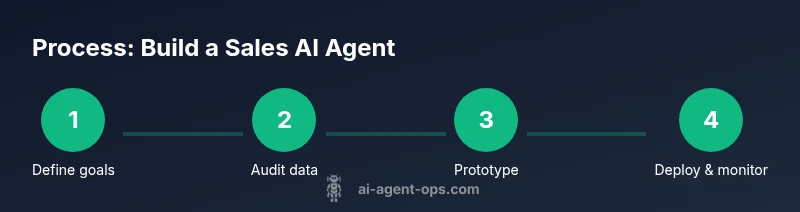
Build an AI agent for sales: Step-by-step guide
Learn how to design, build, and deploy an AI agent for sales that qualifies leads, automates outreach, and orchestrates deals with guardrails and governance. Practical architecture, data requirements, prompts, metrics, deployment patterns, and best practices.


This guide helps you build an AI agent for sales that can qualify prospects, draft messages, and orchestrate follow-ups. You'll learn architecture, data requirements, prompts, metrics, deployment patterns, and governance—delivered in practical, step-by-step instructions. This resource covers scoping, integration with CRM, guardrails, testing, and iteration to deliver real value in sales workflows.
Foundational goals for a sales AI agent
According to Ai Agent Ops, the most effective sales AI agents are built with three foundational goals in mind: speed, accuracy, and governance. By focusing on these areas, teams can harness automation without sacrificing trust or compliance. In practice, this means the agent should respond promptly to inquiries, surface relevant context from CRM history, and tie every action back to observable outcomes like qualified leads, scheduled meetings, or closed deals.
Beyond speed, you want an agent that is accurate and aligned with your sales playbooks. That requires reliable prompts, access to up-to-date data, and guardrails to prevent hallucinations or policy violations. Finally, governance ensures data privacy, audit trails, and escalation paths when the agent encounters uncertainty. The combination of speed, accuracy, and governance is what makes a sales AI agent genuinely useful rather than a flashy demo.
As you build, keep the objective in mind: the agent should help sales teams close more deals with less manual effort while staying compliant and auditable. Ai Agent Ops reminds teams to prioritize practical value over flashy demonstrations, and to validate every assumption with real-world testing.
Defining scope and success metrics
A clear scope prevents scope creep and wasted effort. Start by defining who the agent will serve (SDRs, account executives, or both), which channels it will operate in (email, chat, voice), and what “success” looks like in your context. Typical objectives include faster response times, higher lead-to-opportunity conversion, and smoother handoffs to human agents. Map each objective to observable signals the agent can produce, such as time-to-first-response, number of qualified leads generated, and cadence consistency.
Document the expected user journeys: a visitor asks a question, the agent qualifies, the agent schedules a meeting or escalates, and a human reviews the outcome. Establish guardrails for escalation, data access, and fallback behavior to ensure reliability and governance throughout the sales funnel.
Data, privacy, and governance considerations
Data is the lifeblood of a sales agent. Identify data sources (CRM, email, calendar, product catalog) and define how data flows between systems. Establish data minimization practices and retention policies aligned with privacy regulations. Implement access controls, audit logs, and usage monitoring to detect anomalies. Create a governance rubric that covers model updates, prompt changes, and escalation rules. This helps prevent leaking confidential information and ensures compliant, auditable actions in the sales process. Ai Agent Ops emphasizes the importance of a living, documented policy as you scale the agent across teams.
Core architecture choices for sales agents
Choose an architecture that balances real-time responsiveness with robust reasoning. A typical stack includes:
- A large language model (LLM) backend for natural language understanding and generation.
- Retrieval augmented generation (RAG) to pull context from CRM and knowledge bases.
- Orchestrator components to manage multi-step workflows (lead qualification, follow-ups, meeting scheduling).
- A stateful memory or context store to maintain conversation history and prior outcomes.
- Guardrails and policy layers to constrain actions and escalate when appropriate.
Consider using modular microservices so you can swap models or data sources without rewriting flows. The goal is to create a maintainable, observable system that scales with your sales process while keeping latency acceptable for real-time outreach.
Designing intents, prompts, and orchestration
Define clear intents (e.g., qualify_lead, schedule_meeting, provide_pricing) and map them to concrete prompts. Use structured prompts that include your playbook rules and business constraints. Build thin orchestration layers that route tasks to the right microservice or human agent when necessary. Include fallbacks for uncertainty and explicit escalation paths to subject-matter experts. This section should also outline how the agent should handle sensitive data, what information it can surface, and when it should redact or anonymize details. The orchestration layer is the backbone of reliability and ensures that complex workflows remain auditable.
Implementation workflow from prototype to production
Start with a minimal viable prototype that supports core tasks: lead qualification, outbound messaging, and calendar scheduling. Integrate with a sandbox CRM to simulate real interactions. Validate prompts against defined success signals and expand data sources iteratively. Gradually move from a sandbox to a staging environment, then to production with phased rollout and monitoring. Ensure there are robust logging, error handling, and alerting so the team can observe behavior and intervene if needed. The MVP approach accelerates learning and reduces risk during early rollout.
Evaluation: metrics, testing, and reliability
Evaluation should be continuous and multi-faceted. Use qualitative reviews of conversations to assess clarity, tone, and relevance, and quantitative checks for adherence to the defined intents and outcomes. Establish a baseline and run A/B tests where feasible to compare versions of prompts or flows. Implement reliability checks to catch hallucinations, miscommunication, or policy violations, and apply automated tests to regression-check prompts after updates. Ai Agent Ops analysis shows that structured prompts, rigorous testing, and clear escalation rules materially improve reliability and user satisfaction in sales workflows.
Deployment patterns and guardrails
Adopt deployment patterns that fit your organization’s risk tolerance and scale. Start with a controlled pilot, using a subset of accounts and real data but with strong safeguards. Create guardrails for data privacy, content policy, and escalation to humans when the agent is uncertain. Establish ownership for model updates, data governance, and incident response. Use monitoring dashboards to track key signals such as response latency, escalation frequency, and conversion impact. Having clear on-call procedures ensures your sales AI agent remains dependable at all times.
Real-world challenges and best practices
Sales environments are dynamic, so expect data drift, changing playbooks, and evolving compliance requirements. Keep prompts up to date with current offers and pricing, and design prompts to gracefully handle edge cases. Practice incremental deployment, thorough testing, and continuous feedback from sales teams. Document lessons learned and update guardrails accordingly. Staying human-in-the-loop during initial scaling helps prevent misalignment and accelerates the path to reliable ROI.
Verdict and next steps
The journey to a successful sales AI agent is iterative and collaborative. Start with a clearly defined scope, strong data governance, and a transparent escalation policy. Keep the user experience at the center—speed and accuracy matter most when engaging customers. The Ai Agent Ops team emphasizes starting small, validating assumptions in production, and expanding capabilities only after measurable improvements in core outcomes. The Ai Agent Ops team recommends pairing this guide with hands-on experimentation and cross-functional reviews to maximize impact.
Tools & Materials
- Development environment (Node.js or Python)(Set up a virtual environment and package management; use reproducible configs.)
- LLM API access(Provision access to an LLM provider and ensure usage limits are understood.)
- CRM access (e.g., Salesforce, HubSpot)(Use a sandbox or test data to validate flows safely.)
- Data sources for contact data(CRM history, emails, meeting notes, product catalog.)
- Monitoring and logging tools(Prometheus, Grafana or similar to observe latency and errors.)
- Privacy and compliance checklist(GDPR/CCPA and data retention guidelines.)
- Guardrails and policy definitions(Defined allowed actions, escalation rules, and redaction policies.)
- Testing datasets(Synthetic data recommended for safe testing.)
Steps
Estimated time: 4-6 weeks
- 1
Define target outcomes
Identify who the agent will serve (SDRs, AEs, or both) and which sales motions it will support (outreach, qualification, scheduling). Map these outcomes to measurable signals you can observe in your CRM and messaging channels.
Tip: Document the exact buyer journeys the agent should enable. - 2
Audit data and prerequisites
Audit available data sources, access controls, and data quality. Ensure you have consented data for training and testing, and establish data handling rules.
Tip: Prioritize data quality over model complexity. - 3
Select architecture and tech stack
Choose an architecture that combines an LLM with retrieval over your data sources and a lightweight orchestrator for multi-step flows.
Tip: Favor modular design to swap components without rewriting flows. - 4
Design intents, prompts, and flows
Define core intents (qualify_lead, schedule_meeting, provide_pricing) and craft prompts that embed your playbooks and escalation rules.
Tip: Include guardrails directly in prompts to reduce drift. - 5
Build MVP with core capabilities
Develop a minimal prototype that supports lead qualification, outreach messages, and calendar scheduling using sandbox data.
Tip: Keep the MVP small; add one capability at a time. - 6
Test with a controlled cohort
Pilot the MVP with a subset of users and accounts; collect qualitative feedback and measure early signals.
Tip: Use structured surveys to capture sentiment and usefulness. - 7
Deploy with guardrails and monitoring
Roll out to production with strong safety rails, logging, and alerts for failures or policy violations.
Tip: Set up an on-call process for incidents. - 8
Iterate and scale
Based on feedback and metrics, refine prompts, data integrations, and orchestration; gradually expand scope.
Tip: Automate routine reviews and updates to keep the agent aligned.
Questions & Answers
What is the purpose of an AI agent in sales?
An AI agent in sales automates routine interactions, qualifies leads, and orchestrates follow-ups, enabling sales teams to move faster and stay consistent with playbooks. It should surface relevant context from data and escalate to humans when needed.
An AI agent in sales automates outreach and qualification, keeps context, and hands off when necessary.
What data do I need to train a sales AI agent?
You need CRM history, contact data, past conversations, product information, and approved messaging templates. Clean, de-duplicated data improves accuracy and reduces hallucinations.
CRM history, contact data, past messages, and product details are essential to train a sales AI agent.
How do I measure success for a sales AI agent?
Define outcomes such as time-to-first-contact, rate of qualified leads, meeting booking rate, and progression to opportunities. Use controlled experiments and ongoing monitoring to assess impact.
Track response speed, quality of leads, and how many meetings get booked.
What are common risks and how can I guard against them?
Risks include data privacy breaches, incorrect information, and compliance violations. Implement escalation paths, data access controls, and content policies to mitigate these risks.
Be mindful of privacy and accuracy; have clear escalation rules.
Can I use no-code tools to build a sales AI agent?
Yes, no-code tools can help create MVPs quickly, but may have limitations in customization and governance. Plan for eventual code-based integration for scale.
Yes, you can start without coding, but expect to upgrade later for full control.
Watch Video
Key Takeaways
- Define clear sales outcomes before building
- Use modular architecture for flexibility
- Guardrails and governance enable safe scaling
- Iterative testing accelerates value realization