Build AI Agent for Job Search: A Step-by-Step Guide
Learn to build an AI agent for job search that automates resume tailoring, posting monitoring, and outreach. This guide covers architecture, data flows, prompts, evaluation, and safe deployment for developers and product teams.


Build an AI agent to streamline your job search by automating resume tailoring, keyword extraction, and personalized outreach. This guide walks you through planning, selecting tools, and assembling a reusable agent workflow that scans postings, drafts tailored applications, and tracks responses. By the end, you’ll have a practical, repeatable process you can customize for any field.
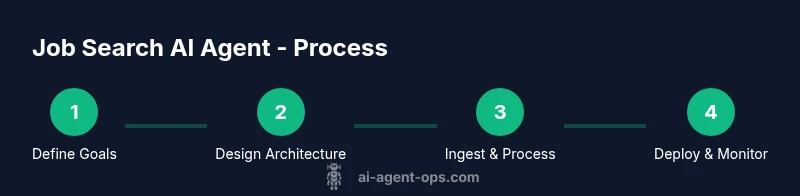
Define your job search goals
According to Ai Agent Ops, a successful AI agent starts with precise goals and measurable outcomes. Decide which roles, industries, locations, and seniority levels you want to target. Set SMART metrics: response rate, number of tailored applications submitted, interview invitations, and time saved per week. Translate these goals into concrete capabilities for your agent, such as resume tailoring, posting monitoring, or automated outreach. This alignment prevents scope creep and ensures your agent delivers tangible value from day one. Clarify target companies, salary bands, and preferred channels (LinkedIn, email, or applicant tracking systems). Start with a simple, testable workflow to validate core assumptions before scaling. By anchoring development to real-world needs, you’ll reduce wasted effort and accelerate learning for your team.
Design the agent architecture
A robust job-search AI agent follows a modular architecture that keeps concerns separated and scalable. Core components include a data ingestion layer, a reasoning/decision module, an action layer, and a memory/context store for persona and history. Use a loop that continuously senses new postings, decides which action to take (tailor resume, draft outreach, or log a lead), executes the action, and then updates the context. Safety rails, rate-limiters, and privacy guards are built-in from the start. According to Ai Agent Ops, this modular design makes it easier to swap tools, improve prompts, and measure impact without rebuilding the system from scratch.
Data sources and ingestion
Identify reliable data sources such as job boards, company career pages, RSS feeds, and direct emails. Normalize data into a consistent schema: position title, company, location, posting date, requirements, and links. Establish deduplication to avoid repeats, and use embeddings for fast retrieval of relevant postings. Decide between streaming vs batch ingestion based on posting velocity and latency needs. Include a data retention policy and consent checks to stay compliant with privacy expectations and platform terms.
Tools, platforms, and prompts
Choose a light stack to begin: an LLM for reasoning, a retrieval system for postings, and an orchestration layer to manage actions. Use retrieval-augmented generation (RAG) to combine current postings with stored resume templates and outreach templates. Craft prompts for three core actions: (1) tailoring resumes, (2) drafting outreach messages, and (3) deciding when to follow up. Plan for guardrails to limit hallucinations and ensure factual accuracy. Keep prompts versioned and testable with small datasets before scaling.
Building the resume tailoring module
The tailoring module should accept a base resume and a posting’s requirements, extract keywords, and re-rank achievements to match those keywords. Use a two-step prompt: (a) summarize the job posting, (b) rewrite the resume sections to align with the posting without changing critical facts. Add checks for length, readability, and ATS compatibility. Store each tailored resume as a versioned artifact and log the rationale for each change so you can audit results later.
Outreach automation and follow-ups
Automate outreach campaigns with personalized messages derived from the posting context and the candidate profile. Include variations for different channels (email, LinkedIn InMail). Schedule follow-ups at humane intervals and track responses. Ensure every message complies with platform rules and anti-spam guidelines. Include a built-in opt-out and privacy considerations so recipients retain control over communications.
Evaluation, safety, and governance
Define metrics for success: response rate, acceptance rate, time-to-apply, and time saved. Run controlled experiments by A/B testing prompts and message variations. Monitor for bias in recommendations and maintain data governance to protect personal information. Establish a rollback plan if a data source becomes unreliable or an integration fails. Regularly review logs to identify and fix issues before they escalate.
Deployment, monitoring, and scaling
Deploy the agent in a safe environment (local or private cloud) with clear access controls and monitoring dashboards. Use logging, alerting, and health checks to keep the system reliable. As you scale, modularize components further, add new data sources, and refine prompts. Plan for rate limits, budget considerations, and potential vendor changes. Continuous improvement cycles ensure your agent remains effective as job markets evolve.
Tools & Materials
- A modern computer with internet access(Recommended: 8 GB RAM minimum; stable development environment)
- Python 3.x development environment(Create a virtual environment for dependencies)
- VS Code or another code editor(Useful extensions for Python and JSON editing)
- Git for version control(Track prompts, configs, and pipeline changes)
- LLM API access (e.g., an API key)(Obtain a plan suitable for testing and scale)
- Data samples: resumes and job postings(Mock data to validate data contracts and prompts)
- Testing and evaluation scripts(Baseline tests for prompt quality and results)
- Optional web scraping tool(Use only if compliant with terms and laws)
Steps
Estimated time: 3-6 hours
- 1
Set up environment
Install Python 3.x, create a virtual environment, and install required libraries. Initialize a Git repository to version-control your prompts and config. This creates an isolated workspace for safe experimentation.
Tip: Use pyenv or conda to manage Python versions and keep environments reproducible. - 2
Define goals and data contracts
Document target roles, preferred industries, and channels. Create data schemas for postings, resumes, and messages. This contract guides data flow and guarantees consistency across components.
Tip: Write concrete success metrics (e.g., 15% response rate) to drive measurable progress. - 3
Choose stack and architecture
Select an orchestration layer, an LLM, and a retrieval system. Design a loop: sense postings → decide action → execute → update context. Prepare guardrails for rate limits and privacy.
Tip: Keep components loosely coupled to simplify replacements later. - 4
Build ingestion pipeline
Create pipelines to fetch postings, normalize data, deduplicate, and store in a structured format. Add basic NLP for keyword extraction and posting summarization.
Tip: Test with a small set of postings before scaling to more sources. - 5
Develop resume tailoring module
Implement prompts to tailor resumes to postings. Include checks for ATS compatibility, word limits, and readability. Save tailored versions with version history.
Tip: Log rationale for changes to improve future prompt refinement. - 6
Develop outreach and follow-up module
Create templates for emails and messages. Implement timing logic for follow-up cadences and channel-specific constraints. Ensure compliant and respectful communication.
Tip: Add a per-recipient opt-out flag to honor preferences. - 7
Evaluate, test, and iterate
Run end-to-end tests with mock data. Measure metrics, adjust prompts, and refine data processing. Use controlled experiments to compare variants.
Tip: Automate regression tests for prompts to catch drift early. - 8
Prepare for deployment
Package the pipeline, document dependencies, and set up a simple monitoring dashboard. Plan for scale, error handling, and rollback procedures.
Tip: Keep a changelog and create rollback point snapshots before major updates.
Questions & Answers
What is an AI agent for job search?
An AI agent for job search automates tasks like resume tailoring, posting monitoring, and outreach. It uses prompts and actions to interact with job platforms and candidates, streamlining repetition-heavy parts of the process.
An AI agent automates job-search tasks like tailoring resumes, monitoring postings, and outreach.
What data sources can I use?
Use job boards, company career pages, emails, and your resume database. Ensure data handling complies with privacy regulations and platform terms.
Use job boards, company pages, emails, and your resume database, while respecting privacy.
How do I measure success?
Define metrics such as response rate, application completion rate, and time saved. Run A/B tests on prompts and analyze results to iterate.
Measure success with response rate, completion rate, and time saved, then iterate.
Is automation safe for outreach?
Yes, when you personalize messages, respect platform rules, and include opt-out options. Avoid spammy or overly generic messages.
Outreach is safe when personalized and compliant with platform rules.
What are common pitfalls?
Watch for drift in prompts, data quality issues, and privacy gaps. Regularly audit data inputs and output decisions.
Common pitfalls include prompt drift, data quality issues, and privacy gaps.
How should I deploy the agent?
Start locally or on a private cloud with strong access controls. Plan for monitoring, logging, and easy rollback if needed.
Deploy in a controlled environment with monitoring and rollback plans.
Can I expand to more sources later?
Yes. Design the ingestion layer to be extensible, allowing new data sources and channels without reworking core logic.
Yes—build extensible ingestion to add sources later.
Watch Video
Key Takeaways
- Define clear goals and metrics up front
- Architect a modular agent stack
- Test with real data before scaling
- Prioritize privacy and compliance
- Iterate based on results