How to Use an AI Agent to Apply for Jobs on GitHub
Learn how to design an AI agent that finds GitHub job openings, tailors applications, and submits them safely—complete with templates, guardrails, and a practical, step-by-step guide.


By building a guided AI agent to apply for jobs on GitHub, you can automatically discover relevant openings, tailor cover messages, and submit applications through supported portals. This quick guide shows how to configure data sources, templates, and safeguards so your outreach remains compliant, respectful, and effective without sacrificing speed.
What an AI agent to apply for jobs on GitHub aims to do
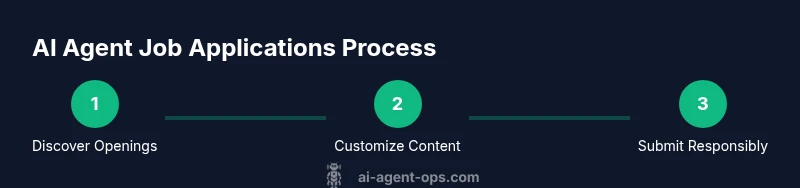
In practice, an AI agent for job applications on GitHub is a lightweight automation that tracks openings, assesses fit, tailors messaging, and submits applications through allowed channels. The Ai Agent Ops team notes that the most effective agents balance speed with accuracy and stay within platform rules. The goal is not to replace human judgment but to augment it: the agent surfaces relevant opportunities, generates personalized content, and queues submissions for review before final send. You’ll need clearly defined signals (keywords, seniority, location) and guardrails to prevent misfires, such as applying to roles that require different documents or misrepresenting experience. By starting with a defensible scope and incrementally increasing complexity, you can build a repeatable workflow that saves time while preserving quality. The Ai Agent Ops team emphasizes a human-in-the-loop approach when dealing with sensitive data or high-stakes roles. Keep transparency with users about what the agent does and what it cannot do. This foundation supports safe, effective automation that respects both candidates and hiring teams.
Core components and architecture
An effective AI agent for job applications uses a modular architecture: a data layer to fetch openings, a reasoning layer to match signals to roles, and an action layer to generate messages and trigger submissions. The agent should expose clear inputs (role keywords, location, experience) and outputs (application status, next steps). Use a lightweight runner (script or microservice), a templates directory, and a safe set of prompts. For GitHub-centric workflows, you might integrate with GitHub Actions, a no-code automation tool, or a Python script with the GitHub API. The design should separate concerns: data collection, decision logic, content generation, and submission. Logging and observability are essential so you can audit decisions and adjust prompts. Security concerns include handling sensitive data securely, storing credentials safely, and adhering to platform policies. By isolating modules, you can swap components without rewriting the entire system, which makes testing and compliance easier. The Ai Agent Ops perspective emphasizes keeping the agent extensible, transparent, and auditable for teams of any size.
Data sources and input signals
Your agent’s input signals determine which openings to consider. Pull from GitHub job boards, company career pages, and developer communities that post roles for engineers and researchers. Include signals such as required skills, seniority, location, and posting recency. Normalize postings into a common schema (title, company, location, requirements, application method). Use unique identifiers for postings to prevent duplicates. Avoid noisy sources and ensure you respect robots.txt and terms of service. The Ai Agent Ops team notes that success comes from disciplined data hygiene: de-duplicate postings, track template versions, and record outcomes (applied, contacted, rejected) to improve future matches. Establish a cadence for refreshing data (for example, every 6–12 hours) and a fallback plan when sources are temporarily unavailable. This approach keeps the agent focused on relevant opportunities and reduces wasted effort.
Crafting templates: resumes, cover letters, and outreach
Design dynamic templates with placeholders for role, company, and key skills. Create a resume variant library focused on common tech stacks and roles found on GitHub. Build tailored cover messages that reference specific project contributions or repositories, but avoid fabricating details. Personalize while staying truthful by citing verifiable items such as open-source contributions and public repositories. Include a call to action and a polite sign-off. For automation, separate content templates from the logic: use prompts that fill blanks from the data layer. This separation makes updates easy and reduces the risk of injecting incorrect information. Include a note about automation and an option for a human reviewer to approve before submission. This balance preserves trust with hiring teams while preserving efficiency.
Guardrails, ethics, and risk management
Automation can save time, but it also introduces risk. Enforce rate limits, respect job posting rules, and implement a human-in-the-loop check for high-stakes roles or ambiguous postings. Add data protection measures: minimize storage of personal data, encrypt credentials, and limit access to the automation run. Implement a fail-fast strategy: if a posting cannot be reviewed for accuracy, skip it and log the reason. Maintain auditable prompts and versioned templates so you can reproduce decisions. Include a clear opt-out mechanism for job posters who prefer not to be contacted, and ensure your approach complies with platform policies. The Ai Agent Ops team would remind developers to test in a sandbox environment first and to monitor performance with dashboards that highlight failed submissions, slow responses, and content quality.
Real-world workflow considerations
Context: your team is evaluating whether to deploy an AI agent for job applications. Start by a small pilot: select a handful of openings that fit well and collect feedback from reviewers. If the pilot demonstrates value, scale gradually while tightening guardrails. Document responsibilities, approvals, and escalation paths so the team understands who signs off on automated actions. Keep line-by-line traceability: store the prompt versions, source postings, and generated content. Establish success metrics such as response time, acceptance rate, and reviewer approval rate. Finally, maintain a culture of continuous improvement: review failed cases, refine prompts, and update templates to reflect evolving job-market language. The Ai Agent Ops perspective supports iterative learning and responsible automation to minimize risk while maximizing impact.
Authoritative sources
- NIST AI Risk Management Framework: https://www.nist.gov/topics/ai-risk-management
- MIT AI Policy and Ethics: https://ai.mit.edu/
- ACM Code of Ethics: https://www.acm.org/code-of-ethics
Tools & Materials
- GitHub account with API access(Personal access token with relevant scopes; ensure compliance with GitHub terms)
- Resume template(One-page or two-page format tailored to common roles)
- Cover letter template(Dynamic prompts to customize per role)
- Outreach templates(Prompts with placeholders for company and role)
- Applicant tracking sheet(Spreadsheet to log openings and statuses)
- Automation tooling(Python scripts, or no-code tools for basic flows)
- Test sandbox(Environment to validate prompts and submissions before real use)
- Policy guidelines(GitHub terms, posting rules, and privacy considerations)
Steps
Estimated time: 2-6 hours
- 1
Define scope and success metrics
Clarify what constitutes a successful automation run, identify target openings, and establish guardrails. Define acceptable channels and a human-in-the-loop threshold for high-stakes roles.
Tip: Start with a conservative scope and measurable signals to avoid overreach. - 2
Inventory openings and signals
Identify reliable sources (GitHub job boards, company pages, and developer communities). Normalize postings into a standard schema and de-duplicate duplicates to keep results clean.
Tip: Use keyword filters and recency signals to prioritize relevant openings. - 3
Develop the AI agent core
Build a lightweight core that can parse postings, extract requirements, and decide when to trigger a submission. Keep components modular for easy testing and updates.
Tip: Keep the reasoning deterministic for predictable behavior. - 4
Create templates for resumes and outreach
Develop dynamic templates with placeholders and ensure factual personalization. Separate content templates from logic to simplify maintenance and audits.
Tip: Include a human-review flag before final submission for high-stakes roles. - 5
Implement submission logic
Define allowed submission channels and implement safe submission pathways. Respect rate limits and platform policies; log outcomes for traceability.
Tip: Test submissions with a sandbox before live use. - 6
Add safeguards and compliance checks
Enforce privacy protections, credential handling, and opt-out options. Implement a fail-safe with alerts for failures and anomalies.
Tip: Maintain an auditable trail of prompts, sources, and generated content. - 7
Test, iterate, and monitor
Run a pilot, collect reviewer feedback, and tighten prompts and templates. Monitor metrics and adjust to evolving job-market language.
Tip: Use version control for prompts and maintain a dashboard of key indicators.
Questions & Answers
Is it ethical to automate job applications?
Automation should respect policies and privacy; use to increase efficiency, not spam. Keep a human-in-the-loop for high-stakes roles.
Automation can help, but it should respect policies and human oversight.
Can this integrate with GitHub Careers forms?
Integration depends on available APIs and terms of service. If direct submission isn't possible, use supported channels and maintain compliance.
Depends on API access and terms—use supported channels and stay compliant.
What if multiple openings require different resumes?
Create a small library of resume variants matched to common role profiles and tailor outreach per posting.
Have resume variants ready and customize outreach per posting.
How do you prevent information inaccuracies?
Implement human review for uncertain cases and validate every generated content against verifiable signals.
Use human checks for unclear cases and verify facts.
What are the risks of automation on job applications?
Policy violations, misrepresentation, and breach of rate limits are key risks; mitigate with guardrails and monitoring.
Risks include policy violations and misrepresentation; monitor and guard.
Where to start for no-code builders?
Prototype with no-code tools to validate flow; migrate to code if needed for scale and control.
No-code prototyping is fine to begin; move to code for scale.
Watch Video
Key Takeaways
- Define guardrails and human-in-the-loop checks
- Use modular design to swap components
- Personalize outreach while avoiding misinformation
- Test in a sandbox before live deployment