AI Agent Coding: Build Autonomous Agents for Automation
A comprehensive, educational guide to AI agent coding. Learn core concepts, patterns, and a practical workflow to design, build, test, and deploy autonomous agents that reason, plan, and act.


AI agent coding combines software engineering with AI to create agents that perceive, reason, and act toward a goal using tools and data. In this guide, you’ll learn core concepts, architectures, and a hands-on workflow to design, build, test, and deploy agentic AI systems. Prerequisites include a basic programming environment, access to a language model API, and safe execution sandboxes.
What is AI agent coding?
AI agent coding blends traditional software engineering with artificial intelligence to create autonomous software agents that can perceive their environment, reason about goals, and take actions to achieve those goals. Unlike static programs, AI agents use observation loops, planning, and tools to adapt to changing inputs. At its core, ai agent coding requires defining a clear objective, decomposing it into actionable steps, and building a loop where the agent senses, decides, and acts. The practice draws on programming fundamentals, data handling, and AI model capabilities to enable agents to operate in real-world contexts. For teams new to this field, start with small pilots that demonstrate the agent’s ability to handle simple tasks before expanding to multi-step workflows. The emphasis is on reliability, safety, and observable behavior, not just clever responses. Ai Agent Ops emphasizes a practical, repeatable approach to ai agent coding that teams can adopt across projects.
Core concepts and primitives in AI agents
When you code AI agents, you work with several foundational concepts that repeat across use cases. Goals define what the agent should accomplish; perceptions gather data from the environment; observations link data to context; actions are the concrete steps the agent can take; and plans are sequences of actions designed to reach the goal. Memory stores past interactions for context, while tool-use enables the agent to extend its capabilities beyond its internal logic. A robust agent includes safety checks, logging, and a clear evaluation metric to determine success. Understanding how these primitives fit together helps you design agents that are both capable and controllable. Remember to separate the agent’s decision logic from the environment adapters to keep your system modular and testable.
Architecture patterns for agentic AI
There isn’t a one-size-fits-all architecture for AI agents. Start with a simple loop that senses, thinks, and acts, then evolve toward more sophisticated patterns. Hierarchical agents introduce sub-goals and modular planners, making complex tasks more manageable. Multi-agent orchestration uses several specialized agents that collaborate or compete to achieve outcomes. Enable memory modules to retain relevant context between sessions and create a clear boundary between decision-making and tool integration. As your system scales, consider a plug-in architecture for tools, an observability layer for monitoring behavior, and a governance framework to manage risk and compliance.
Building a simple AI agent: a hands-on example
Here’s a practical, illustrative example to ground the concepts you’ve learned. Build a weather-assistant agent that can fetch forecasts, summarize conditions, and warn about notable changes. The agent will (1) receive a user query, (2) decide which tools are needed (e.g., a weather API and a summarizer), and (3) return a concise answer. Pseudo-code is provided to convey structure without prescribing a specific library:
class WeatherAgent:
    def __init__(self, tools):
        self.tools = tools  # contains llm, api_client, summarizer
        self.memory = {}

    def perceive(self, user_query):
        return self.tools.llm.run(f"Question: {user_query}")

    def decide(self, observations):
        if 'forecast' in observations:
            return 'fetch_forecast'
        return 'ask_clarifying'

    def act(self, action, user_query):
        if action == 'fetch_forecast':
            result = self.tools.api_client.get_forecast()
            return self.tools.summarizer.summarize(result)
        return 'I need more details to proceed.'
In a real project, you’d replace placeholders with concrete implementations and ensure proper error handling. The key takeaway is to keep the loop small and observable, so you can diagnose issues quickly during development.
Testing, safety, and governance considerations
Testing AI agents requires more than unit tests. You should validate both code quality and agent behavior under diverse inputs. Use sandboxed environments to prevent unintended actions, and implement guardrails for rate limits, permission scopes, and fail-safes for dangerous commands. Observability is essential: log decisions, tool usage, and the rationale behind actions to facilitate audits and improvements. Governance should cover data privacy, model drift, and the potential for emergent behavior. Regular reviews and risk assessments help ensure that agents operate within acceptable boundaries and align with organizational policies.
Advanced topics: memory, planning, and multi-agent orchestration
As agents grow more capable, you’ll introduce persistent memory to retain context across sessions, allowing for more meaningful interactions and refined decision-making. Planning becomes a core capability, where agents generate and revise action sequences on the fly based on results. Multi-agent orchestration enables collaboration among specialized agents, such as a research agent, a data-processing agent, and a user-facing assistant. This pattern can improve throughput and resilience but requires robust coordination, shared standards, and explicit boundary definitions to prevent conflicts. Consider event-driven architectures and standardized protocols for agent-to-agent communication to simplify scaling.
Getting started: a practical learning path and milestones
A structured learning path accelerates mastery of ai agent coding. Start with core programming fundamentals and simple LLM integrations. Progress to building a tiny single-agent loop, then add perception, tool integration, and memory. Create small projects that solve real tasks, such as data retrieval, summarization, or automation workflows. Document decisions, test results, and guardrails. Milestones should include a working prototype, a safety plan, and a basic observability dashboard. Over time, you’ll refine your process, establish best practices, and contribute reusable components to your team’s toolkit.
The future of AI agents in product teams
As teams adopt AI agents more broadly, product roadmaps will increasingly incorporate agentic workflows. Expect growing emphasis on reliability, explainability, and governance to satisfy stakeholders and regulators. Successful organizations will blend human oversight with agent autonomy, deploying agents for well-scoped tasks while maintaining strategic decision-making under human direction. The Ai Agent Ops team expects continued innovation in agent orchestration, modular tool ecosystems, and scalable memory systems that enable agents to operate effectively at scale.
Tools & Materials
- Web browser(For accessing documentation and online references)
- Code editor/IDE(e.g., VS Code or JetBrains IDEs)
- Python 3.x runtime(Prefer 3.9+ and a virtual environment setup)
- LLM API access(API key and endpoint for your chosen model family)
- Sandboxed runtime(Isolated environment to test agent actions safely)
- Logging/monitoring setup(Optional but recommended for observability)
- Example prompts and datasets(For experiments and testing)
Steps
Estimated time: 2-4 hours
- 1
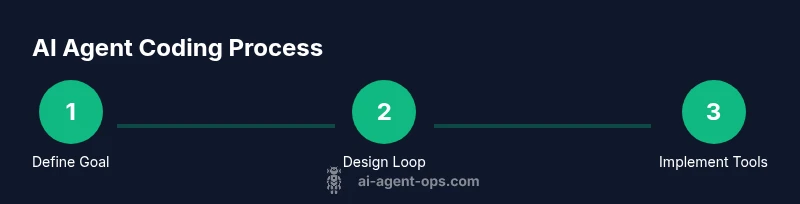
Define objective and success criteria
Articulate a concrete goal for the agent and note measurable criteria for success. This clarity guides architecture, tool selection, and evaluation. Document constraints early to avoid scope creep.
Tip: Write down at least three success metrics and what constitutes a failure. - 2
Design the agent loop architecture
Outline the perception-decision-action cycle, decide on memory needs, and determine how tools will be invoked. Keep the loop simple at first to reduce debugging complexity.
Tip: Start with a minimal viable loop before adding advanced planning. - 3
Choose tools and data sources
Identify the external tools (APIs, databases, or files) your agent will use. Define interfaces and error handling for each tool to ensure reliability.
Tip: Prefer explicit timeouts and clear error codes for tool calls. - 4
Implement the memory and context handling
Add a memory module to retain relevant context across interactions. Use summarization for long histories and avoid leaking sensitive data.
Tip: Limit memory growth with pruning rules and privacy controls. - 5
Add safety, guardrails, and monitoring
Implement input validation, action limits, and watchdogs. Set up logging for decisions and outcomes to support audits.
Tip: Simulate failure modes to ensure safe recovery paths. - 6
Test in a sandbox and iterate
Run diverse prompts, edge cases, and adversarial inputs in a contained environment. Use the results to refine prompts and logic.
Tip: Automate regression tests for regression-safe improvements.
Questions & Answers
What is AI agent coding and how does it differ from traditional programming?
AI agent coding creates autonomous software agents that perceive, reason, and act toward goals using data and tools. Unlike traditional programs, these agents operate in an observation-decision-action loop and adapt to changing conditions.
AI agent coding builds autonomous software that can sense, reason, and act toward goals, rather than just following fixed instructions.
Which architectural patterns work best for AI agents?
Common patterns include single-agent loops for simple tasks, hierarchical agents for complex goals, and multi-agent orchestration where specialized agents collaborate. Memory and tool interfaces are shared concerns across patterns.
Patterns include single-agent loops, hierarchical agents, and multi-agent orchestration, with shared memory and tool interfaces.
Do I need special hardware to run AI agents?
You can start with CPU-based environments for development and testing. For production deployments or large models, GPUs or specialized accelerators may be necessary depending on latency and throughput requirements.
You can begin on a CPU-based setup and scale with GPUs as needed.
How can I ensure safety and prevent agent misbehavior?
Implement guardrails, input validation, and strict permission controls. Use monitoring to detect anomalous actions and have a rollback or kill-switch for unsafe trajectories.
Guardrails, validation, and monitoring help keep agents behaving safely.
What skills should my team focus on to work with AI agents?
Develop Python proficiency, understand AI concepts and APIs, and gain experience with observability, testing, and software architecture for agent ecosystems.
Team skills should include Python, AI concepts, API integration, and strong observability and testing practices.
Watch Video
Key Takeaways
- Define clear agent goals and success criteria
- Use modular architectures to scale safely
- Incorporate robust memory and grounded tool use
- Test thoroughly in sandbox environments
- Instrument observability for accountability and improvement