Where to Buy AI Agents: A Practical Guide for Tech Teams
Discover where to buy AI agents across enterprise vendors, marketplaces, and no-code platforms. Learn evaluation criteria, licensing models, deployment tips, and ROI considerations for tech teams.


AI agents can be purchased through three primary channels: enterprise AI vendors, specialized AI agent marketplaces, and no-code/low-code platforms that offer ready-to-deploy agents. This guide explains where to buy, how to compare offerings, licensing models, deployment options, and support levels to ensure a fit with your team's goals. Expect clear SLAs, governance options, and scalable runtimes as you evaluate these options.
What buying AI agents really means
When you ask yourself where to buy ai agents, you’re choosing between several packaged capabilities that combine AI reasoning, domain-specific adapters, and a management surface. In practice, a purchase is not a single model; it’s a platform service with defined SLAs, upgrade paths, and governance controls. This distinction matters for developers who fear integration headaches and for executives who want predictable roadmaps. The Ai Agent Ops team emphasizes treating AI agents like shared services that can be scaled, audited, and updated without disruptive rewrites. By framing the decision around governance, security, and lifecycle management, product teams can align procurement with architecture and business outcomes. In short, buy with a plan for ongoing maintenance and clear ownership.
Channels to consider when evaluating where to buy ai agents
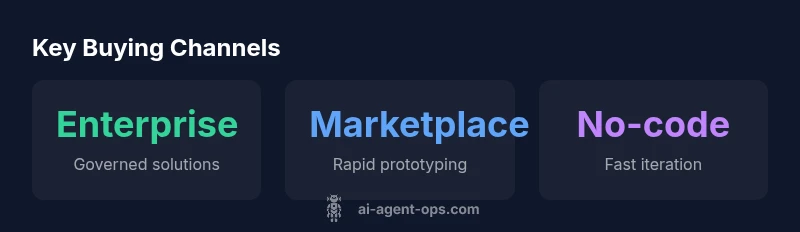
There are three main channels to explore: (1) enterprise AI vendors that offer customizable agents with governance and security baked in; (2) AI agent marketplaces that host a wide range of pre-built agents for rapid experimentation; and (3) no-code/low-code platforms that let teams assemble agents with minimal coding. Each channel has strengths and trade-offs: large vendors may offer strong support but higher costs, marketplaces provide speed and breadth but variable quality, and no-code tools excel at speed but may limit advanced customization. Your choice should depend on team skill, data sensitivity, and required integrations. In all cases, ensure the provider supports your target tech stack and offers clear licensing terms.
How to evaluate offerings across channels
Start with a structured evaluation rubric. For each channel, map capabilities to your use cases, assess integration points, and verify governance controls. Key criteria include: compatibility with existing data sources and APIs, support for prompt orchestration and workflow orchestration, reliability of uptime and SLAs, and quality of documentation. Look for transparent pricing, licensing terms, and upgrade policies. Ask vendors to demonstrate handling of sensitive data, model updates, and rollback procedures. A side-by-side comparison helps avoid vendor lock-in and highlights total cost of ownership across time.
Licensing models and total cost of ownership
Licensing for AI agents varies widely. Common models include per-seat, per-agent, usage-based, and bundled enterprise agreements. Consider not just upfront costs but ongoing expenses: data transfer, API calls, monitoring, and support. The total cost of ownership also depends on deployment complexity, required integrations, and governance features. Ai Agent Ops Analysis, 2026 notes that teams that forecast total cost early tend to avoid surprise charges during scale-up. Favor vendors that provide clear SLAs, predictable renewal terms, and transparent upgrade cadences.
Deployment considerations and integration with workflows
Deploying an AI agent means more than turning on a feature flag. You’ll need to integrate with data sources, event streams, authentication systems, and downstream tools. Map data flows, define input/output contracts, and establish error handling. Plan for version control, monitoring, and rollback if an agent behaves unexpectedly. When evaluating where to buy ai agents, prefer platforms with pre-built connectors to your stack and well-documented APIs. Consider phased deployments and sandbox environments to test governance and security before production.
Security, governance, and compliance
Security and governance are non-negotiable when buying AI agents. Verify data handling policies, access controls, and encryption at rest and in transit. Ensure you can audit model behavior, track prompts, and record decision trails. Compliance requirements, such as data residency and industry-specific standards, may influence channel choice. The Ai Agent Ops team recommends conducting a risk assessment early and selecting vendors that offer built-in governance dashboards, incident response playbooks, and clear data management policies.
Real-world use cases and vendor examples
In practice, buyers often start with customer support automation, internal process optimization, and data enrichment tasks. Enterprise vendors tend to offer robust governance and performance guarantees suitable for regulated industries, while marketplaces shine for experimentation and rapid prototyping. No-code platforms enable non-technical teams to prototype workflows quickly, but may require later migration for scale. Use cases selected for pilots should be narrowly scoped with measurable outcomes to gauge ROI and to inform future expansion.
ROI and measurement: how to set benchmarks
ROI isn’t just about cost savings; it’s about time-to-value, error reduction, and improved decision quality. Define KPIs before purchase: process time reduction, accuracy improvements, and user adoption rates. Establish a baseline, then measure improvements post-deployment. For AI agents, consider both tangible benefits (time saved, fewer escalations) and intangible gains (consistency, faster decision cycles). Ai Agent Ops Analysis, 2026 suggests setting quarterly reviews to adjust objectives as you learn from pilots and early deployments.
Getting started: a practical buying checklist
To begin your search for where to buy ai agents, assemble a cross-functional team including developers, security, procurement, and product leadership. List your top 2–3 use cases, identify required data sources, and define acceptable risk levels. Create a short evaluation rubric covering capabilities, integration, governance, licensing, and support. Request live demos or sandbox access, and insist on a transparent data handling and security posture. Finally, chart a 90-day pilot plan with clear success criteria and a realistic path to production.
Comparison of channels for buying AI agents
| Channel | What it offers | Typical deployment time | Pros | Cons |
|---|---|---|---|---|
| Enterprise vendors | Custom agent solutions with governance | 2–6 weeks | Strong security; enterprise support | Higher cost; longer procurement |
| AI agent marketplaces | Market-ready agents; broad selection | 1–4 weeks | Fast onboarding; diverse options | Quality varies; limited customization |
| No-code/low-code platforms | Drag-and-drop agent assembly | 1–3 weeks | Low barrier; rapid iteration | Limited advanced features; potential lock-in |
Questions & Answers
What exactly is an AI agent and why should I buy one?
An AI agent is a software component that can sense, decide, and act within a defined domain, often orchestrating tasks across systems. Buying one means acquiring a packaged capability with governance and support, not just a model. This helps teams accelerate automation while maintaining control and visibility.
An AI agent is a smart software that can act on tasks across systems. Buying one gives you a ready-to-use automation tool with governance and support, not just a model.
Is there a best channel for beginners when buying AI agents?
For beginners, marketplaces and no-code platforms offer rapid experimentation and lower upfront risk. Enterprises are suitable when you need strong governance and security. Start with a sandbox or pilot to learn capabilities before committing to a full-scale deployment.
If you’re new, start with a marketplace or no-code platform to explore quickly, then consider enterprise options for deeper governance.
What should I look for in licensing terms?
Look for clear per-user or per-agent pricing, usage-based options, data-handling commitments, and upgrade policies. Ensure terms include exit options, data portability, and support levels. Transparent renewal terms help manage long-term costs.
Check pricing models, data handling promises, upgrade terms, and clear renewal options.
How long does deployment typically take for AI agents?
Deployment timelines vary by channel and complexity but expect a few weeks for enterprise solutions and even shorter for marketplaces or no-code platforms. Pilot scopes and integration depth significantly influence the total timeline.
Most deployments take a few weeks, depending on integration needs and governance requirements.
How can I measure ROI when I buy AI agents?
Define KPIs before you start—time saved, error reduction, and user adoption. Track changes over a 90-day pilot, then scale based on solid improvements and a clear cost/benefit analysis.
Set goals up front, track improvements in time, errors, and adoption, then decide on scale based on evidence.
“Buying AI agents is less about finding a single perfect model and more about selecting a reliable platform that fits your workflow, governance, and update cadence.”
Key Takeaways
- Define your goals before shopping for AI agents.
- Choose a channel that fits your team's skills and processes.
- Assess licensing, deployment, and governance from day one.
- Pilot with a focused use case to measure ROI quickly.
- Plan for integration and ongoing vendor support.