AI Agent for Web Scraping: Build a Scraping Agent Today
Learn how to design an ai agent that can scrape webpages, handle data ethically, and scale with robust parsing, proxies, and compliant workflows.


By the end of this guide you will know how to design an ai agent that can scrape webpages, orchestrate crawling tasks, and deliver structured data. According to Ai Agent Ops, agentic AI improves automation efficiency when tasks are multi-step and data-driven. The Ai Agent Ops Team found that starting with clear goals and guardrails reduces risk and accelerates deployment.
Introduction to AI agents for web scraping
AI agents that can scrape webpages extend traditional crawlers by leveraging intelligent task planning, adaptive parsing, and automated decision making. Instead of writing monolithic scrapers, you compose an agent that can decide which pages to visit, how to extract data, and how to handle errors. This section lays the foundation: what such an agent is, what it can do, and why it matters for teams looking to automate data collection at scale. You’ll see examples of end-to-end workflows where an agent selects sources, navigates dynamic content, and stores results in a structured format. The Ai Agent Ops team's perspective is that agentic AI shines when the workflow has multiple decisions, dependencies, and data-transform steps. Build with guardrails and clear success criteria from day one to avoid scope creep and accidental data leakage.
Core concepts behind a web-scraping AI agent
An AI agent for web scraping combines three layers: the orchestration layer (which decides next actions based on goals and observations), the scraping layer (which fetches and renders pages), and the data layer (which structures and stores results). The orchestration layer often relies on a lightweight planner or an LLM-driven policy to choose the next page, the data to extract, and the transformation needed. The scraping layer can be a headless browser or a robust HTTP client with proper header management. The data layer uses schemas and validation rules to enforce consistency. Across all layers, logging and observability are essential so you can audit decisions and reproduce results. The Ai Agent Ops team recommends starting with a minimal viable agent and gradually adding capabilities like state persistence, retry policies, and modular parsers.
Practical benefits of AI agents for scraping
Compared to hand-coded crawlers, AI agents can reduce manual maintenance by adapting to layout changes and content variations. They can prioritize targets, switch down on noisy pages, and skip irrelevant sections automatically. For teams collecting data from multiple domains, an agent can coordinate parallel tasks, enforce rate limits, and harmonize outputs into a single schema. This approach supports faster prototyping and safer scaling. Real-world benefits include faster time-to-insight, improved data quality through consistent parsing rules, and better governance through auditable decisions and action histories.
Understanding the data pipeline
A robust scraping agent sits on a data pipeline that includes ingestion, parsing, validation, and storage. Ingestion handles requests with respectful delays; parsing converts HTML into structured fields like title, price, date, and metadata; validation checks type, range, and completeness; storage writes to a data warehouse or data lake with versioning. A well-designed pipeline also includes provenance metadata (source URL, fetch time, user agent) to support reproducibility and compliance audits. This block emphasizes designing the pipeline before writing code to minimize rework.
Architecture choices: headless browser vs. API-first
Choosing between a headless browser (Chrome/Chromium) and API-first scraping depends on content complexity and site protections. Headless browsers handle dynamic content, client-side rendering, and CAPTCHAs more gracefully but come with higher resource costs. API-first approaches offer speed and predictability but require access to official endpoints and careful respect for terms of service. Your agent should be able to switch between modes, maintain session state, and fall back gracefully when a primary method is blocked. The aim is to maximize coverage while staying within legal and ethical boundaries.
Data quality and normalization strategies
Structured data requires consistent fields across sources. Define core schemas upfront (e.g., product_title, price, date_published, author). Build extraction rules that map to these fields and implement normalization (text casing, trimming, unit standardization). Implement robust validation with schema checks, optional vs. required fields, and default values where appropriate. Data quality controls reduce downstream cleaning time and improve analytics accuracy. The agent should report anomalies (missing fields, unexpected formats) to human reviewers when thresholds are exceeded.
Ethical and legal guardrails for scraping
Even the most capable agent must respect robots.txt, terms of service, and jurisdictional data-protection laws. Implement site-aware policies: respect crawl delays, honor robots.txt, and avoid scraping sensitive or copyrighted content beyond permissible use. Maintain an auditable trail of decisions and consent where applicable. Ethical considerations extend to rate limits, data retention, and user privacy. The Ai Agent Ops team emphasizes building guardrails into the agent’s planning stage to prevent inadvertent policy violations.
Security and credentials management
Scraping often requires handling credentials, API keys, and session tokens. Use secret management services to store credentials securely, rotate keys regularly, and limit access via least-privilege policies. Never embed secrets directly in code or logs. Protect data in transit with TLS and at rest with encryption. Build error handling that prevents credential leakage through error messages or stack traces. Proper security practices reduce risk and protect both your organization and data subjects.
Observability and auditing capabilities
A scraping agent should expose dashboards or logs that show task status, success rates, and data quality metrics. Track retries, response times, and error distributions to identify bottlenecks. Include an audit trail that records decisions and the rationale behind them. Observability makes it easier to debug issues, demonstrate compliance, and improve the agent over time. This section highlights practical monitoring patterns and recommended metrics.
Deployment patterns and scaling considerations
Start with a single-region deployment to validate the workflow, then scale horizontally as demand increases. Use containerization (Docker), orchestration (Kubernetes), and serverless options where appropriate. Manage concurrency with sensible limits to avoid overwhelming target sites and triggering anti-scraping measures. Design for fault tolerance with retries, backoffs, and circuit breakers. The end goal is a reliable, compliant, and scalable scraping agent that can adapt to evolving data requirements.
Quality assurance, testing, and iteration
Testing is critical before production: unit tests for extraction logic, integration tests for the entire pipeline, and end-to-end tests that simulate real-world scenarios. Create synthetic test pages that mimic common layouts and edge cases. Run regression tests after changes to verify that updates do not break existing rules. Establish a feedback loop where results inform rule updates and guardrail adjustments. The Ai Agent Ops perspective is that iterative testing reduces surprise deployments and improves long-term reliability.
Tools & Materials
- Development environment (IDE, version control)(Set up Python/Node.js environment with linting and formatting tools)
- Headless browser or API client(Playwright or Puppeteer for dynamic pages; REST clients for API-based scraping)
- Proxy or VPN service(Optional, for geolocation testing and rate-limiting needs)
- Robots.txt checker(Automated checks before crawling a domain)
- Secret management tool(Store API keys and credentials securely (e.g., Vault, AWS Secrets Manager))
- Data storage solution(SQL/NoSQL database or data lake with schema support)
- Logging and observability stack(Structured logging, metrics, and dashboards)
- Sample target URLs list(Curated list for testing with consented sources)
- Legal and compliance guide(Reference to robots.txt, terms of use, data protection laws)
Steps
Estimated time: 6-12 hours
- 1
Define scraping goals and success criteria
Identify the data you need, how you will use it, and what success looks like. Define acceptance criteria for data quality and mission duration. Establish guardrails and escalation paths for policy violations.
Tip: Write clear data schemas before you fetch anything. - 2
Map data sources and access methods
List domains, assess content structure, and decide between dynamic rendering or API endpoints. Determine required permissions and compliance constraints per site.
Tip: Start with a single source to minimize complexity. - 3
Choose architecture and tooling
Select an orchestration approach (LLM-guided planner vs. rule-based). Pick a scraping engine (headless browser vs. API client) based on content type.
Tip: Keep the plan modular to swap components later. - 4
Implement data extraction rules
Develop selectors (CSS/XPath) and normalization logic. Create a schema and validation layer to ensure consistent outputs.
Tip: Use robust selectors and avoid brittle absolute paths. - 5
Integrate governance and guardrails
Embed robots.txt checks, rate limits, and consent considerations in the decision layer. Implement logging for compliance auditing.
Tip: Treat policy checks as first-class steps in the plan. - 6
Set up data pipeline and storage
Configure ingestion, transformation, and validation stages. Ensure provenance metadata is captured for reproducibility.
Tip: Version your data schema and track changes. - 7
Test with real-world scenarios
Run end-to-end tests on multiple pages with different layouts. Validate data quality and error handling across sites.
Tip: Automate a regression suite for layout changes. - 8
Deploy and monitor
Launch in a controlled environment, monitor performance, and adjust timeouts and backoffs. Set alerting for anomalies.
Tip: Use phased rollout to catch issues early.
Questions & Answers
What is an AI agent that can scrape webpages?
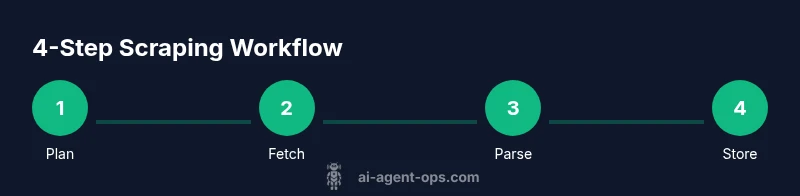
An AI agent that can scrape webpages is a software entity that uses decision-making components to plan, fetch, parse, and store data from websites. It combines a data extraction strategy with orchestration logic to automate multi-step tasks and handle dynamic content.
An AI agent that scrapes webpages is an automated system that plans, fetches, and extracts data from sites, then saves it for use.
Is web scraping legally allowed for all sites?
Legal allowances vary by site and jurisdiction. Always check terms of service, robots.txt, and data-protection rules. When in doubt, seek consent or use publicly available APIs instead of scraping restricted content.
Legality depends on the site and local laws; check terms and robots.txt and use APIs when possible.
What are the main architectural choices for scraping agents?
Common choices include headless browsers for dynamic sites and API-first approaches for static endpoints. You can combine both, letting the agent switch methods as needed while preserving state and governance.
You can choose between headless browsers and API-first methods, or use both with smart routing.
How can I ensure data quality in scraping agents?
Define core schemas, implement validation at ingestion, and use automated checks for completeness and consistency. Regularly review sampling of extracted data to catch drift or layout changes.
Define schemas, validate data as it comes in, and routinely sample extractions for drift.
What ethical guardrails should be built into the agent?
Implement rate limits, respect consent, avoid sensitive data, and maintain an audit trail of decisions. These guardrails help you stay compliant and protect users.
Limit how fast you crawl, respect terms, and keep an audit trail for compliance.
How do I test an AI scraping agent effectively?
Create synthetic test pages that mimic real layouts, validate edge cases, and run end-to-end tests against the pipeline. Use regression tests to ensure changes don’t break existing behavior.
Test with synthetic layouts and end-to-end checks; keep regression tests updated.
Watch Video
Key Takeaways
- Define clear goals and data schemas first.
- Choose architecture suited to content complexity.
- Guardrails reduce risk and improve compliance.
- Test thoroughly before production deployment.
- Ai Agent Ops recommends starting with ethical, policy-driven design.