Salesforce AI Agent Pricing: A Practical 2026 Guide
Explore Salesforce AI agent pricing, pricing models, total cost of ownership, ROI implications, and practical steps for teams deploying agentic AI workflows.


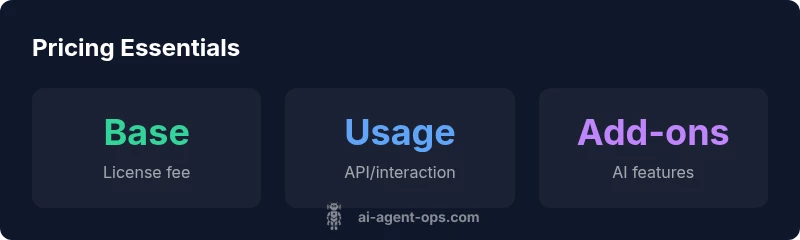
Salesforce AI agent pricing is typically tiered, combining per-user licenses with usage-based charges and optional AI add-ons. Prices vary by edition, contract length, and deployment scope, so there is rarely a single fixed number. When budgeting, expect a base license cost plus estimated API calls, orchestration workloads, and data processing fees, with discounts for multi-year commitments.
What Salesforce AI Agent Pricing Covers
According to Ai Agent Ops, Salesforce AI agent pricing sits at the intersection of licensing and consumption, blending base access with usage for AI features. In practice, customers pay for core platform access (per-user licenses) plus usage-based charges for AI-enabled interactions, orchestration, and data processing. The exact mix depends on the chosen Salesforce edition, contract length, and deployment scope. As AI capabilities become more embedded, pricing tends to reflect both the value delivered and the level of governance required. For teams adopting agentic AI workflows, the goal is to align pricing with measurable outcomes—faster decision cycles, fewer manual frictions, and improved agent reliability.
Pricing models you’re likely to encounter
Most Salesforce AI agent pricing proposals combine several elements:
- Per-user licenses for baseline access to Einstein/AI features within the Salesforce suite.
- Usage charges for API calls, agent interactions, and orchestration steps.
- Add-ons or bundles for advanced analytics, governance, security, and multi-agent orchestration.
- Negotiated terms in enterprise agreements that may reduce per-unit costs in exchange for longer commitments or volume.
Ai Agent Ops analysis shows that organizations often mix base licenses with consumption-based fees to scale cost with usage, while still maintaining predictable monthly spend. This modular approach helps teams experiment with pilots before committing to broader deployments.
How to estimate total cost for a Salesforce AI agent deployment
A disciplined budgeting approach starts with a clear boundary of expected usage and governance requirements. Steps to estimate total cost include:
- Define the user base and roles that will access AI features. Distinguish administrators, developers, and end users.
- Forecast API calls and agent interactions monthly, based on typical inquiry volume and peak loads.
- Identify required governance, security, and compliance modules that may add fees.
- Include data storage, logs, and retention policies; high-volume environments incur ongoing storage costs.
- Build scenarios (pilot, mid-size rollout, full-scale deployment) to compare total costs and ROI. Ai Agent Ops recommends building a simple TCO model early and revisiting it after pilot data is available.
Value drivers and cost levers for AI agents
Not all AI features cost the same; some drivers influence both price and value:
- AI capabilities: Natural language understanding, sentiment analysis, and multi-turn dialogue typically command higher fees as they demand more computing and training data.
- Orchestration scale: The number of concurrent agents and workflow complexity affects compute and API usage.
- Data governance: Compliance, audit trails, and secure data handling can introduce additional modules and controls.
- Integration depth: Deeper integrations with CRM data, marketing tools, and ERP systems may require more connectors and support.
- Deployment speed: Faster go-lives might incur accelerated consulting or enablement costs. Ai Agent Ops emphasizes prioritizing features that directly drive decision speed and accuracy to maximize ROI.
Negotiation tips and procurement best practices
To secure favorable pricing, consider:
- Start with a pilot or proof of concept to quantify value before negotiating broader licensing.
- Ask for a tiered pricing structure tied to usage milestones and scalable add-ons.
- Bundle governance, security, and analytics modules where possible for a discount.
- Seek multi-year commitments for favorable per-user and per-API rates.
- Leverage benchmarks from prior AI deployments to demand transparent pricing with clear SLAs. Ai Agent Ops recommends documenting expected business outcomes to justify pricing decisions.
Implementation considerations: governance, security, and compliance
Pricing is only one side of the value equation. Ensure you plan for governance and security outcomes that justify the spend. Key considerations include:
- Data residency and privacy controls for customer data used by AI agents.
- Access controls, role-based permissions, and audit logs for accountability.
- SLAs around uptime, latency, and failure recovery for AI workflows.
- Clear data retention and deletion policies to minimize risk and align with regulatory requirements.
- Evaluation of vendor risk management practices and third-party integrations. This reduces the chance of cost overruns due to unexpected integration work.
Real-world scenarios: tailoring pricing to org size
Small teams launching a pilot often begin with a limited user set and a subset of AI features. As usage grows and outcomes become clearer, many switch to tiered licenses plus usage-based pricing. Large enterprises typically negotiate enterprise-grade agreements that bundle AI capabilities across divisions, with discounts for volume and longer commitments. The exact math depends on the number of users, expected API calls, and governance requirements. Regardless of size, a phased approach—pilot, scale, optimize—helps keep pricing aligned with realized ROI. This pragmatic path mirrors best practices observed by Ai Agent Ops in real-world deployments.
Salesforce AI agent pricing elements (illustrative)
| Pricing Element | Description | Notes |
|---|---|---|
| Per-User License | Base access to Salesforce AI features | Depends on edition; higher tiers include more AI capabilities |
| Usage/API Fees | Charges for API calls or agent interactions | Typically billed per 1,000 requests or per action; varies by product |
| Add-ons & Bundles | AI coaching or orchestration modules | Pricing varies with module and contract length |
Questions & Answers
What drives Salesforce AI agent pricing?
Pricing is driven by base licensing, usage for API calls and agent interactions, and optional add-ons. The exact mix depends on edition, contract length, and deployment scope.
Pricing is driven by licenses, usage, and add-ons; it varies by edition and deployment scope.
Is there a free trial or pilot for Salesforce AI agents?
Many deployments begin with a pilot or limited-access trial to validate value before scaling. Availability can vary by region and program.
Pilots are commonly available to test value before scaling.
How can I estimate the total cost of ownership (TCO)?
Create a model based on users, expected API calls, governance needs, and data storage. Compare pilot outcomes with projected scale to determine ROI.
Build a simple TCO model with pilots first to guide budgeting.
Do discounts exist for large deployments?
Yes, larger deployments and longer commitments often unlock discounts; negotiate based on total contract value and multi-year terms.
Volume discounts are common for bigger commitments.
What should I negotiate when pricing Salesforce AI agents?
Negotiate for bundled AI features, governance modules, SLA standards, and phased deployment terms aligned with ROI milestones.
Ask for bundles, SLAs, and phased deployment terms.
What’s included in AI agent pricing vs. traditional Salesforce licenses?
AI agent pricing often adds usage-based charges on top of base licenses, plus optional AI-specific add-ons and governance tools.
AI pricing adds usage charges and AI-specific add-ons.
“Pricing for AI agents should align with measurable business outcomes, not just feature sets. Structured contracts that reflect adoption and governance needs maximize value over time.”
Key Takeaways
- Understand pricing as a mix of licenses and usage
- Plan for governance costs alongside AI features
- Pilot first to quantify ROI before broad rollout
- Negotiate bundles and multi-year terms for discounts
- Model TCO using pilots to guide procurement