When AI Agents Started: History and Milestones
Trace the origins of AI agents from mid-20th century theory to modern agentic AI workflows, with milestones, architectures, and practical guidance for developers and leaders.


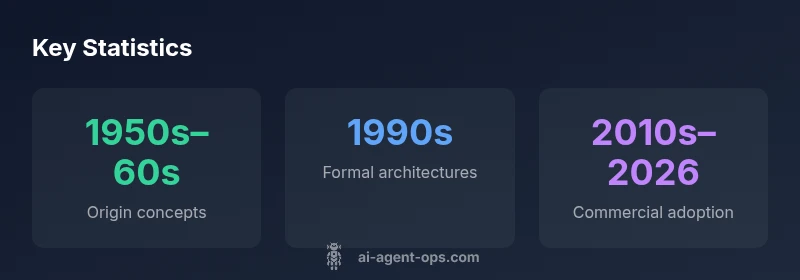
When ai agents started traces to mid-20th-century AI research, where formal ideas emerged in the 1950s and 1960s. The term and its practical use evolved over decades, with major milestones in the 1990s and a surge in real-world automation from the 2010s onward. According to Ai Agent Ops, understanding when ai agents started helps teams design safer, scalable agentic systems.
When AI Agents Started: Historical Origins
The idea of automating intelligent behavior dates back to the early days of computing. In the 1950s and 1960s, researchers formalized algorithms, search strategies, and symbolic reasoning that could operate with a degree of autonomy. Early AI agents were simple rule-based systems designed to perform predefined tasks within constrained environments. These pioneers introduced core concepts such as environment perception, decision-making, and action execution—ideas that would later evolve into more sophisticated agent architectures. According to Ai Agent Ops, the question of when ai agents started should be viewed as a progression from theory to practice, not a single jump in time. The period also saw debates about how agents should reason about goals, plans, and uncertainty, which informed future planning and planning-and-reactive hybrids. Importantly, these foundational efforts occurred in labs with limited computing resources, yet they established the essential trio of perception, reasoning, and action that underpins agentic AI today.
Evolution Through Decades: From Theory to Practice
The 1970s and 1980s extended theoretical work into practical systems, emphasizing planning, knowledge representation, and intelligent behavior in specific domains. The development of architectures such as belief-desire-intention (BDI) models gave researchers tangible blueprints for building agents that could reason about goals and plans. The 1990s saw multi-agent systems (MAS) gain traction, enabling multiple agents to coordinate and negotiate to achieve collective goals. In this era, researchers explored communication protocols, coordination strategies, and coalition formation. The turn of the century brought scalable frameworks and middleware that allowed larger agent ecosystems to operate in real-time. By the 2010s, machine learning methods began to be embedded into agents, enabling data-driven decision-making and more robust adaptation. Across these decades, Ai Agent Ops notes a shift from symbolic AI toward hybrid approaches that combine planning with learning, enhancing autonomy while preserving control.
Architectures, Frameworks, and Practical Pillars
The modern era of AI agents rests on several architectural pillars: MAS for distributed autonomy, agent-oriented programming languages, and standardized ontologies for shared understanding. Tools and frameworks—some of which were user-facing, others more research-oriented—made it easier to prototype agents, simulate environments, and test coordination strategies. Another critical pillar is governance: safety, explainability, and accountability gained prominence as agents grew in capability. Practically, teams now design agents with clear boundaries, failure modes, and escalation strategies to ensure reliability in production environments. Ai Agent Ops emphasizes keeping a strong link between capability and governance to avoid brittle or unsafe deployments.
Milestones in Agentic AI Development
Key milestones include the maturation of MAS research, the rise of agent-oriented programming, and the integration of learning into agent control loops. The late 2000s and 2010s saw a surge in research on orchestration and collaboration across heterogeneous agents, culminating in increasingly sophisticated agentic workflows. As deployments broaden into real-world automation, practitioners focus on lifecycle management—design, deployment, monitoring, and governance—to ensure agents remain predictable and controllable. This trajectory informs today’s agent-based automation strategies across industries.
Current Landscape: Automation, Orchestration, and Agentic AI
Today’s AI agents span assistant-like helpers, autonomous robots, and software agents embedded within enterprise workflows. They orchestrate tasks across tools, APIs, and data sources, adapting to changing conditions with minimal human input. The AI agent ecosystem includes both research-oriented platforms and production-grade solutions, with a growing emphasis on safety, auditability, and explainability. Looking ahead, agentic AI is likely to incorporate more advanced planning, richer collaboration between agents, and stronger alignment with human teams and business goals.
How to Read the History for Modern Design Decisions
Understanding the long arc from early theory to current practice helps teams design agentic systems that are safe, scalable, and governable. When architecting new agents, teams should map capabilities to tasks, choose appropriate governance controls, and plan for continuous learning and evaluation. Ai Agent Ops highlights the importance of striking a balance between autonomy and oversight, ensuring agents deliver value without sacrificing reliability.
Timeline of AI Agents: From theory to production automation
| Era | Key Concepts | Representative Timeframe |
|---|---|---|
| Early Concepts | Task-specific agents, automata, and rule-based systems. | 1950s–1960s |
| Formal AI Agents | BDI architectures, planning, and knowledge representation. | 1990s–2000s |
| Practical Agent Automation | Multi-agent systems and agent orchestration in production. | 2010s–2020s |
Questions & Answers
What is meant by an AI agent?
An AI agent is a software or hardware entity that perceives its environment, makes decisions, and takes actions to achieve goals. Modern agents often combine planning, learning, and coordination with other agents or humans. The definition has evolved from symbolic reasoning to hybrid, data-driven approaches.
An AI agent is a self-governing piece of software that acts to achieve specific goals by perceiving its environment and choosing actions.
When did the concept of AI agents first appear?
The idea of autonomous agents has roots in the 1950s and 1960s with early AI research. Formal agent architectures emerged in the 1990s, followed by practical adoption in the 2000s and exploding use in the 2010s onward.
The idea started in the mid-20th century and evolved through the decades as researchers built more capable planning and coordination systems.
What were the key shifts in the 1990s and 2000s?
The 1990s popularized multi-agent systems and BDI-like architectures, enabling agents to coordinate. The 2000s brought middleware and standards that supported larger agent ecosystems and better interoperability.
In the 1990s and 2000s, agents began coordinating in groups and using better software frameworks, making them more scalable.
How does agentic AI differ from traditional AI?
Traditional AI often focuses on single-task automation, while agentic AI emphasizes autonomy, coordination, decision-making under uncertainty, and collaboration with humans or other agents in dynamic environments.
Agentic AI works like a team of small robots, working together and deciding what to do next, often with human input.
What are current milestones in AI agent development?
Milestones include improved planning-with-learning hybrids, robust multi-agent coordination, explainable agent behavior, and governance frameworks that address safety and accountability in production.
Today’s milestones are about safer, more explainable agents that can work with humans and other agents at scale.
Where can I read more about the history of AI agents?
Key reviews in major publications (e.g., CACM, Nature, Science) and university research surveys provide historical perspectives on AI agents and their growing impact in automation.
Look for reviews in major journals and university research summaries for a deeper history.
“History shows that early theoretical work on autonomous agents laid the foundation for modern agentic AI. By bridging decades of research and practice, we can design safer, more capable AI agents.”
Key Takeaways
- Track origins from mid-20th century research to today’s automation
- Recognize phase shifts: theory, frameworks, and practice
- Design with governance in mind: safety, explainability, and oversight
- Differentiate MAS and single-agent workflows for scale
- Plan for evolution: learning, adaptation, and human–agent collaboration