How Long Have AI Agents Been Around? A Timeline Overview
How long have ai agents been around? A concise timeline tracing milestones from the 1950s to today’s agentic workflows, with practical guidance for reliable deployment in 2026.


AI agents have a long lineage, stretching from mid-20th century ideas to today’s autonomous systems. The earliest concepts emerged in the 1950s, with landmark moments in the 1960s, and a rapid expansion in the 1990s–2000s. Modern agent-oriented AI has surged in the 2010s–2020s, delivering practical, scalable automation across industries. In short: AI agents have been around for roughly seven decades.
how long have ai agents been around: a historical overview
To understand how long have ai agents been around, we trace a lineage from mid-20th century ideas to today’s proactive assistants. According to Ai Agent Ops, the modern notion of autonomous software agents grew from cognitive architectures and early agent-based modeling, accelerating as computing power and data access expanded. The question also invites a chronological lens: what counts as an AI agent, and when did it acquire practical impact? In this article, we map a timeline from conceptual frameworks to operational systems, emphasizing governance, safety, and real-world value. Over seven decades, researchers and engineers have moved from abstract reasoning to agents that can perceive, decide, and act across domains, often without continuous human input. This arc is not a single moment but a sequence of breakthroughs, each enabling more capable, scalable automation. how long have ai agents been around is not merely historical trivia; it is a lens on how we build, govern, and trust agentic AI today.
Milestones Across Decades
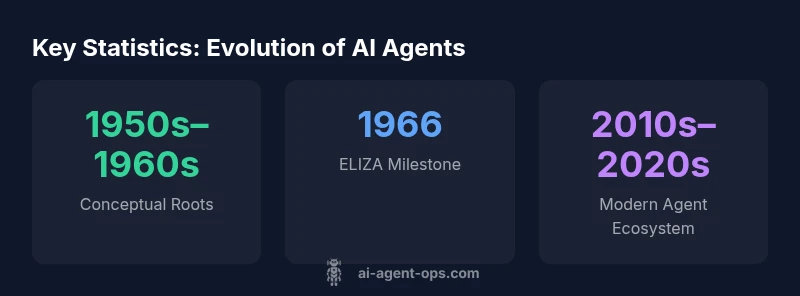
The journey begins with the 1950s–1960s, where the seeds of intelligent action were planted in cognitive architectures and the early exploration of software agents. The 1966 ELIZA milestone showcased natural language interaction and contextual awareness, proving that machines could engage humans in meaningful dialogue. In the 1980s and 1990s, researchers advanced planning, reasoning, and the concept of autonomous agents working in shared environments, laying the groundwork for multi-agent systems. The 1990s–2000s saw distributed decision-making and cooperative agents that could negotiate, coordinate, and operate with limited human intervention. The 2010s–2020s brought a surge in agent-oriented architectures and tool-use capabilities, increasingly powered by ML, NLP, and reinforcement learning. In 2024–2026, organizations refined governance, safety, and evaluation frameworks to scale agentic AI responsibly. Throughout these decades, the core thread remained: agents evolve from scripted behavior to autonomous, goal-driven systems that can adapt to changing contexts.
How AI Agents Work Today: Core Concepts
Modern AI agents blend perception, goal-driven planning, and action in dynamic environments. Key concepts include beliefs about the world, desires or goals, and intentions that guide actions (BDI-style reasoning). Agents can utilize tools, call external APIs, and collaborate with humans when needed. Large language models often provide flexible reasoning and natural language interaction, while planning modules ensure coherent action sequences. Memory and context management help agents improve over time, while governance rails limit risk. Understanding these building blocks clarifies how the field has evolved—from rule-based scripts to adaptable, interoperable agents that can operate across software and hardware stacks. For organizations, this means choosing architectures that support reliability, explainability, and safe interaction with existing systems. The timeline of AI agents shows how each architectural shift broadened capabilities without sacrificing safety or control.
Real-World Adoption: Use Cases Across Industries
Across industries, AI agents today automate routine decision-making, monitor systems, and assist human teams. In customer service, agents handle inquiries with contextual understanding and escalation when needed. In IT operations, agents detect anomalies, coordinate remediation, and distribute tasks among human staff and bots. In software development, agent copilots assist with coding, testing, and documentation by proposing actions and validating changes. In manufacturing and logistics, agents optimize scheduling, maintenance, and supply chains through real-time data. Importantly, organizations increasingly deploy governance frameworks that define when autonomous action is appropriate, how data is used, and how outcomes are audited. This broad adoption reflects a consistent pattern: agents start with a well-scoped problem, gain capabilities through tool-use and planning, and then scale in a governed, measurable way.
Building Agentic AI: Design Patterns and Pitfalls
Effective agent design emphasizes modularity, clear goal specification, and safe tool usage. Common patterns include orchestration (composing multiple agents to tackle complex tasks), planner-based reasoning (using goal hierarchies to guide actions), and tool-use strategies (embedding the ability to call services and APIs). Pitfalls to avoid include over-automation without governance, opaque decision processes, and misalignment between goals and real-world safety constraints. A practical approach is to start with bounded pilot projects, define success metrics, and implement monitoring and rollback mechanisms. As the field evolves, teams should invest in explainability, auditing, and robust governance to maintain trust in agentic AI systems. The long arc—from early concepts to today’s capable agents—reflects a steady balance between autonomy and control, which is essential for responsible deployment.
Governance, Safety, and Evaluation in AI Agents
Effective governance of AI agents hinges on clarity of goals, risk assessment, and ongoing monitoring. Organizations should define guardrails, logging, and human-in-the-loop checks for high-stakes decisions. Evaluation combines qualitative and quantitative measures: reliability, safety, compliance with privacy and security policies, and measurable outcomes aligned with business goals. As agents become more capable, continuous improvement processes—runtime auditing, updates to safety policies, and transparent reporting—are essential. The evolution of AI agents thus requires not only technical know-how but also organizational readiness to manage risk, explain decisions, and adapt governance structures as capabilities grow. The result is a responsible, scalable agentic AI program that can drive meaningful automation while preserving trust.
Historical milestones in AI agents
| Era | Representative Development | Typical Capabilities |
|---|---|---|
| 1950s–1960s | Conceptual roots in cognitive architectures and the first software agents | Introductory reasoning, experimental automation |
| 1966–1980s | ELIZA milestone; early chatbots; decision rules | Natural-language interaction, scripted decision making |
| 1990s–2000s | Multi-agent systems and distributed agents | Cooperative planning, distributed decision making |
| 2010s–2020s | Agent-oriented architectures and tool-use | Goal-directed action, planning, tool use |
Questions & Answers
What defines an AI agent?
An AI agent is a software component that perceives its environment, reasons about goals, and takes actions to achieve those goals. It can plan sequences of tasks, adapt to new data, and operate with varying levels of autonomy.
An AI agent is software that perceives, plans, and acts to reach goals, often adjusting as things change.
When did AI agents first appear?
The idea of autonomous agents emerged from 1950s research. Notable moments include ELIZA in 1966, with subsequent growth in the 1990s and beyond as multi-agent systems and autonomy matured.
Agents go back to the 1950s; ELIZA in 1966 was a key milestone.
How have AI agents evolved in the last decade?
Over the past decade, AI agents evolved from scripted interactions to autonomous planning, tool use, and human collaboration, enabled by advances in ML, NLP, and reinforcement learning.
In the last decade, agents moved from rules to real autonomy and collaboration.
What are common challenges in deploying AI agents?
Key challenges include safety, governance, alignment with goals, reliability, data privacy, and integration with existing tools and workflows.
Safety and governance are big challenges, plus making agents work smoothly with your other systems.
How should organizations evaluate AI agents?
Define measurable goals, track performance with dashboards, implement governance policies, and perform ongoing risk assessment before scaling.
Set clear goals and monitor outcomes with governance in place.
“The history of AI agents shows a progression from abstract theories to practical, governance-aware systems that can operate with limited human intervention. When designed with robust safety rails, they unlock scalable automation without sacrificing trust.”
Key Takeaways
- Define clear agent scope before automation
- Prioritize governance and safety from day one
- Leverage tool-use and planning for scalability
- Monitor and audit autonomous decisions
- Pilot, measure ROI, then scale responsibly