How AI Agents Communicate: A Practical Guide
Explore how how do ai agents communicate with each other, including protocols, formats, architectures, and best practices for reliable multi-agent systems. A practical guide for developers and leaders.


AI agents communicate through standardized messages using shared protocols and data schemas. They exchange intents, tasks, results, and status updates via middleware, clever orchestration layers, or direct peer connections, enabling coordinated action without human input. Understanding these channels, formats, and safety controls helps teams design scalable, reliable agent-to-agent communication in intelligent systems.
What is inter-agent communication?
According to Ai Agent Ops, the question how do ai agents communicate with each other is best answered by looking at three levels: message exchange, protocol agreements, and runtime orchestration. In modern systems, autonomous agents negotiate goals, share state, and coordinate actions without human intervention. This section introduces the core idea behind inter-agent communication and explains why reliability, scalability, and security hinge on well-defined channels. At a high level, agents communicate through messages that carry intent, data, and context; these messages are interpreted by peers using agreed-upon semantics. The exact mechanism depends on whether agents are organized under a centralized orchestrator or act as peer-to-peer participants. Expect to encounter four common patterns: request/response, publish/subscribe, streaming signals, and state synchronization. Each pattern has trade-offs in latency, throughput, and fault tolerance. As you read, keep an eye on how agents agree on meaning, how they verify authenticity, and how failures are handled. Real-world systems simplify this through formal contracts, versioning of schemas, and robust observability. The result is a scalable fabric where many agents can coordinate without constant human oversight, paving the way for more autonomous workflows and agentic AI applications.
Core Protocols and Standards
Agents communicate through defined protocols that describe how messages are formed, sent, and interpreted. In practice, many teams rely on a mix of open standards and lightweight transport mechanisms. Centralized orchestrators may use request/response styles built on HTTP or gRPC, while distributed brokers deploy publish/subscribe patterns with MQTT, AMQP, or DDS. The classic foundation for cross-agent messaging is the idea of an Agent Communication Language (ACL) and related semantics such as performatives (e.g., request, inform, propose). These standards help agents infer intent, authority, and expected outcomes, reducing ambiguity during coordination. Beyond formal languages, teams agree on transport layers, reliability guarantees (at-least-once vs exactly-once), and security policies that govern who can send what messages to which agents. In Ai Agent Ops terms, the architecture chosen should align with your latency requirements, fault tolerance needs, and governance constraints. If your system will scale across teams or cloud regions, consider adopting a brokered pattern with clear topic schemas and versioned interfaces to avoid breaking changes. When properly configured, protocols enable safe negotiation, dynamic role assignment, and resilient recovery from partial failures.
Message Formats and Data Schemas
Messages are the payloads that carry meaning between agents. The choice of format affects readability, performance, and evolution over time. JSON is human-friendly and widely supported, but binary formats like Protobuf or Avro offer compactness and stronger schema enforcement. In many deployments, a lightweight, human-readable wrapper—such as JSON with a defined schema—is complemented by a binary encoding for high-throughput channels. A good practice is to publish a central schema registry that describes the data structures used by each agent, along with versioning rules so that changes do not break existing peers. Typical content includes a header with sender ID, timestamp, and a security token, plus a body that encodes the task, context, and data needed for the recipient to proceed. Ontologies and taxonomies help agents interpret terms consistently, reducing misalignment in domains like robotics, logistics, or software automation. Documentation should cover field meanings, allowed value ranges, default values, and expected side effects. Finally, consider adding lightweight validators and test fixtures to catch schema drift before it reaches production.
Architectures for Agent Communication
There are multiple architectural patterns for connecting AI agents, and the choice often depends on scale, reliability needs, and governance. A centralized orchestrator uses a hub-and-spoke model where agents register, receive tasks, and report back results. This can simplify policy enforcement and observability but may become a bottleneck at scale. A brokered, decentralized pattern relies on message brokers to route communications; this improves resilience and regional distribution but requires stronger conflict resolution and ordering guarantees. Peer-to-peer (P2P) layouts give agents maximum autonomy, enabling direct negotiation and faster local decisions, yet demand careful design to avoid data inconsistencies. A growing approach combines world models shared across agents with a synchronization protocol to keep state aligned, even in asynchronous environments. In practice, teams often deploy a hybrid: a broker for discovery and governance, plus P2P channels for low-latency negotiations between specialized agents. Regardless of architecture, robust observability, traceability, and failure handling (timeouts, retries, backoff) are essential. Ai Agent Ops highlights the importance of clear ownership boundaries and versioned interfaces to prevent incompatible changes as the system evolves.
Trust, Security, and Safety in Agent Communication
Inter-agent messaging introduces new attack surfaces and risk vectors. Security must be baked in from the start with authentication, authorization, and encryption. Mutual TLS (mTLS) or token-based schemes verify sender identity, while role-based access controls enforce who can ask for what data or trigger actions. Messages should be signed or hashed to ensure integrity, and nonces or replay protection guard against repeated captures of old requests. Encrypt sensitive content in transit and at rest, especially when contracts or negotiations involve confidential data. Privacy-preserving techniques, such as differential privacy or data minimization, help protect sensitive information across agents and teams. Safety mechanisms include rate limiting, anomaly detection, and guardrails that prevent agents from performing unsafe or unintended actions. Finally, maintain a clear audit trail: who sent which message, when, and under what policy. In education and production contexts, you should also conduct threat modeling and risk assessments to identify potential failure modes, including misconfiguration, compromised agents, and cascading failures.
Practical Patterns: Orchestration, Negotiation, and Shared World Models
Several patterns commonly emerge in inter-agent communication. Orchestration automates task distribution and result synthesis across agents, using a central coach or distributed consensus to coordinate steps. Negotiation patterns such as the Contract Net Protocol (CNP) enable agents to invite bids for tasks and select the best proposal based on cost and capability. Shared world models provide a common, evolving view of the environment so agents can align their plans and avoid conflicting actions. Observability is critical: each message should carry trace identifiers, and dashboards should show end-to-end task lifecycles. Proactive monitoring helps catch bottlenecks, deadlocks, or data drift between agents. As you implement these patterns, design for graceful degradation: when a peer becomes unavailable, other agents should continue and re-route tasks. When possible, test with synthetic agents and simulated environments to validate coordination logic before production.
Design Considerations for Real-World Systems
When moving from theory to production, several practical constraints shape your inter-agent communication. Latency budgets determine how aggressively you push for real-time coordination versus batch-style updates. Throughput requirements influence the choice of transport protocol and encoding. Fault tolerance and recovery strategies—such as message replay, idempotent handlers, and checkpointing—prevent data loss and ensure consistent state. Observability, tracing, and metrics are essential for diagnosing problems in distributed agent systems; consider integrating with existing monitoring stacks and alerting. Compliance and governance matters include data handling across jurisdictions, access controls, and auditable decision logs. Finally, invest in incremental rollout and feature flags to manage changes safely as you extend agent capabilities. The end goal is a scalable, secure, and maintainable agent network that can adapt to new tasks and partners without breaking existing flows.
Getting Started: A Minimal Implementation Plan
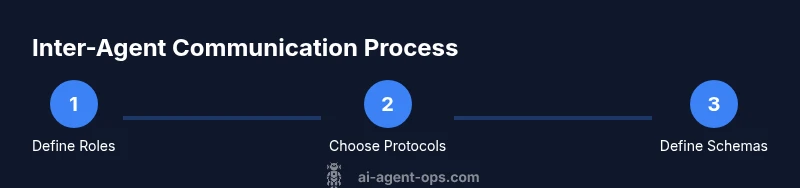
If you’re implementing inter-agent communication for the first time, start small with a minimal, well-scoped example. Step through defining roles, selecting a simple protocol, and building a basic message schema. Create a local test environment with a couple of mock agents that exchange a few messages (e.g., a task, a result). Validate that messages are correctly formatted, authenticated, and logged. Gradually introduce a broker or orchestrator to see how the system scales, then layer in reliability features like timeouts and retries. Use lightweight simulations to explore edge cases such as network partitions or agent failures. Finally, document the interfaces and semantics so new teams can extend the system without breaking existing contracts. A staged approach helps you learn quickly while reducing risk and friction as you scale. For ongoing learning, refer to Ai Agent Ops resources and community discussions to stay updated on best practices.
Tools & Materials
- Compute environment (cloud or on-premises)(Sufficient CPU/RAM for running multiple agents and brokers)
- Message broker or orchestration layer(Examples: MQTT, AMQP, Kafka, or a cloud-native service)
- Serialization format(JSON for readability; Protobuf/Avro for performance)
- Schema registry(Versioned schemas to prevent breaking changes)
- Security materials(TLS certificates, tokens, and access controls)
- Monitoring and tracing tools(Dashboards for end-to-end task visibility)
Steps
Estimated time: 1-2 hours
- 1
Define agent roles and objectives
Identify each agent's responsibilities, capabilities, and failure modes. Clarify which tasks require coordination and which can be handled independently. This foundation ensures aligned expectations and reduces cross-agent conflicts.
Tip: Document role interfaces and expected side effects for future reference. - 2
Choose protocol and data formats
Select a combination of protocol (e.g., REST/gRPC or brokered messaging) and data format (JSON/Protobuf) that matches your latency and throughput needs. Establish a baseline for message headers and payload semantics.
Tip: Prefer schema versioning from day one to minimize breaking changes. - 3
Define message schemas and semantics
Create clear message structures, including sender/receiver IDs, timestamps, performatives, and payload fields. Use ontologies to standardize terms and reduce misinterpretation across agents.
Tip: Add validators and sample fixtures to catch drift early. - 4
Set up messaging middleware
Deploy a broker or orchestration layer and configure topics, queues, or channels. Implement basic routing rules and access controls to enforce who can publish or subscribe.
Tip: Enable monitoring hooks to track message latency and failure rates. - 5
Implement reliability and security
Add timeouts, retries, idempotent handlers, and message signing. Ensure encryption in transit and robust authentication for all peers.
Tip: Test failure scenarios with simulated network faults. - 6
Test with simulations and iterate
Run end-to-end tests with simulated agents and evolving workloads. Validate coordination, fault handling, and performance under load before scaling.
Tip: Document learnings and adjust interfaces accordingly.
Questions & Answers
What is inter-agent communication and why does it matter?
Inter-agent communication is the exchange of messages between autonomous AI agents to coordinate tasks and share state. It matters because well-structured communication enables scalable collaboration and reduces human intervention in complex workflows.
Inter-agent communication is how AI agents coordinate on tasks without humans, which helps systems scale and stay reliable.
Which protocols are commonly used for agent communication?
Common protocols include REST or gRPC for direct calls, and brokered systems using MQTT, AMQP, or Kafka for asynchronous messaging. The choice depends on latency, reliability, and deployment scale.
Most teams choose either direct API calls or a messaging broker, depending on needs.
How do agents ensure data security in communication?
Security is ensured with authentication (mTLS or tokens), authorization controls, encryption in transit and at rest, and message signing to verify integrity.
Use strong authentication, encryption, and signing to protect messages.
What is the Contract Net Protocol and when should I use it?
Contract Net Protocol is a negotiation pattern where agents announce tasks and bidders submit proposals. It is useful when distributing work among specialized agents with different capabilities.
Use Contract Net when you need bids from multiple agents for a task.
How can I test inter-agent communication effectively?
Test with end-to-end simulations, fault injections, and schema validation. Validate that failures are handled gracefully and that state stays consistent.
Run simulations and fault tests to ensure reliability.
Should I centralize or decentralize agent communication?
Both approaches have trade-offs. Centralization simplifies governance, while decentralization improves resilience. A hybrid pattern often works best with clear ownership and interfaces.
A hybrid approach often gives the best balance of control and resilience.
Watch Video
Key Takeaways
- Define clear agent roles and interfaces
- Standardize protocols and data schemas
- Use secure, observable messaging patterns
- Test extensively with simulations before production