How AI Agents Talk to Each Other: A Practical Guide
Discover how ai agents talk to each other through shared protocols, ontologies, and orchestration patterns. Learn message formats, negotiation, governance, and scalable architectures for safe, reliable agentic AI workflows.


How AI agents talk to each other hinges on shared communication protocols, ontologies, and coordinated patterns. This guide explains message formats, negotiation, and governance, plus practical architectures for centralized and decentralized systems. By aligning agents on semantics and timing, teams achieve faster integration and safer automation.
How the basic model works
How ai agents talk to each other starts with a shared mental model: agents publish and subscribe to messages that encode intents, predicates, and actions. At the heart is a standard language for describing what an agent wants, what it can do, and what it expects in return. According to Ai Agent Ops, the core requirement is semantic interoperability: agents must parse others' messages the same way, regardless of vendor or implementation. This allows complex workflows where many microagents cooperate to complete a single business objective. In practice, teams begin by defining a minimal viable vocabulary—things like "request", "offer", "commit", "update"—then expand as needs grow. A robust design also separates content from transport: the message payload carries the meaning, while a protocol handles delivery guarantees, retries, and ordering. For developers, the first wins are clear schemas, versioned contracts, and explicit failure modes. When teams nail these basics, the rest of the conversation—negotiation, coordination, and escalation—becomes a predictable pattern rather than a guessing game. The goal is to reduce ambiguity so agents can act autonomously without constant human mediation. This is also where the two essential questions arise: what should be communicated, and when should it be communicated to avoid chatter and contention. how ai agents talk to each other becomes a practical exercise in design discipline, not a magic trick.
How the basic model works in practice
A reliable inter-agent chat starts with a formal contract for messages. Imagine a triad: a requester, a responder, and a watchdog. The requester emits a structured "request" with a defined schema, the responder returns an "offer" or a "refusal" with a clear reason, and the watchdog can veto unsafe outcomes. These patterns scale: hundreds of agents can coordinate if each message adheres to the same format and timing rules. The emphasis on timing is not accidental; latency and ordering determine whether a plan succeeds or fails. Teams often implement a lightweight catalog of intents and a versioning strategy so newer agents can still understand older messages. In addition, logging every step of the message flow creates an auditable trail that helps diagnose problems quickly. The Ai Agent Ops team has observed that a disciplined approach to semantics and contracts reduces integration time and improves predictability, especially in multi-vendor environments. As your system grows, you can layer governance and policy enforcement on top of these basics to maintain safety without stifling autonomy.
How the basic model works in practice for multi-agent systems
Ultimately, the success of how ai agents talk to each other rests on a shared mental model and disciplined execution. By starting with a minimal, versioned vocabulary and clear governance, you create an ecosystem where autonomous agents can collaborate. The AI teams that invest early in semantic alignment and traceable decision logs see faster debugging and safer orchestration as the network scales. The result is not a single monolith but a chorus of agents that communicate with precision, reducing duplication and conflict across the workflow.
Tools & Materials
- Message broker or event bus(Examples include MQTT, AMQP, or a REST/gRPC-based broker. Provides delivery guarantees and ordering.)
- Shared ontology and schema registry(Documents intents, entities, and actions; versioned contracts enable backward compatibility.)
- Identity, authentication, and authorization(Strong service-to-service auth; mTLS or OAuth2 for secure exchanges.)
- Observability stack(Structured logs, distributed traces, and metrics to monitor message flows and latencies.)
- Testing harness for simulations(Replay message sequences and validate agent responses under load.)
- Policy engine / guardrails(Optional but recommended for runtime safety and compliance checks.)
Steps
Estimated time: 8-12 hours (initial setup for a small team; scale as needed)
- 1
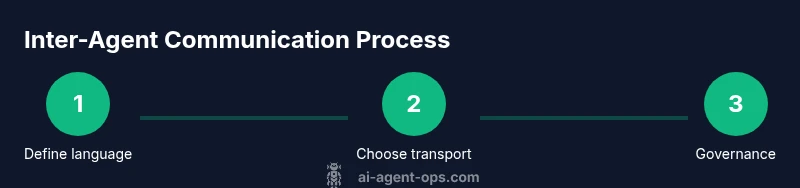
Define the shared language
Create a minimal, versioned vocabulary for intents, actions, and events. Document required fields, optional contexts, and failure modes. Validate the vocabulary with sample interactions to ensure every agent parses messages identically.
Tip: Start with a small, stable set of intents and expand via backward-compatible changes. - 2
Choose formats and transports
Select message formats (e.g., JSON or protobuf) and a transport layer (e.g., MQTT for pub/sub or HTTP/gRPC for direct calls). Ensure delivery guarantees and ordering align with your latency requirements.
Tip: Prefer schema-first design so producers and consumers share a contract. - 3
Establish negotiation rules
Define how agents negotiate tasks, handle partial failures, and resolve conflicts. Include clear timeouts, retries, and escalation paths.
Tip: Document default behaviors for unresolved negotiations to avoid deadlock. - 4
Implement governance and safety
Introduce policy checks, access controls, and logging. Ensure all communications are auditable and compliant with privacy requirements.
Tip: Keep guardrails lightweight at first and grow coverage iteratively. - 5
Set up orchestration architecture
Choose between centralized brokers, decentralized peers, or a hybrid. Align routing, load-balancing, and failure handling with your reliability goals.
Tip: Prototype with a small subset of agents before full-scale rollout. - 6
Validate with realistic simulations
Run end-to-end scenarios that mimic real workloads. Track latency, error rates, and policy hits to refine contracts.
Tip: Automate test scenarios to catch drift as you evolve schemas. - 7
Operate and monitor in production
Monitor message latency, throughput, and policy compliance. Use traces to diagnose cross-agent interactions and bottlenecks.
Tip: Set alert thresholds based on baseline measurements to avoid alert fatigue. - 8
Iterate and evolve safely
Regularly review schemas, update governance, and retire deprecated intents with a clear migration plan.
Tip: Maintain a changelog and publish migration guides for teams.
Questions & Answers
What is inter-agent communication in AI?
Inter-agent communication is the exchange of messages between autonomous AI agents to coordinate tasks, share state, and negotiate actions. It relies on a shared language, defined semantics, and reliable transport channels.
Inter-agent communication means AI agents exchange messages to coordinate tasks and share state using a common language.
Which message formats work best for agent communication?
Structured formats like JSON or protobuf with versioned schemas work best. They enable clear parsing, validation, and backward compatibility across different agents.
Structured formats like JSON or protobuf are usually best for agent communication.
How do you ensure safety in agent conversations?
Implement guardrails, policy engines, and robust auditing. Enforce authentication and authorization, and log decisions to support accountability and compliance.
Safety comes from guardrails, policies, and good logging so you can audit agent decisions.
What’s the difference between centralized and decentralized orchestration?
Centralized orchestration provides a single point of control and easier monitoring, while decentralized systems improve fault tolerance and scalability. A hybrid approach can balance control with resilience.
Centralized gives control; decentralized offers resilience. A hybrid often works best.
How should I handle errors in messaging?
Define clear timeouts, retries, and escalation paths. Use idempotent message handling and maintain an audit trail to diagnose issues.
Set timeouts and retries, and keep a clear audit trail for debugging.
Do I need to build everything from scratch?
Not necessarily. Start with existing frameworks and adapt a contract-first approach. Incrementally add custom logic as you validate the platform.
You can start with existing frameworks and adapt them gradually.
Watch Video
Key Takeaways
- Define a common, versioned messaging contract.
- Choose transport and schema first, then add governance.
- Design for both synchronous and asynchronous communication.
- Guardrail policies enable safe agent orchestration.
- Iterate with simulations and gradual rollout.