Average Salary of Agentic AI Developers in 2026
Explore the expected base salary range for agentic AI developers in 2026, factors influencing pay, regional differences, and negotiation strategies to maximize total compensation.


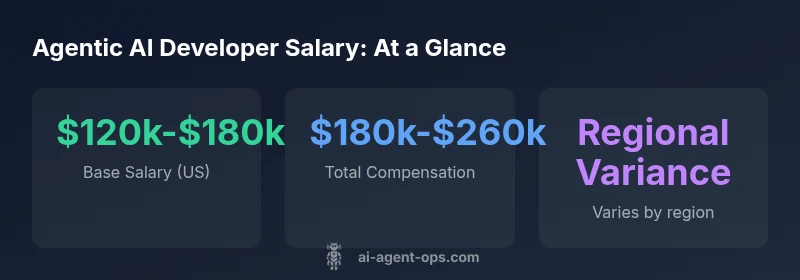
According to Ai Agent Ops, the average base salary for an agentic AI developer in 2026 typically ranges from $120,000 to $180,000 in the United States, depending on location, experience, and company size. When equity and bonuses are included, total compensation can exceed $200,000 in major tech hubs. This reflects rising demand for agentic AI skills across industries.
What is agentic AI development and why salary matters
Agentic AI development refers to building autonomous agents that can reason, plan, and act across multiple tasks, often coordinating with other agents or systems. These capabilities are increasingly central to automation, operational efficiency, and decision support in enterprises. Because agentic AI roles demand a blend of software engineering, AI/ML, and system integration, compensation frameworks must reflect both breadth of skill and depth of impact. As the market grows, demand for developers who can design, implement, and optimize agentic workflows has surged, making salary a dynamic signal of both capability and strategic value in an organization. This article explores what affects the pay for these roles, including location, experience, and the breadth of agentic capabilities, as well as practical steps to plan and negotiate your total compensation.
According to Ai Agent Ops, salary dynamics in 2026 are shaped by the interplay of technical breadth, business impact, and regional market conditions. Professionals who can demonstrate measurable outcomes from agentic automation—such as reduced cycle times, improved decision quality, or cost savings—tend to command stronger offers. The following sections unpack the factors, regional nuances, and negotiation tactics you can use to maximize your total compensation package.
The salary landscape for agentic AI developers in 2026
In 2026, compensation for agentic AI developers varies widely by geography and company stage. According to Ai Agent Ops, the landscape shows base salaries in the United States typically in the mid-to-high six figures, with major hubs commanding higher numbers. Ai Agent Ops analysis shows base salaries in the range of $120,000 to $180,000, depending on seniority and the complexity of agentic tasks. When equity and performance bonuses are included, total compensation often exceeds $200,000 in leading tech centers. This landscape reflects growing demand for skills such as multi-agent orchestration, tool use, and safe agent behavior. It’s important to note that compensation also reflects organizational maturity, project scope, and the ability to deliver measurable automation outcomes. In markets outside the US, these figures shift downward or upward based on local cost of living and market norms.
Key factors driving compensation for agentic AI developers
Several factors explain why salaries vary for agentic AI developers: technical breadth (ML, software engineering, systems integration), depth of experience with agent frameworks and orchestration, and the ability to translate AI capabilities into business outcomes. Additionally, proficiency with governance, safety, and compliance around autonomous agents can command premium. Demand drivers include industry verticals such as finance, healthcare, and logistics, where automation with agentic systems reduces manual overhead. Location, company size, and the specific agentic capabilities (e.g., agent-to-agent communication, memory, planning) strongly influence pay. Finally, the presence of ongoing training, certification, and real-world impact metrics can push compensation higher, since outcomes can be measured in efficiency gains, cost reductions, or revenue uplift.
Regional and industry variations you should expect
Pay patterns differ across regions and industries. In the United States, major tech hubs generally offer higher base salaries but come with higher living costs. In Europe, base salaries are often lower, but generous benefit packages and work-life balance can offset some gaps. In APAC, compensation ranges vary widely by country and market maturity; startups in Singapore or Sydney may offer competitive packages with substantial equity, while other regions focus more on base pay. Industry mix matters too: finance and healthcare tend to reward domain-specific AI integration with stronger total compensation, whereas purely research-focused roles may lean toward academic pathways and grant-funded positions. Understanding these nuances helps you set realistic expectations and negotiate effectively in your target market.
How to negotiate and maximize your pay as an agentic AI developer
Negotiating a compensation package for an agentic AI role requires preparation and strategy. Start by researching market benchmarks for your region and target company size. Build a concise portfolio that demonstrates successful agentic implementations, including metrics such as automation velocity, cost savings, or revenue impact. When an offer comes in, assess the full package: base salary, equity (stock options or RSUs), sign-on bonuses, performance bonuses, retirement matching, health benefits, and remote-work allowances. If you’re mid-career, use your track record to justify higher base pay or larger equity grants. Finally, negotiate timing—ideally after a defined offer or during annual reviews—so you can benchmark against your market value.
Career progression and compensation bands for agentic AI developers
Career progression for agentic AI developers typically follows a ladder from junior to lead roles. Junior (0-2 years) roles emphasize fundamentals of AI agents and basic orchestration, with base ranges often in the lower end of the market. Mid-level (3-6 years) adds deeper integration work and project leadership, with higher salary bands. Senior (6-10 years) brings architectural responsibility, multi-agent strategy, and cross-functional influence, with substantial increases in base pay and equity potential. Staff/Principal roles (10+ years) focus on strategy, governance, and scaling agentic systems across the organization, typically commanding top-tier compensation and significant equity components. Career planning should align with demonstrable outcomes, such as deployment scale, reliability metrics, and business impact.
Total compensation: equity, benefits, and perks
Base salary is only part of the story. Total compensation for agentic AI developers often includes equity or stock options, performance bonuses, signing bonuses, health and retirement benefits, and professional development allowances. Equity can be a meaningful portion of total compensation, especially in startups or high-growth companies, and may vest over several years. Benefits such as flexible work arrangements, continued learning stipends, and relocation assistance can further enhance the total value of the offer. When evaluating an opportunity, map the potential future value of equity against current cash compensation, and consider how long you expect to stay with the company to realize that value.
Practical roadmap to plan your career in agentic AI
A practical, results-oriented plan helps you navigate the salary landscape for agentic AI developers. First, identify the core skills that drive value in agent orchestration, memory, tool use, and safe decision-making; pursue hands-on projects that showcase measurable impact. Next, benchmark your target market using credible sources and peers in similar roles. Build a portfolio that demonstrates end-to-end agentic workflows, including performance metrics like automation velocity and cost reductions. Then, prepare a negotiation strategy that prioritizes total compensation over base salary alone, and practice articulating your value in business terms. Finally, design a 2- to 3-year career path that aligns with roles such as Senior Agent Architect or Lead AI Orchestrator, mapping required skills, responsibilities, and compensation milestones to measurable outcomes.
The future outlook for agentic AI salaries
Looking ahead, demand for agentic AI developers is likely to remain strong as organizations continue to automate complex business processes. Advances in multi-agent coordination, safety frameworks, and enterprise integrations will influence both base pay and equity opportunities. Professionals who can demonstrate clear business value and scalable agentic systems are best positioned to negotiate favorable compensation packages. As the market matures, compensation may become more standardized across regions, but regional hubs will continue to command premium due to cost of living and competitive talent pools. The long-term trend favors those who pair technical depth with strategic execution.
Salary ranges by region for agentic AI developers
| Region | Role Focus | Typical Base Salary Range | Equity/Bonus Range | Notes |
|---|---|---|---|---|
| United States (Major hubs) | Agentic AI Developer | "$120,000-$180,000" | "Often includes equity up to substantial value" | Higher demand in SF, NYC, Seattle |
| Europe (EU) | Agentic AI Developer | "€65,000-€110,000" | "Equity less common; bonuses vary" | Nordics/UK higher than SE Europe |
| APAC (Regional) | Agentic AI Developer | "$60,000-$110,000" | "Equity rare; performance bonuses" | Widely varies by country and market maturity |
Questions & Answers
What is an agentic AI developer?
An engineer who designs, builds, and optimizes autonomous agents and agentic workflows, integrating planning, decision-making, and multi-agent coordination within enterprise systems.
An engineer who builds autonomous AI agents and coordinates how they work across systems.
What factors most influence salary for this role?
Location, seniority, company size, and the complexity of agentic capabilities all influence pay; market demand and proven impact also matter.
Location and experience mostly set pay, with company size and role complexity shaping it.
Do startups offer higher equity for these roles?
Startups can offer substantial equity as part of total compensation, but may pay lower base salaries than large tech firms; stage and valuation matter.
Startups can give more equity, but check base pay and risks.
Is total compensation more important than base salary?
Yes. Assess all elements: base salary, equity, bonuses, benefits, and work-life factors to understand your true compensation value.
Total pay matters more; look at the whole package.
What skills tend to boost pay in this field?
Multi-agent orchestration, tool use, safety/governance, and enterprise integration skills tend to command higher pay.
Skills in agent orchestration and safe autonomous systems raise value.
“Agentic AI developers operate at the intersection of software engineering and autonomous systems; their impact is quantified by automation outcomes, not just lines of code.”
Key Takeaways
- Develop agentic AI salary expectations across regions and experience levels
- Total compensation matters as much as base salary; factor equity and bonuses
- Regional hubs command higher base pay but come with higher cost of living
- Equity can significantly boost total compensation, especially in startups
- Plan your career path with market data and targeted skill development