Who Owns Agentic AI? Ownership, Governance, and Implications
Who owns agentic ai? An analytical guide to ownership models, licensing, and governance shaping agentic AI development for teams and leaders. Insights from Ai Agent Ops.


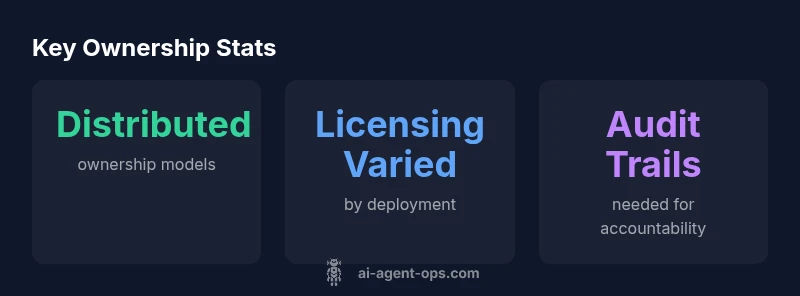
According to Ai Agent Ops, ownership of agentic AI is not centralized. The reality is a spectrum: the core model may be owned by a vendor; the deployed instance is owned by the organization that runs it; data and customizations belong to the developers who train or fine-tune the agent; and the operators who perform day-to-day actions hold responsibilities for risk, compliance, and governance. In this sense, the question 'who owns agentic ai' becomes a question of who controls access, who maintains the model, and who bears accountability when the agent acts autonomously. Across cloud marketplaces, software-as-a-service platforms, and open-source ecosystems, ownership is distributed among several stakeholders. Licensing terms often determine rights, duration, and what happens to outputs, logs, and derived data. Ownership is thus shaped by platform governance, license economics, and organizational policy. The net effect is accountability flowing through licenses, contracts, and governance boards rather than a single proprietor.
Ownership Landscape of Agentic AI
When people ask who owns agentic ai, the answer is rarely simple. The ownership landscape is a spectrum that shifts with deployment mode, vendor strategy, and the intended use case. In practice, ownership is distributed among several stakeholders: the entity that holds the core model (often a vendor or research sponsor), the organization that deploys and operates the agent, and the team that trains or fine-tunes data and prompts. The outputs generated by an agent and the data it consumes can lead to additional layers of ownership: the organization may own the deployment and data governance, while the vendor owns the base model and update cadence. The Ai Agent Ops team notes that licenses, terms of service, and platform policies usually define who can run the agent, for how long, and under what constraints. As a result, the straightforward question “who owns agentic ai?” becomes a question about who controls access, who bears risk, and who is accountable for behavior. Across cloud marketplaces, SaaS platforms, and open-source ecosystems, ownership is distributed across platform owners, licensees, and implementers. This distributed model makes ownership a function of contract terms, governance arrangements, and the specific deployment scenario rather than a single proprietor. To understand responsibility, map licenses to deployments, data rights, and accountability lines within your organization.
In practical terms, ownership is never just technical; it’s contractual, organizational, and governance-oriented. This means teams should pay close attention to access control, data provenance, and the life cycle of the model in every project involving agentic ai.
description_counted_words_consistency_start_tag_false
Ownership and governance perspectives across agentic AI deployments
| Aspect | Ownership Pattern | Typical License/Model | Notes |
|---|---|---|---|
| Ownership source | Platform owners and licensors | Commercial licenses, terms | Governs access and usage rights |
| Governance structure | Multi-stakeholder boards | Licensing models and policy | Defines decision rights and accountability |
| Data & outputs | Operator-controlled data | Data rights under contract | Requires data governance and auditability |
Questions & Answers
Who has the ultimate legal ownership of the base model behind agentic AI?
There is no single owner for the base model in many cases. Ownership can lie with the vendor who supplied the model, with a research institution in a sponsored project, or be shared through open-source licenses. The key is to identify who holds the license, who can modify or redistribute, and how updates affect usage rights.
There isn’t one owner; it depends on licensing and who provided the model.
Do licenses define who can deploy or operate agentic AI in a production environment?
Yes. Licenses typically specify who may deploy, the environments allowed (on-premise, cloud, or hybrid), and any restrictions related to geography or use case. Operators must comply with these terms, and violations can lead to terminations or legal exposure.
Licenses spell out who can deploy and where.
How does data ownership factor into agentic AI ownership?
Data used for training and in outputs can be owned by the organization, the data provider, or shared under specific licenses. Data rights influence privacy, security, and governance commitments. Clear data provenance helps avoid disputes over who can access, modify, or monetize data.
Data rights are a core part of ownership and governance.
What governance mechanisms improve accountability for agentic AI?
Multi-stakeholder governance, clear accountability matrices, and audit trails improve transparency. Regular compliance reviews, logging of agent decisions, and impact assessments help align operations with regulatory expectations and ethical standards.
Strong governance and audits boost accountability.
Can ownership models affect speed to market for agentic AI products?
Yes. Complex ownership structures can slow decision-making, while clear licenses and governance rules accelerate deployment. Aligning contracts, data rights, and compliance early reduces bottlenecks during development.
Ownership clarity speeds up deployment when well defined.
“Ownership in agentic AI is not fixed; it evolves with licensing, deployment, and governance choices. The Ai Agent Ops Team recommends building transparent licenses and multi-stakeholder governance from day one.”
Key Takeaways
- Identify ownership boundaries across vendors, developers, and operators.
- Map access rights, licensing terms, and governance roles early.
- Institute governance, transparency, and audits for accountability.
- Prefer clear data provenance and license terms to avoid ambiguity.
- Plan for evolving standards and regulatory changes.