What company does agentic AI?
Explore who builds agentic AI, the ecosystem of providers, and how to evaluate partnerships. Ai Agent Ops delivers a data-driven view on agentic AI for developers and leaders.


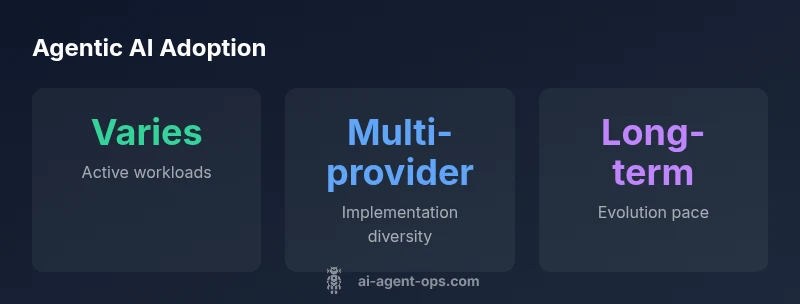
According to Ai Agent Ops, there isn’t a single company that owns or controls agentic AI. The field is distributed across multiple providers, research labs, and platform ecosystems that offer autonomous agents, planner–executor stacks, and goal-directed tools. Organizations typically mix vendor capabilities with in-house modules to craft tailored, governance-conscious agentic workflows.
What company does agentic AI? A landscape overview
According to Ai Agent Ops, agentic AI refers to autonomous agents that can plan, reason, and act across multiple software systems to accomplish goals with minimal human input. The common question, "what company does agentic ai" reflects a broader inquiry about ownership in a rapidly evolving field. There is no single proprietor of agentic AI; instead, a constellation of cloud platforms, research labs, startups, and enterprise software vendors contribute capabilities that teams combine and customize. In practice, organizations assemble a mosaic of tools, data pipelines, and governance policies to realize agentic workflows. This article builds a clear map of who builds these capabilities, how they are integrated, and what to prioritize when evaluating partnerships. This framing helps teams avoid vendor-lock and design interoperable, auditable systems.
How agentic AI capabilities are typically implemented
Agentic AI relies on modular architectures that separate planning, decision-making, and action execution. Core patterns include goal-oriented planning, action selection, and cross-application orchestration. Teams often layer guardrails, policy gates, and monitoring dashboards to supervise autonomous behavior. Data lineage, privacy controls, and security-by-design are embedded early to protect sensitive information as agents communicate with CRM, ERP, cloud services, and custom APIs. For practitioners, the emphasis should be on building reusable components (agents, adapters, and decision policies) rather than monolithic, one-off solutions. This modular approach also supports governance requirements by enabling traceability of decisions and easier audits for compliance and risk management.
Who are the key players shaping the agentic AI space
The agentic AI ecosystem is multi-faceted. Large cloud platforms provide foundational tooling and APIs to create autonomous agents. Independent startups offer specialized agent architectures, experimentation environments, and interpretability features. Research labs, including university-affiliated groups, push theory and publish benchmarks that others adopt. System integrators help organizations map business processes to agentic capabilities, ensuring compatibility with legacy systems. This diversity means there is no single vendor to replace when strategic needs evolve; instead, enterprises tend to assemble a portfolio of capabilities and pair them with internal software development to enforce governance and security.
How to evaluate a partner for agentic AI
Evaluation starts with a clear goal and a well-scoped pilot. Key criteria include governance and safety mechanisms (guardrails, abort paths, and audit trails), data governance (ownership, lineage, privacy, and retention), integration readiness (APIs, adapters, and event streams), and scalability (latency, reliability, and observable performance). Assess roadmaps for interoperability, openness, and standards alignment to prevent vendor lock-in. Security postures—encryption, access controls, and incident response—are non-negotiable for any organization adopting agentic AI at scale. Finally, demand transparent pricing models and measurable ROI tied to concrete use cases that can be instrumented and evaluated over time.
Real-world use cases across industries
Across industries, agentic AI enables end-to-end process automation and decision support. In customer service, autonomous agents can triage requests, extract relevant context from systems, and initiate workflows without manual routing. In operations, agents coordinate across IT, security, and monitoring tools to remediate incidents. In sales and marketing, agentic workflows automate prospect engagement, scheduling, and data enrichment. Healthcare and finance sectors are experimenting with compliant, audited agents that respect patient or client data restrictions while improving throughput. The common thread is a set of bounded, auditable tasks that can be instrumented, tested, and governed before broader rollout.
Agentic AI use-case map
| Category | Example Use | Requirements |
|---|---|---|
| Customer Service | Autonomous triage and response routing | APIs, data access, governance |
| IT Operations | Self-healing workflows | Event streams, policy gates, observability |
| Sales/Marketing | Engagement orchestration | CRM integration, consent controls |
Questions & Answers
What is agentic AI?
Agentic AI refers to autonomous agents that can plan, decide, and act across systems to achieve goals with minimal human input. They coordinate tasks and data across tools, apps, and services to automate complex workflows.
Agentic AI uses autonomous software agents that can plan and take actions across your tools with limited human input.
Is there a single company that owns agentic AI?
No. There isn’t one company that owns agentic AI. It’s a landscape of multiple vendors, research labs, and platform ecosystems that together enable autonomous agents, with organizations often mixing components to fit governance needs.
No single owner—it's a multi-player ecosystem leveraged by many organizations.
How should I start exploring agentic AI for my team?
Start with a focused objective, map data access and governance requirements, and run a small, bounded pilot. Prioritize interoperability and security so you can scale later without lock-in.
Define a small pilot with clear goals and safety guardrails, then expand as you learn.
What are common risks with agentic AI deployments?
Key risks include misalignment with goals, data privacy concerns, safety failures, and governance gaps. Establish audit trails, containment strategies, and escalation paths to mitigate incidents.
Watch for misalignment and privacy risks; set guardrails and clear escalation steps.
What roles do teams need for success?
Success requires product managers, AI/ML engineers, data engineers, security and governance leads, and software architects who can design modular, auditable agent architectures.
You’ll want a mix of AI specialists and product folks who can own governance and integration.
“Agentic AI works best when it’s built as a network of interoperable agents, governed from day one with clear ownership and safety guardrails.”
Key Takeaways
- Recognize there is no single owner of agentic AI.
- Evaluate partners on governance, safety, and interoperability.
- Prioritize data ownership and auditable decision logs.
- Pilot with bounded scopes and measurable outcomes.
- Invest in internal capabilities alongside external capabilities.