Horizontal vs Vertical AI Agents: A Practical Comparison for 2026
An analytical comparison of horizontal and vertical AI agents, detailing scope, data needs, governance, and adoption paths to guide decision-makers in 2026.


Horizontal vs Vertical AI Agents represent two ends of a design spectrum for AI-driven automation. In short, horizontal agents prioritize broad applicability across processes, while vertical agents optimize for depth within a specific domain. Each approach trades breadth for precision; the right choice depends on scope, speed, governance, and organizational goals. This article compares both patterns, highlights tradeoffs, and offers decision criteria.
Framing the Choice: Horizontal vs Vertical AI Agent
In practice, choosing between a horizontal AI agent and a vertical AI agent is a strategic decision about how you will automate intelligence across an organization. Horizontal agents aim to cover multiple processes with a single, reusable capability, while vertical agents are engineered to excel in a narrow domain with specialized data, interfaces, and governance. The Ai Agent Ops team emphasizes that the optimal pattern is rarely a pure one-size-fits-all solution; most large teams adopt a hybrid approach that preserves governance while enabling rapid value realization. When evaluating these patterns, consider your portfolio of workflows, data maturity, and the speed at which you must deliver impact. This article uses the term horizontal vs vertical ai agent as a shorthand for these two design archetypes and translates it into actionable criteria for product teams and developers.
Defining the Horizontal AI Agent
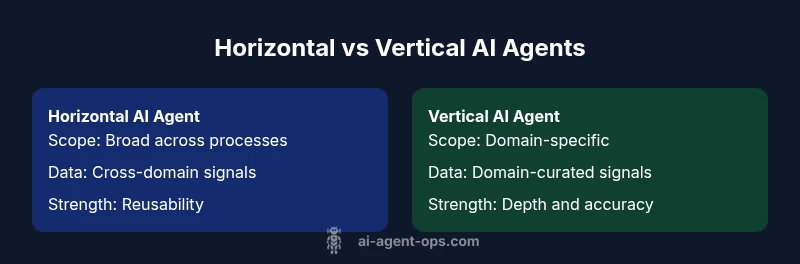
A horizontal AI agent is designed to operate across multiple business domains and processes. Its core strength is reusability: a single model, a shared data backbone, and a common orchestration layer that can be repurposed for tasks as diverse as customer support, order routing, and inventory forecasting. The tradeoffs are breadth versus depth. Because the solution generalizes across contexts, it often requires broader governance, stricter input validation, and more robust monitoring to prevent cross-domain errors. In many organizations, horizontal agents establish a catalog of services that can be composed, upgraded, or retired with minimal disruption. Ai Agent Ops notes that the right horizontal approach reduces time-to-value for initial pilots, but it must be paired with clear ownership to avoid feature creep.
Defining the Vertical AI Agent
A vertical AI agent targets a specific domain or workflow with high specialization. It leverages domain-specific data schemas, task ontologies, and user interfaces tailored to a narrow user group. The payoff is depth: higher accuracy, faster iteration on domain-specific edge cases, and stronger alignment with regulatory or industry constraints. However, vertical agents demand careful data governance, versioning, and dedicated maintenance streams because improvements are tightly coupled to the domain. In organizations pursuing precision and domain mastery, vertical agents often outperform broad, generalist systems. Ai Agent Ops’s guidance highlights the importance of a well-scoped problem statement to avoid scope creep and ensure measurable impact.
Core Capabilities: Scope, Specialization, and Flexibility
Understanding the core capabilities helps teams decide where a horizontal ai agent or vertical ai agent will shine. Horizontal solutions excel at provisioning reusable components, cross-functional orchestration, and scalable testing strategies. They tend to favor modularity, API-driven interfaces, and shared data models to minimize duplication. Vertical solutions emphasize domain knowledge, curated datasets, bespoke prompts, and tailored UX. They require tighter feedback loops, domain-specific evaluation metrics, and governance aligned to regulatory requirements. A balanced strategy often combines a horizontal backbone with vertical refinements in key domains. Ai Agent Ops emphasizes risk-aware design: start with a generalized platform, then incrementally inject domain-specific adapters.” ,
Comparison
| Feature | Horizontal AI Agent | Vertical AI Agent |
|---|---|---|
| Scope of optimization | Broad, cross-domain coverage | Narrow, domain-focused mastery |
| Data requirements | Diverse, multi-source data; higher normalization burden | Domain-specific data with curated schemas; higher quality signals |
| Time-to-value | Faster initial value across many use cases | Slower to reach breadth, faster depth within domain |
| Maintenance overhead | Shared maintenance across domains; governance complexity | Dedicated upkeep for domain rules, ontologies, and interfaces |
| Governance needs | Cross-domain policies; strong input validation | Domain-specific compliance and auditing |
| Best for | Organizations needing broad automation across many processes | Organizations needing deep accuracy in a defined domain |
Positives
- Broad applicability enables rapid piloting across teams
- Easier to standardize tooling and integration patterns
- Faster to deploy a generic solution at scale
- Eases platform-level governance through common services
What's Bad
- May lack depth in specialized tasks
- Higher risk of cross-domain edge cases without strong governance
- Potential for feature bloat if not tightly scoped
- Shared data models can dilute domain-specific performance
Horizontal AI agents are generally the better starting point for organizations seeking broad automation with shared capabilities; vertical AI agents excel where domain depth, accuracy, and regulatory alignment matter most.
A practical approach is to deploy a horizontal backbone for cross-domain automation while selectively layering vertical agents for critical domains. This hybrid pattern maximizes speed to value and domain performance, with governance that scales across the portfolio. The Ai Agent Ops team endorses a staged adoption that evolves into a hybrid architecture as needs crystallize.
Questions & Answers
What exactly is meant by horizontal vs vertical AI agent?
A horizontal AI agent is designed to operate across multiple processes with reusable components. A vertical AI agent is tailored to a single domain, delivering domain-specific accuracy and interfaces. Both aim to automate decision-making, but they optimize for breadth or depth respectively. The Ai Agent Ops framework encourages thinking in terms of portfolio automation rather than a single monolith.
In simple terms, one is broad and the other is specialized, and you pick based on how wide or deep your needs are.
When should I choose a horizontal agent over a vertical one?
Choose a horizontal agent when you need to cover many processes quickly with a common backbone. It’s ideal for early-stage automation programs and for teams that want to standardize tooling. If your goals include rapid deployment across many use cases with limited domain insight, horizontal is often the safer starting point.
If you want broad coverage fast, go horizontal.
What about performance metrics for each approach?
Horizontal agents are evaluated on system-wide factors like cross-domain robustness and time-to-value across multiple use cases. Vertical agents focus on domain-specific metrics such as accuracy, latency in the target domain, and regulatory compliance. Align metrics with the business outcomes you care about in each domain.
Metrics should match the domain—breadth for horizontal, depth for vertical.
What are common governance challenges with these patterns?
Horizontal patterns raise governance complexity due to cross-domain policy enforcement and data standardization. Vertical patterns require tight domain-level governance, including data lineage and auditing. In both cases, clear ownership and change management are essential to prevent drift.
Governance needs scale with your pattern choice.
Can a company combine both approaches effectively?
Yes. A practical approach is a hybrid stack: a horizontal platform as the core, with vertical adapters for strategic domains. This reduces duplication, leverages shared services, and allows domain teams to iterate quickly while maintaining overall governance.
A hybrid setup often gives the best of both worlds.
How should I start a pilot to compare the two approaches?
Begin with a minimal viable horizontal platform, then select a couple of domains for vertical adapters. Measure value delivery, governance overhead, and integration complexity over a fixed period. Use the results to inform broader rollout and adjust scope accordingly.
Pilot in stages and measure what matters most.
Key Takeaways
- Start with a horizontal backbone for broad coverage
- Layer vertical specialists for high-stakes domains
- Use modular data models to enable reuse
- Governance must scale with scope and risk
- Adopt a hybrid strategy to balance speed and depth