Difference Between AI Agent and App: A Practical Guide for Builders
An analytic comparison of AI agents and traditional apps, covering autonomy, architecture, use cases, and decision-making. Learn when to deploy each and how to design for governance.


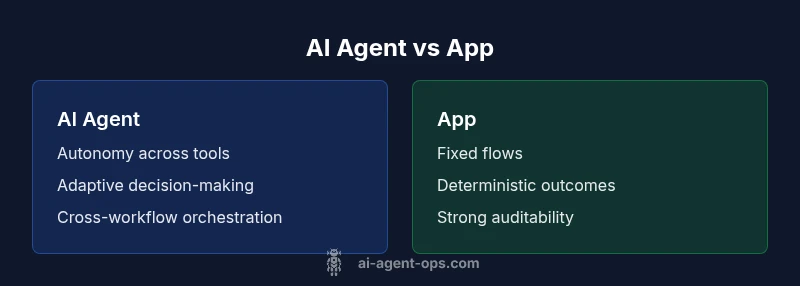
An AI agent is an autonomous decision-maker that can plan, choose actions across tools, and learn from feedback; a traditional app is a fixed software program with predefined logic and user-driven workflows. The difference matters for automation: agents adapt, while apps enforce static, rule-bound behavior. This guide explains the core distinctions and when to use each.
Understanding the difference between ai agent and app
In many modern automation discussions, teams talk about AI agents and traditional apps. The phrase difference between ai agent and app captures a fundamental shift in how software acts, learns, and participates in workflows. This section lays the groundwork by defining the terms and outlining what set them apart. An AI agent refers to a software component that can observe a state, plan a sequence of actions, select tools to execute those actions, and learn from outcomes. By contrast, an app is a fixed program designed to carry out pre-specified tasks under user or system prompts. The practical consequences of this distinction appear in how you design, deploy, and govern technology within a product or business process. As you evaluate options, consider how autonomy, adaptability, and orchestration influence risk, cost, and time to value. The difference between ai agent and app is not just a label; it signals different expectations for control, learning, and integration.
What is an AI agent?
AI agents are software entities capable of perceiving their environment, formulating goals, and acting to achieve those goals across multiple tools and services. They use reasoning, planning, and sometimes machine learning to decide which actions to take and in what order. A key characteristic is autonomy: the agent can initiate tasks, manage dependencies, and adjust plans based on feedback. In practice, AI agents operate within orchestration layers that connect data sources, APIs, and workflows, often requiring governance to prevent unintended actions. The core promise is increasing speed and adaptability, especially in complex, multi-step processes where static software would struggle to keep up. This is the essence of the difference between ai agent and app: agents think and act across tools, not just execute a single, prewritten path.
What is a traditional app?
A traditional application is a well-defined software artifact designed to perform a fixed set of tasks under specified conditions. Apps rely on static logic, deterministic flows, and explicit user interactions. They excel at reliability, predictability, and clear ownership, but they lack the built-in capacity to adapt without explicit engineering changes. In the context of the difference between ai agent and app, standard apps serve as strong building blocks for operational workflows, customer interfaces, or data processing tasks. They are typically easier to audit and model for compliance, but they require developers to predefine every path the software might take, which can slow response to evolving needs.
Autonomy and decision-making
Autonomy is the most visible axis of the difference between ai agent and app. AI agents can generate goals, choose between multiple actions, and adjust their trajectory based on outcomes. They use decision-making heuristics, probabilistic reasoning, and sometimes reinforcement learning to improve over time. Apps, in contrast, operate within pre-programmed decision trees or rule sets. They execute actions faithfully but cannot readily create new strategies without human input. For organizations, autonomous agents can compress cycle times and reduce manual decision points, whereas apps preserve control and auditability, ensuring predictable outcomes.
Architecture and data flows
The underlying architecture of an AI agent typically includes perception modules, a planner, a set of capabilities (tools), and a feedback loop that informs learning or policy updates. Data flows are dynamic, with real-time state, decisions, actions, and outcomes streaming through orchestration layers. Traditional apps, by comparison, rely on stable data inputs, predictable state machines, and clear API boundaries. Data governance is often more straightforward for apps due to the fixed behavior. When evaluating the difference between ai agent and app on architecture, consider how data provenance, latency, and fault tolerance will be managed as agents interact with multiple external systems.
Use cases: when to choose AI agent vs app
AI agents shine in scenarios requiring cross-tool coordination, adaptive decision-making, and end-to-end automation. They are well-suited for complex workflows like incident response, procurement orchestration, or customer support that must navigate multiple systems. Traditional apps excel in well-defined tasks with minimal variability, such as data entry, form processing, or report generation. The choice depends on whether your priority is adaptability and speed to value (agent) or reliability and explicit control (app). In practice, teams often combine both, using agents to orchestrate multiple apps and services while feeding them with stable inputs and guardrails.
Interaction models and orchestration
Interacting with an AI agent typically involves prompts, goals, and tool calls, often orchestrated by a central middleware layer. Agents may negotiate tool usage, sequence tasks, and handle retries automatically. Apps usually expose APIs or user interfaces for deterministic workflows, with limited self-modification capabilities. The difference between ai agent and app becomes apparent in orchestration: agents offer dynamic routing and decision-making across services, while apps provide modular, composable functionality with explicit boundaries. Designing effective interactions requires clear responsibilities, fallback plans, and monitoring to catch misbehavior early.
Performance, reliability, and monitoring
Performance metrics shift when dealing with AI agents. Beyond latency and throughput, you measure decision quality, action success rates, and policy adherence. Reliability concerns include handling unexpected tool responses and maintaining safe operation under uncertainty. Apps emphasize uptime, predictable responses, and strong error handling for well-defined paths. When evaluating the difference between ai agent and app, teams must align SLAs with the agent’s probabilistic nature and implement robust monitoring dashboards, audit logs, and fail-safe mechanisms to preserve system integrity. Governance overlays are often more critical for agents due to their higher degree of autonomy.
Development and deployment considerations
Building with AI agents requires data pipelines, tool inventories, guardrails, and continuous learning loops. You’ll design planners, action catalogs, and feedback signals to shape behavior. Apps demand careful scoping, versioning, and release management within established CI/CD pipelines. The difference between ai agent and app influences development velocity, risk management, and the cadence of improvements. A practical approach is to start with a constrained agent using a narrow goal, then expand capabilities as you gain confidence in safety, observability, and governance.
Security, governance, and safety
Security considerations for AI agents include access control across tools, monitoring for misbehavior, and ensuring data privacy in multi-system workflows. Governance models require transparent decision logs, explainability of actions, and auditable policies. Apps typically offer clearer traceability due to fixed logic, but they can still suffer from insecure integrations or data leakage through poorly guarded APIs. The difference between ai agent and app is amplified by risk management: agents demand stronger policy enforcement, runtime safeguards, and risk-based access controls to prevent undesirable outcomes.
Economic and licensing considerations
From a cost perspective, AI agents may incur ongoing compute, tool subscriptions, and training or fine-tuning expenses, alongside potential savings from reduced manual toil. Apps usually have upfront development costs and ongoing maintenance, with licensing tied to runtime usage or feature tiers. The difference between ai agent and app extends to total cost of ownership and value realization: agents can unlock higher throughput but require investment in governance and monitoring, while apps offer predictable costs and simpler budgeting when requirements are stable.
Migration and integration paths
Adopting AI agents often entails an integration strategy that includes selecting compatible toolsets, designing safe interaction patterns, and deploying an orchestration layer. For existing apps, migration might involve wrapping legacy functionality with agent-native interfaces or gradually introducing agents to coordinate multiple systems. The difference between ai agent and app becomes a decision about how much re-architecture is needed to achieve desired automation and what risk you’re willing to absorb during transition.
The future landscape: agentic AI and beyond
The ongoing evolution of agentic AI points to tighter integration between agents and enterprise ecosystems, with shared knowledge bases and more robust collaboration between humans and machines. The difference between ai agent and app will blur as platforms standardize agent capabilities, governance, and safety. Leaders should monitor emerging patterns for orchestration, compliance, and ethical considerations, ensuring that automation remains transparent, auditable, and aligned with business goals.
Practical decision framework
To decide between an AI agent and an app, map your goals, data flows, and risk tolerance. Start with a narrow agent that handles a specific, high-value coordination task; measure decision quality and governance outcomes; then either expand the agent’s scope or shift toward a more traditional app for stable processes. Always plan for monitoring, rollback options, and governance reviews. The practical framework helps teams balance innovation with reliability when navigating the difference between ai agent and app.
Comparison
| Feature | AI Agent | App |
|---|---|---|
| Autonomy | high autonomy and planning across tools | low autonomy; fixed flows |
| Learning capability | adaptive learning; feedback loops | static behavior; no learning unless updated by developers |
| Decision-making scope | broad, cross-tool decisions | narrow, task-specific decisions |
| Orchestration capacity | strong cross-service orchestration | limited to defined modules or services |
| Interfaces | prompts, APIs, events; dynamic tool usage | UI-first or API-driven; predefined paths |
| Deployment model | agent platforms and orchestration layers | standalone apps or microservices |
| Typical use cases | complex, multi-step automation and workflows | repeatable, well-defined tasks |
| Monitoring & metrics | decision quality, tool usage, latency | uptime, response time, feature completeness |
| Security & governance | policy enforcement, audit trails for actions | clear boundaries; easier access control |
Positives
- Higher automation potential with adaptive behavior
- Better orchestration across tools and services
- Faster incident handling via autonomous decision-making
- Supports continuous improvement through feedback
- Can reduce manual handoffs and latency
What's Bad
- Increased complexity and governance needs
- Higher upfront effort and cost
- Potential reliability risk if not properly monitored
- Security and privacy considerations
AI agents complement apps; choose based on autonomy vs control
Choose AI agents to increase automation and adaptability, but maintain apps for reliability and predictability. Use a staged approach to balance risk and value.
Questions & Answers
What is an AI agent?
An AI agent is a software component that can perceive its environment, reason about goals, and take actions across tools to achieve outcomes. It often includes planning, learning, and handling uncertainty. In practice, agents orchestrate multiple services to automate end-to-end processes.
An AI agent perceives, plans, and acts across services to automate outcomes.
How is an AI agent different from an app?
An AI agent operates autonomously across tools with the ability to adjust behavior based on feedback. An app follows predefined logic with fixed workflows. The key difference is adaptability and decision-making scope versus predictability and control.
Agents are autonomous and adaptive; apps are fixed and predictable.
Can AI agents replace apps?
Not always. AI agents can replace parts of automation that benefit from cross-tool orchestration and learning, but many stable, well-defined tasks remain better served by traditional apps. Often a hybrid approach yields the best balance of speed and reliability.
Agents can handle complex coordination, while apps remain for stable tasks.
What are common architectures for AI agents?
Common architectures include perception modules, planners, tool catalogs, and execution layers, all connected via an orchestration backbone. These components enable agents to interpret state, decide on actions, and learn from outcomes while maintaining governance controls.
Agents use perception, planning, tool use, and execution layers with governance.
What integration considerations exist?
Key considerations include API compatibility, data provenance, latency budgets, and secure tool access. Planning for observability and rollback is essential when agents orchestrate multiple systems.
Plan for compatibility, data flow, latency, and rollbacks when integrating.
How do safety and governance apply to AI agents?
Safety and governance require explicit policies, explainability of actions, audit logs, and guardrails to prevent unintended behavior. Continuous monitoring is necessary to ensure compliance and risk management in agentic workflows.
Agents need clear policies, logs, and ongoing monitoring for safety.
Key Takeaways
- Define goals before choosing between AI agent and app
- Assess autonomy needs and governance burden
- Favor hybrid patterns when appropriate
- Invest in observability for agents
- Plan for safe rollout and rollback options