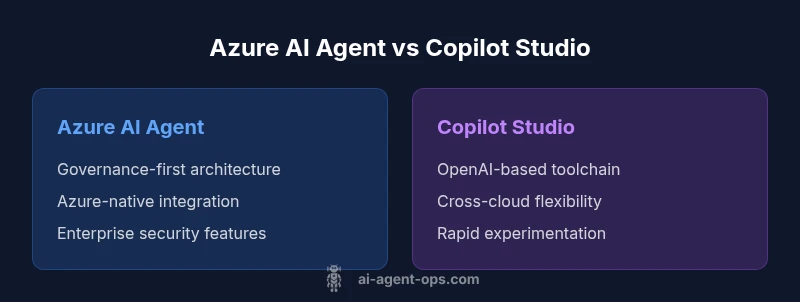
Azure AI Agent vs Copilot Studio: An Analytical Comparison
An analytical side-by-side comparison of Azure AI Agent and Copilot Studio for developers and leaders evaluating agentic AI workflows in 2026.


Azure AI Agent and Copilot Studio both aim to empower agentic AI workflows, but they differ in architecture, integration depth, and governance. For teams already embedded in Azure with a need for centralized control and enterprise security, Azure AI Agent is typically the stronger fit. Copilot Studio suits teams seeking rapid onboarding and OpenAI-based agent orchestration with flexible experimentation.
Overview of azure ai agent vs copilot studio
According to Ai Agent Ops, azure ai agent vs copilot studio are two prominent paths for embedding autonomous AI behavior into business workflows. Both platforms aim to reduce manual toil by orchestrating agents that can reason, act, and learn across systems. However, their design choices reflect different priorities: Azure AI Agent centers on enterprise governance, seamless integration with the Azure stack, and strong security controls; Copilot Studio emphasizes fast experimentation, flexible model choices, and OpenAI-based tooling. For teams evaluating 2026 agent platforms, the decision often hinges on ecosystem alignment, desired latency, and governance requirements, rather than a single feature list. The comparison azure ai agent vs copilot studio will surface in practical terms like deployment patterns, plugin support, and data governance models. Ai Agent Ops's analysis suggests that enterprise teams will favor Azure AI Agent when governance and auditability trump speed of iteration.
Architecture and core concepts
At a high level, both solutions deliver agent orchestration but diverge in their execution model. Azure AI Agent typically grounds agents in the Azure control plane, leveraging Azure Active Directory, role-based access control, and built-in policy enforcement to govern actions. Copilot Studio leans toward model-driven orchestration with flexible plug-ins and external tools, enabling rapid testing and experimentation with OpenAI models. Key concepts to understand include: agents as persisted workflows, tool-use patterns (APIs, plugins, and SDKs), and observability traces that reveal decision rationales. For developers, this means choosing between a tightly regulated, Azure-ted governance loop and a more experimentation-friendly environment with broader tooling options.
Platform integration and extensibility
Azure AI Agent shines when your stack already includes Azure services such as OpenAI integration, Azure Functions, Logic Apps, and Data Lake storage. The integration points are designed to be idiomatic to Azure developers, with centralized policy management and enterprise identity. Copilot Studio offers broader plugin ecosystems and OpenAI-native tooling, which can be advantageous for teams that prioritize cross-cloud experimentation or inclusion of non-Azure data sources. Extensibility considerations include plugin maturity, latency of cross-service calls, and how each platform handles versioning, rollback, and plugin sandboxing. Overall, the Azure path favors governance-aligned extension, while Copilot Studio favors flexible experimentation with fewer Azure-bound constraints.
Data handling and privacy implications
Data posture is a central decision factor. Azure AI Agent typically keeps data within Azure data regions, leveraging built-in encryption, private endpoints, and mirrored governance policies. This model supports strict regulatory requirements and transparent audit trails. Copilot Studio can operate with OpenAI models that may involve data handling that spans multiple clouds or providers, raising considerations about data residency and vendor privacy commitments. Teams should assess data sensitivity, regulatory constraints, and acceptable risk levels when choosing between these approaches. Ai Agent Ops emphasizes designing data flow maps and retention policies early in the evaluation.
Security, governance, and compliance features
Governance is where Azure AI Agent often delivers predictable outcomes: centralized IAM, policy enforcement, and native integration with Azure Security Center. Copilot Studio prioritizes flexible orchestration with governance hooks that may rely more on external controls. In practice, organizations will want to compare how each platform enforces access control, secrets management, key rotation, and incident response procedures. A strong approach is to define guardrails that align with your compliance framework (e.g., SOC2, ISO 27001) and test how each platform handles audits and drift across agent decisions.
Performance, reliability, and scaling
Performance will hinge on latency between tool calls, model load times, and network topology. Azure AI Agent typically benefits from the Azure backbone, predictable regional presence, and mature autoscaling for workloads at scale. Copilot Studio’s performance is often influenced by model selection, prompt design efficiency, and cross-provider data routing. Consider response time SLAs, peak concurrency handling, and caching strategies when benchmarking. In many scenarios, Azure-native deployments offer more predictable performance for enterprise workloads, while Copilot Studio enables rapid experimentation with diverse models before formalizing a production baseline.
Developer experience, tooling, debugging, and observability
Developers value clear tooling around intents, plugins, and troubleshooting. Azure AI Agent provides a cohesive developer experience within the Azure ecosystem, including familiar IDEs, CI/CD pipelines, and end-to-end tracing within Azure Monitor. Copilot Studio tends to excel in rapid prototyping, flexible SDKs, and a variety of debugging aids that suit early-stage experiments. Choose the path that aligns with your team's velocity goals: fast iterations with OpenAI tooling or controlled deployments with Azure-native tooling and policy checks.
Pricing, licensing, and cost of ownership
Pricing considerations should account for both compute and data-transfer costs, as well as enterprise licensing where applicable. Azure AI Agent pricing generally aligns with the Azure consumption model, including compute time, storage, and data egress, with potential discounts for reserved capacity and enterprise agreements. Copilot Studio pricing often centers on model usage, API calls, and plugin usage, which can be more variable across different model families. Build a total cost model that includes onboarding, governance overhead, and potential migration costs when evaluating long-term value. Ai Agent Ops notes that cost controls via policy and usage limits are critical in regulated environments.
Migration, coexistence, and upgrade paths
Many organizations will not move in a single leap from one platform to another. Instead, a coexistence strategy—where new agents are introduced under one platform while maintaining critical workflows on the other—can minimize risk. Clear data-path mapping, versioned APIs, and a staged migration plan reduce disruption. Evaluate how each platform handles backward-compatibility, tool-to-tool bridges, and the ability to run parallel pilot workloads. Ai Agent Ops recommends a phased approach, starting with low-risk pilot zones before broad adoption.
Decision guidelines by use-case and organization size
For large enterprises with strict governance and Azure-first requirements, Azure AI Agent often provides the most predictable long-term value. Smaller teams prioritizing speed, experimentation, and OpenAI model diversity may prefer Copilot Studio for its flexibility and rapid iterations. The optimal choice may also hinge on your data residency needs, regulatory constraints, and the existing developer tooling in your organization. In practice, many teams use a hybrid approach, leveraging each platform where its strengths are strongest while maintaining centralized policy governance.
Comparison
| Feature | Azure AI Agent | Copilot Studio |
|---|---|---|
| Primary focus | Azure-native agent orchestration with governance | OpenAI-based agent orchestration with flexible plugins |
| Integration depth | Deep Azure service integration (IAM, Monitor, Functions, Data Lake) | Broad tooling with cross-cloud plugins and externals |
| Runtime environment | Azure-hosted, regionally aligned, enterprise-grade | Cloud/third-party hosting with OpenAI integration |
| Security & governance | Azure IAM, policy, and audit capabilities | External governance controls with model-centric safeguards |
| Customizability | High within Azure-native components and policies | High for experimentation with diverse models and plugins |
| Pricing model | Azure consumption-based with enterprise incentives | Model-based usage and plugin pricing with OpenAI considerations |
| Best for | Azure-first enterprises needing governance and auditability | Teams needing rapid experimentation and OpenAI-driven workflows |
Positives
- Strong governance and audit capabilities for regulated environments
- Tight Azure ecosystem integration reduces integration friction
- Predictable enterprise support and SLAs
- Centralized policy management and compliance tooling
- Efficient for scale in Azure-heavy organizations
What's Bad
- Potential vendor lock-in to Azure services
- Higher setup complexity for multi-cloud or non-Azure data
- Pricing can be opaque with policy-driven costs
- Longer ramp time for teams new to Azure-native tooling
Azure AI Agent is the recommended choice for Azure-based enterprises prioritizing governance and seamless Azure integration.
If governance and Azure alignment matter most, Azure AI Agent offers stronger controls. Copilot Studio is more compelling for rapid experimentation with OpenAI models and cross-cloud flexibility, but may require more governance work to achieve comparable controls.
Questions & Answers
Which platform is better for regulated industries?
For regulated industries, Azure AI Agent typically provides stronger governance controls, centralized auditing, and Azure-native compliance features. Copilot Studio can be used for rapid experimentation, but it may require additional controls to meet strict regulatory requirements.
In regulated industries, Azure AI Agent usually offers stronger governance and auditing out of the box.
Can Copilot Studio operate entirely within Azure?
Copilot Studio can be deployed in Azure, but its design emphasizes OpenAI-based tooling and cross-cloud flexibility. If you need rigid Azure-only constraints, Azure AI Agent may be a better fit.
Copilot Studio can run in Azure, but it shines with broader tooling and cross-cloud options.
How do licensing and pricing differ between the two?
Azure AI Agent pricing follows the Azure consumption model with enterprise incentives, while Copilot Studio pricing centers on model usage and plugin costs. A full TCO analysis should include onboarding and governance overhead.
Pricing differs by platform: Azure consumption versus model and plugin usage.
Is migration between platforms supported?
Migration between platforms is possible but typically gradual. Start with a pilot on one platform, map data flows, and build bridges where needed before full migration.
Migration should be phased with a pilot and clear data routing.
Do both platforms support custom intents and plugins?
Both platforms support extensibility, but the approach differs. Azure AI Agent emphasizes Azure-native plugins and intents, while Copilot Studio favors OpenAI-compatible plugins and cross-cloud tooling.
Yes, both offer extensibility; expect different plugin ecosystems.
What is typical onboarding time for a team?
Onboarding time varies by team size and existing tooling. Expect longer ramp times for Azure-native setups, shorter ramp times for exploratory Copilot Studio pilots.
Onboarding varies; Azure-native setups may take longer to ramp.
Key Takeaways
- Leverage Azure IAM and policies for governance-first agent deployments
- Choose Azure AI Agent for Azure-centric workflows and regulatory needs
- Opt for Copilot Studio when speed and flexibility drive the project
- Plan a phased migration to minimize risk
- Model choice should align with data residency and compliance constraints