ai agents vs saas: a practical side-by-side comparison
Objectively compare AI agents vs SaaS platforms, covering use cases, governance, pricing ranges, and guidance on choosing AI workflows for smarter automation.


ai agents vs saas presents two contrasting paths for automation. AI agents offer autonomous task execution and agentic workflows inside your data stack, while SaaS platforms deliver hosted software with predictable pricing. The choice hinges on control, integration depth, data privacy, and governance. This quick answer highlights key differentiators and when to combine both approaches in modern automation strategies.
ai agents vs saas: core distinction
ai agents vs saas represents two distinct paths for building automated workflows in modern organizations. AI agents refer to autonomous components powered by large language models and decision logic that can observe, decide, and act across systems. SaaS platforms, by contrast, are hosted software solutions that deliver ready-made capabilities through standardized interfaces. The two approaches are not mutually exclusive; many teams blend them to balance flexibility with speed. According to Ai Agent Ops, the choice often boils down to data control, governance, and the level of customization you require. If your goal is to orchestrate complex, evolving tasks that adapt to changing inputs, AI agents can offer more leverage because they can reason about new scenarios and modify their actions without custom code. On the other hand, SaaS platforms shine when you need reliable, well-supported functionality that’s simple to deploy and governed by proven security and compliance controls. In practice, the line between AI agents and SaaS is not absolute: you can embed AI agents inside a SaaS stack, or wrap SaaS capabilities inside a custom, agent-driven workflow. The result is a spectrum of options rather than a binary choice. This article maps that spectrum and provides a framework for deciding where your organization should start.
Use cases where AI agents excel
AI agents shine in scenarios that require adaptation, reasoning, and continuous optimization across multiple systems. For example, an AI agent can monitor customer data, trigger downstream actions, and adjust its approach in real time without re-coding flows. This is particularly valuable in supply chain orchestration, where dynamic events (like delays or demand spikes) require on-the-fly recalibration. AI agents can also automate complex decision loops, such as A/B testing interpretations, risk assessments, and policy-driven actions that depend on a broad mix of signals. For teams building agentic AI workflows, the primary advantage is the ability to extend capability beyond fixed UI actions into decision-driven orchestration. The trade-off is increased development effort, governance needs, and potential data exposure if not properly secured. SaaS, by contrast, provides rock-solid reliability for well-defined processes, including CRM updates, invoicing, or basic ITSM tasks where the workflow is predictable and standardized. The decision to lean AI agents or SaaS often comes down to the expected pace of change and the degree of customization required by critical business processes.
Deployment speed and reliability: SaaS advantages
SaaS platforms are designed for rapid deployment and predictable outcomes. A typical SaaS rollout includes clear onboarding, standardized APIs, and vendor-managed security controls, which reduces the upfront burden on your internal team. For teams focused on quickest time-to-value, SaaS can deliver a functioning automation layer in days or weeks rather than months. Reliability is another strong suit: if a vendor experiences an outage, SLAs, monitoring, and diagnostics are backed by a dedicated support team. Compliance programs (e.g., SOC 2, ISO 27001) are often pre-woven into the product, helping with governance and risk management. However, SaaS can introduce vendor lock-in and limit customization, which matters if your business rules or data flows require bespoke logic. In practice, many organizations adopt a hybrid pattern: use SaaS for standardized routines and AI agents for the exceptions, optimization, and unique workflows that are not easily captured by a generic solution.
Architecture and data ownership: where control lives
Control over data, models, and the execution environment is the central architectural question when comparing AI agents vs SaaS. AI agents typically run inside your own cloud or on-prem data stack, which can offer tighter data governance, more direct access control, and the ability to compose agents with your proprietary pipelines. This arrangement reduces data leakage risk and improves regulatory compliance for sensitive domains, but it also increases the complexity of security, monitoring, and version control. SaaS platforms host data and compute in the vendor’s environment, which simplifies management but introduces questions about data ownership, residency, and long-term retention policies. Many organizations balance these concerns by adopting hybrid architectures: core data stays in-house or in a private cloud, while certain non-sensitive signals are processed through SaaS components that provide speed and reliability. Regardless of the path, clear data lineage, auditable decision logs, and robust access controls are essential for responsible automation.
Integration patterns and ecosystem readiness
An automation stack sits on top of a network of integrations: APIs, webhooks, data formats, and event streams. AI agents typically require flexible integration points, as they must read data, reason about it, and act across disparate systems. This means robust connectors and well-documented APIs are critical to scale and maintain agent-based workflows. SaaS platforms often come with ready-made connectors to popular enterprise tools, which speeds up deployment but can limit customization. The best outcomes often come from a layered approach: use SaaS connectors for standard flows, add AI agents for advanced orchestration, anomaly detection, and policy-based actions, and maintain a shared data layer that keeps governance centralized. Interoperability standards (e.g., open APIs, data schemas, event formats) reduce integration friction and accelerate collaboration between internal teams and external vendors. In addition, consider how updates to one component propagate through the stack and plan for version management and backward compatibility.
Security, governance, and risk management
Governance must scale with automation. AI agents introduce new risk vectors around model bias, data leakage, and decision transparency, while SaaS platforms carry risks related to vendor dependence, data residency, and access controls. A robust security model combines identity and access management, encryption in transit and at rest, and continuous monitoring. Policy-based controls, audit trails, and explainability features help teams demonstrate compliance and reduce risk. When blending AI agents with SaaS components, it’s important to define clear ownership for data processing stages, establish data provenance, and implement guardrail mechanisms that prevent unintended actions. Regular security reviews, penetration testing, and vendor risk assessments should be part of your ongoing program. The Ai Agent Ops framework emphasizes governance as a differentiator: organizations that document decisions, protect sensitive data, and provide auditable logs tend to achieve higher trust and sustained success with either approach.
Total cost of ownership and pricing perspectives
Pricing models for AI agents and SaaS differ in structure and risk. AI agents often involve upfront development work, ongoing infrastructure costs, and potential expenses for model tuning and data management. The long-term cost can be favorable if you achieve high reuse and automation at scale, but there is a clear maintenance burden. SaaS pricing is typically subscription-based with predictable monthly costs, making budgeting easier but potentially increasing total cost if you scale across many teams or require premium features. A balanced view evaluates not just the sticker price, but also hidden costs: integration effort, staff time for governance, and the cost of data preparation and monitoring. In practice, a hybrid approach can optimize cost by combining the strengths of each model: SaaS for standard processes and AI agents for bespoke, high-value workflows, with a centralized cost model that reflects shared data and governance utilities.
Hybrid patterns: blending AI agents with SaaS components
Many teams pursue a blended architecture to capture the benefits of both worlds. A hybrid pattern might place core data stores and governance tooling under your control while using SaaS services for routine user-facing tasks and AI agents for dynamic orchestration. In this setup, agents act as smart coordinators that interpret signals, route actions, and make policy-aligned decisions across SaaS services. Such an approach reduces time-to-value for new capabilities while preserving the flexibility to customize behavior for unique business requirements. The key to success is a well-defined data interface, clear ownership, and modular components that can be swapped without breaking the broader workflow. This strategy aligns with the practical realities Ai Agent Ops teams observe: organizations that adopt hybrid designs enjoy faster iteration cycles, improved governance, and a scalable pathway to increasingly autonomous operations.
Decision framework: a practical checklist
To choose between AI agents and SaaS—and to plan a hybrid path when appropriate—use this practical checklist:
- Define goals: autonomy vs. standardization, velocity vs. predictability.
- Map data flows: where data resides, who owns it, and who can access it.
- Assess required customization: are standard workflows enough or do you need bespoke orchestration?
- Evaluate governance: logging, explainability, and compliance requirements.
- Consider time-to-value: is a rapid SaaS deployment essential or can you invest in agent development?
- Analyze total cost of ownership: upfront vs. ongoing costs, staff needs, and vendor dependencies.
- Plan for interoperability: standards, APIs, and change management.
- Pilot with a phased approach: start small, measure impact, then scale.
- Decide on a hybrid pattern when appropriate: combine SaaS efficiency with AI agent adaptability for maximum value.
This framework, informed by Ai Agent Ops research, helps teams navigate the ai agents vs saas decision with a structured path rather than guesswork.
Future outlook: trends and what to watch
The trajectory for AI agents and SaaS platforms points toward greater convergence. Expect more sophisticated agent orchestration capabilities that can coordinate across multiple SaaS services, pulling signals from unstructured data and turning them into actionable tasks. Vendors will continue to invest in governance features, including explainability dashboards, audit trails, and enhanced data lineage tracking, to address regulatory concerns. Hybrid architectures will become standard, with organizations designing modular stacks where AI agents provide the decision layer and SaaS components deliver reliable, scalable capabilities. As this field evolves, successful teams will emphasize interoperability, security-by-design, and continuous learning loops that improve automation outcomes. The evolving landscape also raises important questions about procurement, risk management, and workforce upskilling, which organizations should address early in the planning process. Ultimately, ai agents vs saas is less about a single choice and more about building adaptable, governed, and cost-aware automation pipelines that grow with your business.
Closing note on strategy and return to the core decision
As you navigate ai agents vs saas decisions, remember that the best pattern often blends both approaches. AI agents bring adaptability and deep integration capabilities, while SaaS delivers speed, reliability, and governance-ready features. The goal is to design an automation stack that maximizes business impact while maintaining clear ownership, security, and cost controls. By starting with a structured assessment and adopting a hybrid model where appropriate, teams can unlock smarter automation that scales with growth and risk tolerance.
Comparison
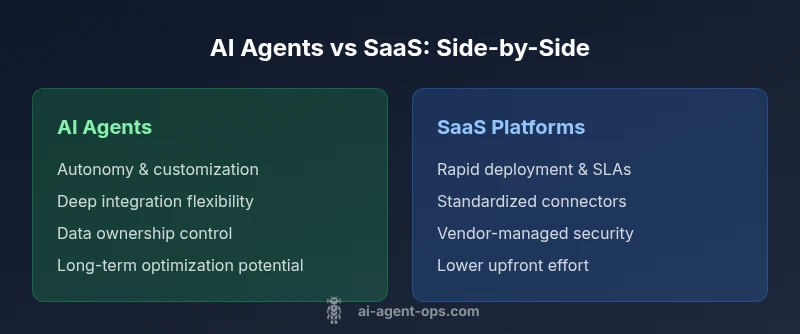
| Feature | AI agents | SaaS platforms |
|---|---|---|
| Control & customization | High customization with programmable decision logic | Low customization; standardized workflows |
| Integration depth | Deep, flexible integration across systems and data sources | Standardized connectors to common apps |
| Data ownership & privacy | Own data in private cloud/on-prem with custom governance | Vendor-hosted data with predefined controls |
| Setup time | Weeks to months depending on scope | Days to weeks for ready-made solutions |
| Governance & compliance | Granular governance; auditable decision logs | Vendor SLAs; prebuilt security/compliance posture |
| Cost model | Capex/opex with development costs; potential long-term savings | Predictable subscription with lower upfront cost |
| Vendor lock-in | Higher risk if heavily customized | Lower risk due to standard APIs and uptime guarantees |
| Reliability & support | Internal ops required; reliability depends on in-house maturity | Vendor-backed support and SLA reliability |
Positives
- Greater autonomy and customization for complex workflows
- Tight data governance and security alignment
- Potentially lower long-term cost with scale
- Flexible orchestration across heterogeneous systems
What's Bad
- Higher upfront and ongoing maintenance cost
- Requires skilled talent and longer time-to-value
- Increased governance complexity to manage autonomous actions
- Integration with legacy systems can be challenging
Hybrid approaches typically offer the best balance of autonomy, speed, and governance.
AI agents excel at bespoke automation and deep integration, while SaaS provides quick deployments and strong vendor support. A blended pattern often yields the fastest time-to-value with controlled risk and scalable governance.
Questions & Answers
What are AI agents and how do they differ from SaaS products?
AI agents are autonomous components that can observe data, reason about it, and take actions across systems. SaaS products are hosted software solutions with ready-made features. The key difference is autonomy and customization versus speed and standardization. Both can co-exist in a layered automation stack.
AI agents are autonomous decision-makers; SaaS products are ready-made software. They complement each other in a layered automation setup.
When should I choose AI agents over SaaS?
Choose AI agents when your workflows require bespoke orchestration, decision-making across multiple systems, and ongoing adaptation. SaaS is preferable for rapid deployment, predictable maintenance, and standard processes with reliable support. A hybrid approach often provides the best balance.
Opt for AI agents for custom, adaptive automation. Use SaaS for fast, reliable standard tasks, and blend them where appropriate.
Can AI agents be hosted in a SaaS environment, or is on-prem required?
Both options exist. AI agents can be deployed in cloud-based environments for scale and governance or hosted on-premises for data sovereignty. SaaS platforms are inherently hosted; blending both approaches is common when data sensitivity and speed are both critical.
You can host AI agents in the cloud or on-prem, and SaaS is hosted. Blending them is common when you need both control and speed.
What security considerations matter when mixing AI agents with SaaS?
Key concerns include data ownership, access control, and auditability. Use strong IAM, encryption, and logs for all actions. Ensure data flows are well-documented, and implement guardrails to prevent unintended autonomous actions.
Prioritize data ownership, access controls, and audit trails. Guard against unintended autonomous actions with governance rules.
How do I estimate the total cost of ownership for AI agents vs SaaS?
TCO depends on development effort, infrastructure, maintenance, and vendor fees. AI agents may incur higher ongoing costs but can reduce manual work over time; SaaS offers predictable pricing but can scale costs with usage. Include governance, security, and data costs in the calculation.
Consider development, maintenance, and governance costs for AI agents, versus subscription costs for SaaS. Include data and security expenses in your math.
What’s a practical step-by-step approach to deciding between the two?
Start with a concrete automation map: list processes, data flows, and governance needs. Run a small SaaS pilot while prototyping an AI agent for the most complex workflow. Compare TCO, risk, and time-to-value, then plan a phased hybrid rollout if beneficial.
Map processes, pilot both paths, compare value, and plan a phased hybrid rollout if it makes sense.
Key Takeaways
- Define automation goals: autonomy vs standardization.
- Favor hybrid patterns to balance flexibility and speed.
- Governance and data lineage are non-negotiable.
- Pilot early; measure impact before scaling.
- Plan for interoperability and cost governance.