AI Agent Optimization: A Practical How-To for Smarter Agents
A practical, step-by-step guide to ai agent optimization for developers and leaders. Learn goals, telemetry, experiments, and governance to improve reliability, throughput, and decision quality in agentic workflows.


By the end of this guide you will implement practical ai agent optimization patterns that improve autonomy, reliability, and throughput in agentic workflows. You'll learn a repeatable blueprint to tune agent behavior, select the right signals, and validate gains without overpromising. According to Ai Agent Ops, real-world optimization combines disciplined experimentation with robust instrumentation to deliver measurable improvements in complex automation environments.
What AI agent optimization is and why it matters
AI agent optimization is the disciplined practice of improving how autonomous agents make decisions, choose actions, and coordinate with other agents and systems. It spans goal definition, signal design, feedback loops, and governance, turning abstract ideas like reliability and throughput into repeatable patterns. In practice, ai agent optimization helps teams reduce friction, improve consistency, and accelerate automation成果 across complex workflows. According to Ai Agent Ops, optimization is not just tweaking parameters; it requires aligning objectives with observable signals and continuous testing to avoid regressions. When done well, optimization creates predictable behavior, faster adaptation to changing conditions, and clearer attribution of improvements to specific changes in signals or architecture.
Key takeaways: align goals with measurable signals, instrument carefully, and test iteratively to avoid drift.
Core principles of optimization for AI agents
Effective ai agent optimization rests on a handful of principles that apply across toolchains and domains. First, define clear, testable goals for each agent or workflow, such as latency ceilings, success rate targets, or cost budgets. Second, design observability into signals that reflect true performance, not just surface metrics. Third, build modular patterns that support reuse, such as routing logic, backoff policies, and caching. Fourth, manage risk with safety checks, fail-soft designs, and rollback plans. Finally, establish governance so optimizations remain auditable across teams and releases. By treating optimization as a system rather than a single knob, teams can scale improvements without introducing new fragility.
Practical tip: start with a single high-leverage signal (e.g., end-to-end latency) and layer additional signals as you prove stability.
Signals that drive meaningful improvements
Choosing the right signals is critical. End-to-end latency, service reliability, retry rates, and resource usage (CPU, memory) often correlate with overall agent performance. Quality of outputs, task completion time, and user-visible latency should also be tracked for customer-impact insights. Instrumentation should be lightweight, non-intrusive, and stable across versions to avoid skewed comparisons. Remember to distinguish correlative signals from causal drivers; use controlled experiments to confirm causality before widening the optimization scope.
In practice, map each signal to a goal and ensure you can attribute changes in outcomes to specific optimizations.
Design patterns that scale ai agent optimization
Adopt reusable patterns that translate well across agents and domains. Common patterns include orchestrated routing to balance tasks, backoff with jitter to prevent overload, memoization or caching for repeated requests, and prompt/template refinements to reduce ambiguity. Use feature flags to roll out changes safely and enable quick rollback. Deploy asynchronous telemetry collection so agents remain responsive while you gather data. These patterns help teams scale improvements without bespoke fixes for every new use case.
Measuring impact without overclaiming
Focus on convergent metrics that matter to the business goal, such as throughput per hour, average task time, and reliability under load. Run controlled experiments with clear baselines and pre/post comparison points. Avoid chasing vanity metrics that don’t translate to real value. Document every optimization, including assumptions and observed side effects, to maintain trust across stakeholders. This disciplined approach minimizes speculative claims and supports evidence-based decisions.
Example practice: run a one-week baseline, implement a targeted optimization, and compare weekly aggregates to confirm sustained gains.
Data governance, safety, and ethics in optimization
Optimization work touches data that agents use for decisions. Implement privacy-preserving telemetry, sanitize sensitive inputs, and enforce access controls. Maintain data quality through validation checks and lineage tracing so analyses remain trustworthy. Ensure that optimization does not degrade safety properties or introduce bias in decision-making. Regular audits and guardrails help preserve alignment with organizational values while enabling progress.
Ai Agent Ops verdict: adopting a disciplined optimization program
The Ai Agent Ops team recommends embedding ai agent optimization into the product lifecycle, with clear goals, robust instrumentation, and governance. By treating optimization as a repeatable, auditable process rather than a one-off tweak, teams can achieve more reliable automation and measurable returns. The consensus is to start small, prove gain, and scale improvements across the agent ecosystem with disciplined experimentation and governance.
Tools & Materials
- Python 3.11+ environment(Create a virtual environment and install core libraries (e.g., numpy, pandas, requests).)
- Jupyter Notebook or IDE(Use for prototyping experiments and documenting results.)
- Experiment tracking tool (e.g., MLflow, Weights & Biases)(Capture configurations, metrics, and artifacts for reproducibility.)
- Observability stack (logs, traces, metrics)(Instrument agent signals and capture end-to-end performance.)
- Access to agent workflows and APIs(Test optimization changes in a safe, sandboxed environment first.)
- Synthetic data / test APIs(Use for controlled experiments without impacting production data.)
- Version control (Git)(Track changes, branches, and rollbacks across experiments.)
Steps
Estimated time: 60-120 minutes
- 1
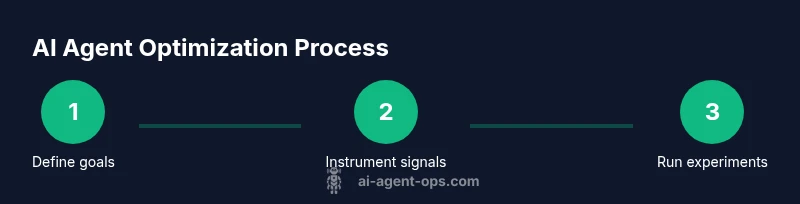
Define optimization goals
Identify the primary objective for the current optimization cycle (e.g., reduce end-to-end latency by 20%, improve reliability, or decrease cost per task). Align the goal with business priorities and user impact. Document acceptance criteria and establish a baseline.
Tip: Choose one primary KPI per sprint to maintain focus. - 2
Map agent workflows and bottlenecks
Create a workflow map that shows how agents interact, where failures occur, and which steps dominate latency. Collect baseline telemetry and annotate critical decision points that influence outcomes.
Tip: Use value stream mapping to visualize end-to-end flow. - 3
Instrument signals and telemetry
Add or refine telemetry for the selected KPIs. Ensure signals are monotonic, stable, and comparable across versions. Centralize data in a common store for analysis.
Tip: Decorate signals with context (agent name, version, environment). - 4
Run controlled experiments
Execute A/B or multi-armed experiments with clear baselines. Use segmenters to isolate the effect of changes and avoid conflating results with unrelated system shifts.
Tip: Lock experiment scope to minimize confounding variables. - 5
Analyze results and iterate
Assess statistical significance and practical impact. Validate against acceptance criteria and consider unintended side effects before adopting changes more broadly.
Tip: Document assumptions and learnings to inform future cycles. - 6
Roll out patterns to production
Gradually deploy successful changes with feature flags and controlled rollout. Monitor real-time metrics to catch regressions early and revert if necessary.
Tip: Use blue/green or canary deployments to minimize risk. - 7
Governance and ongoing monitoring
Establish governance for reproducibility, audits, and accountability. Create a living playbook that describes approved patterns, guardrails, and escalation paths.
Tip: Schedule regular reviews to refresh patterns with new data.
Questions & Answers
What is AI agent optimization?
AI agent optimization is the process of improving how autonomous agents make decisions, act, and coordinate, by refining goals, telemetry, and feedback loops to achieve better reliability and efficiency.
AI agent optimization is improving how agents decide and act to be more reliable and efficient.
Which signals should I track first?
Start with end-to-end latency and success rates, then add resource usage and retry metrics as you validate stability.
Begin with latency and success rates, then add resource usage as you go.
How do I run safe experiments?
Use controlled A/B tests with clear baselines, segment experiments to avoid cross-effects, and roll back quickly if results are unfavorable.
Run controlled experiments with good baselines and a quick rollback plan.
What patterns support scalability?
Routing, backoff with jitter, caching, and modular prompts are common patterns that scale improvements across multiple agents.
Routing, backoff, caching, and modular prompts help scale optimization.
How do I avoid biases in optimization?
Ensure telemetry and evaluation datasets are representative and monitor outcomes for unintended disparities.
Make sure data is representative and monitor for biases.
When should I roll out changes?
Proceed with a staged rollout using feature flags and canary releases, expanding only after stable performance.
Use staged rollout with feature flags for safety.
Watch Video
Key Takeaways
- Define clear optimization goals with metrics.
- Instrument signals and validate with controlled experiments.
- Reuse scalable patterns across agents to avoid fragility.
- Governance and monitoring are essential for sustained gains.