AI Agent for Google Ads: Automate Ad Strategy with Agentic AI
A practical guide to building an AI agent for Google Ads that automates bidding, tests ad copy variants, and optimizes budget allocation with governance and observability for reliable ROAS.


This guide shows you how to design and deploy an ai agent for google ads that automates bidding, ad testing, and budget allocation in real time. According to Ai Agent Ops, a well-architected agent blends data pipelines, policy-conscious decision logic, and robust observability to deliver measurable ROAS. You’ll learn goals, architecture, and practical steps to start.
Why an AI agent for Google Ads matters
In modern digital advertising, speed, scale, and continuous learning separate leaders from laggards. An AI agent for Google Ads can monitor auction signals, optimize bids, test ad variations, and reallocate budget to top performers around the clock. This reduces manual toil for marketers and accelerates experimentation cycles for product teams. According to Ai Agent Ops, success begins with clearly defined objectives, guardrails, and alignment with brand voice and platform policies. The agent should surface insights with transparent reasoning and confidence levels, not just automated actions. Implementing this requires a disciplined architecture that clearly separates data ingestion, decision logic, and action adapters to Google Ads. Start with a near-term pilot focused on one objective (e.g., CPA target) and then scale as you build trust, governance, and observability across campaigns.
Core capabilities of an AI agent in Google Ads
An AI agent combines perception, reasoning, and action to operate campaigns at scale. Core capabilities include: real-time bidding optimization that adapts CPC to meet target ROAS, creative testing by generating and evaluating headlines and assets, audience and keyword intent analysis to identify high-potential segments, budget pacing that shifts spend based on seasonality, automated pausing or scaling when signals degrade, policy-aware actions that respect Google Ads rules, and strong observability with dashboards and explainable logs. Integration with external data such as CRM events or offline conversions enables more accurate optimization. Design for modularity so you can swap models, data sources, or rule sets without destabilizing live campaigns. By separating the ‘what to do’ from the ‘how to do it,’ teams can test ideas quickly while maintaining governance.
Data and integration essentials
Reliable data streams, robust connectors, and governance are the backbone of an AI agent for Google Ads. Typical data sources include Google Ads performance metrics, Google Analytics, CRM data, conversion events, and external signals like market trends. Build data pipelines with clear schemas, timestamps, and lineage to trace decisions back to data points. For Google Ads API access you need developer tokens and OAuth credentials, with careful attention to access scopes and security. Capture feature flags and experiment metadata so decisions are auditable. Observability is essential: log decisions, outcomes, and confidence scores; monitor data drift; and set up alerts for anomalies. A solid data foundation enables credible experiments, reproducible results, and transparent reporting to stakeholders.
Architecture blueprint: components & data flow
A practical architecture separates data, decision-making, and actions. Key components include: (1) Data layer for ingestion of campaign metrics, conversions, and external signals; (2) Feature store and models powering decisions; (3) Orchestration layer that coordinates data fetches, decision runs, and actions; (4) Action adapter that translates decisions into Google Ads API calls; (5) Observability stack with dashboards and tracing; (6) Governance with policy checks and audit trails. Data flows from sources into the warehouse, through feature extraction, into the decision engine, and finally to Google Ads. Include versioned prompts, A/B testing, and a rollback mechanism. A modular design supports rapid experimentation while reducing risk to live campaigns.
Prompting, decision logic, and safety
Define agent behavior with explicit prompts, policies, and decision rules. Prompts should specify goals, constraints, and fallback actions; avoid vague instructions that invite drift. Decision logic combines rule-based safety checks (spend caps, policy compliance) with predictive models or heuristics for bidding and creative scoring. Use confidence thresholds to avoid high-risk actions and provide auditable rationales for every decision. Safety and privacy matter: avoid exposing PII, adhere to platform policies, and implement a manual override path for humans. Test prompts in sandbox environments before production and review prompts regularly to prevent drift as data shifts. From Ai Agent Ops's perspective, the strongest setups emphasize explainability and governance alongside performance.
Building the data pipeline and instrumentation
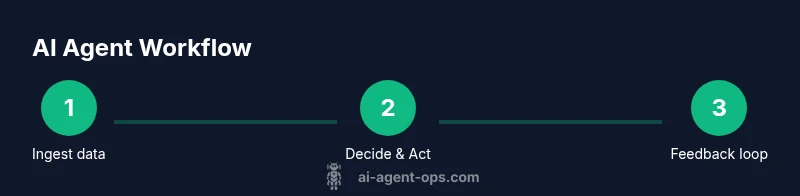
Outline the pipeline steps: ingest data from Google Ads, Analytics, and CRM; normalize and store in a centralized warehouse; compute features for bidding and creative scoring; run the decision engine; push changes to the Google Ads API; and monitor results. Use streaming ingestion for near-real-time scoring and complement with batch analytics as needed. Instrumentation should track CPC, CPA, ROAS, impression share, and conversion rate, with dashboards showing leading indicators (click-throughs, predicted conversions) and lagging indicators (actual ROAS). Implement alerts for anomalies and drift, and schedule monthly reviews to refine features and thresholds. Prioritize security with least-privilege credentials and rotate keys regularly. This pipeline foundation enables reliable experimentation, reproducibility, and scalable growth.
Evaluation, ROAS, and governance
Define an evaluation framework with experiments (A/B tests, multi-armed bandits, or time-series analyses) to compare AI-driven strategies against baselines. Track ROAS, CPA, conversion value, and revenue lift while monitoring for audience bias. Establish governance: who can approve changes, how safety reviews are conducted, and how to rollback when needed. Build real-time dashboards showing performance against targets and provide quarterly stakeholder reports. Document decision logs, rationale, confidence scores, and audit trails. Ai Agent Ops analysis shows that organizations investing in governance and observability achieve more durable improvements and easier compliance with advertising policies. Regular calibration and backtesting support scalable, responsible AI adoption.
Common pitfalls and mitigations
Common issues include data quality gaps, model drift, and short-term overfitting. Mitigate with robust data validation, regular feature recalibration, and longer observation windows. Avoid policy violations by embedding policy checks and an approval workflow before actions execute. Plan for failures: API quota limits, partial outages, and degraded signals; implement graceful degradation, alerts, and automated rollbacks. Enforce privacy and security with encryption, strict access controls, and data minimization. Align incentives to avoid chasing vanity metrics; prioritize reliable improvements to ROAS and customer value.
Deployment plan: from pilot to production
Begin with a constrained pilot focusing on a small set of campaigns with strict guardrails and a limited budget; monitor outcomes, gather learnings, and iterate. Expand gradually to more campaigns and markets as observability and governance mature. Use feature flags and staged rollouts to control exposure to new decision paths; require human sign-off for high-impact actions. Prepare rollback plans and conduct regular safety reviews with the team. Communicate ROI expectations clearly with baselines and uplift projections. Ai Agent Ops recommends a phased, governance-first approach to minimize risk while enabling rapid learning.
Compliance, privacy, and policy considerations
Advertising platforms impose strict data handling and automation rules. Ensure compliance with Google Ads policies and local regulations; avoid automated actions that breach bidding or content policies. Apply data minimization, encryption, and restricted access; maintain audit logs for reviews. Implement privacy-by-design practices and conduct periodic privacy impact assessments. Keep the team updated on policy changes through training and governance updates to stay aligned with platform requirements.
Tools & Materials
- Google Ads API access(Developer token, OAuth credentials, and managed access scopes)
- Cloud data infrastructure(Data warehouse or lakehouse (e.g., BigQuery, Snowflake) for storage and processing)
- Programming environment(Python 3.x, libraries for API access, data processing, and ML helpers)
- Orchestration & CI/CD(Workflow orchestrator (e.g., Airflow) and CI/CD pipeline with secret management)
- Monitoring stack(Prometheus/Grafana or cloud equivalents for observability)
- Security & governance tooling(Role-based access control, secret rotation, and audit logging)
Steps
Estimated time: 6-8 weeks
- 1
Define goals and success metrics
Identify primary objective (e.g., ROAS uplift, CPA decline) and acceptable risk thresholds. Document KPIs, baselines, and desired confidence levels for decisions. Establish a human-in-the-loop policy for high-impact actions.
Tip: Define guardrails early: set spend caps and emergency pause rules to avoid runaway spend. - 2
Design data architecture
Map data sources (Google Ads, Analytics, CRM), determine data quality requirements, and plan lineage for auditability. Choose a storage layer and define feature stores for bidding and creative scoring.
Tip: Prioritize deterministic data schemas and timestamp alignment to minimize drift. - 3
Secure API access
Obtain developer tokens and OAuth credentials; configure least-privilege access scopes and rotate credentials regularly. Implement a secure vault for secrets.
Tip: Test API credentials in a sandbox before production. - 4
Build the decision engine
Implement a modular decision module that combines rule-based checks with predictive signals. Include explainable outputs and confidence scores for each action.
Tip: Use feature flags to enable/disable new decision paths safely. - 5
Create the action bridge
Develop the adapter that translates decisions into Google Ads API calls (bids, budgets, ads status). Ensure robust error handling and idempotent operations.
Tip: Log every action with context to facilitate audits. - 6
Instrument and observe
Set up dashboards for CPC, CPA, ROAS, impressions, click-through rate, and conversion value. Instrument decision rationales and confidence levels.
Tip: Establish alert thresholds for anomalies and drift. - 7
Run a pilot
Launch a controlled pilot on a small campaign set with limited budget. Compare AI-driven results against a solid baseline.
Tip: Document learnings and iterate on prompts and features. - 8
Scale with governance
Gradually expand campaigns, implement stage-gate approvals, and maintain a rollback plan for high-risk changes.
Tip: Maintain a change-log to track decisions and outcomes. - 9
Review and recalibrate
Conduct regular calibration of models, prompts, and thresholds based on performance data and new platform policies.
Tip: Run monthly sanity checks to prevent drift. - 10
Document and share results
Produce stakeholder-ready reports with ROI projections and performance dashboards. Highlight learnings for cross-team adoption.
Tip: Create a playbook of best practices for future pilots.
Questions & Answers
What is an AI agent for Google Ads?
An AI agent for Google Ads is a software component that uses AI to monitor campaigns, make bidding and budget decisions, and test ad variations automatically while following platform policies. It augments human decision-making with data-driven actions and explainable reasoning.
An AI agent for Google Ads automates bidding, testing, and budgeting while staying within policy rules, helping teams move faster with explanations for its decisions.
What data is needed to power the agent?
Key data sources include Google Ads performance metrics, Analytics data, conversion data, and external signals like CRM events. A well-defined data pipeline with timestamps, lineage, and quality checks is essential for reliable decisions.
You need ads data, analytics, and conversions plus external signals, all tracked with clear timestamps and quality checks.
How do you ensure safety and compliance?
Implement guardrails such as spend caps, policy checks, and human-in-the-loop for high-risk actions. Use sandbox testing, audit trails, and regular reviews of prompts and decision rules to prevent drift and policy violations.
Use guardrails, human review for risky actions, and regular prompt reviews to stay compliant.
What are the common pitfalls to avoid?
Data drift, overfitting to short-term campaigns, and API quota issues are common. Mitigate with robust validation, longer observation windows, and staged rollouts.
Watch out for data drift and quota limits; test gradually and validate data quality.
How should I measure success?
Run controlled experiments (A/B tests or time-series checks) comparing AI-driven strategies to baselines. Track ROAS, CPA, and revenue lift, and report results with confidence intervals.
Compare AI-driven results to baselines using experiments and ROAS-focused metrics.
Watch Video
Key Takeaways
- Define clear goals and guardrails before automation.
- Build modular, auditable decision logic with governance.
- Instrument data with robust observability and versioned features.
- Pilot, then scale with staged governance and rollback plans.
- Maintain privacy and policy compliance throughout the lifecycle.