AI Agent for Manual Testing: A Practical Guide
Learn how an AI agent for manual testing augments QA, improves coverage, and speeds feedback with agentic AI, while maintaining governance and safety.


This guide shows you how to integrate an AI agent into manual testing workflows, what to automate, and how to measure outcomes. You’ll learn setup, data requirements, test design patterns, and governance. By the end, your QA team will run smarter tests with agentic AI, reducing manual effort while preserving test fidelity. This quick-start also covers risks, ethics, and governance for safe adoption.
Why AI agents enhance manual testing
Manual testing remains essential for quality assurance, but it often suffers from fatigue, repetitive steps, and subjective judgments. An AI agent for manual testing acts as a cognitive teammate: it observes test flags, suggests test steps, and records results, freeing testers to focus on exploratory work and risk-based decision making. According to Ai Agent Ops, adopting AI agents in manual testing can help teams scale coverage and reduce cognitive load, enabling more consistent test execution across features and teams. In practice, an agent can guide testers through complex workflows, ensure alignment with test design patterns, and surface inconsistencies that humans might miss after long days. The benefits are most pronounced in environments with frequent regression needs, high test matrix complexity, and evolving requirements. However, you must design the agent to complement, not replace, human judgment; governance, safety, and traceability are essential.
To set up for success, start with a narrow pilot on a well-understood feature, then broaden to adjacent areas. The agent should interact with testers via clear prompts, explain its recommendations, and log all decisions with timestamps. By integrating the agent into your existing tooling—issue trackers, test management systems, and CI/CD—you can create a unified workflow where humans retain final decision privileges while the AI handles repetitive, structured tasks. This partnership can increase test coverage, reduce flaky results, and accelerate feedback loops for developers.
What qualifies as an AI agent for manual testing?
An AI agent for manual testing is a software component that combines perception, planning, and action to assist testers rather than replace them. Core elements typically include a perception layer to understand test requirements and outcomes, a reasoning/planning module to suggest next steps, and an execution layer that can guide testers or drive automated checks within a test harness. In practice, agents rely on language models (LLMs) to interpret requirements and generate test steps, along with a memory mechanism to track context across sessions. They can trigger lightweight automation, propose edge-case tests, and help maintain consistency with test design patterns such as equivalence partitioning, boundary value analysis, and risk-based testing. The goal is to support human judgment with repeatable processes and traceable results, not to automate thinking itself. When designed well, agentic AI complements tester expertise by offering rapid scenario exploration, data-driven prompts, and structured retrospectives after each run.
Patterns and use cases well-suited for agentic testing
- Guided manual testing: The AI agent walks testers through predefined test steps, prompts for confirmations, and logs outcomes with timestamps.
- AI-assisted test design: Given user stories, requirements, or acceptance criteria, the agent generates test cases, edge cases, and data sets that testers can review and refine.
- Regression prioritization: The agent analyzes recent changes and flags tests most likely affected, helping teams focus where it matters.
- Exploratory testing support: By proposing coverage gaps and suggesting new experiments, the agent extends human exploration without duplicating effort.
- Data-driven test maintenance: The agent monitors test data quality, detects flaky data, and suggests data-stability improvements.
- Compliance-aware testing: The agent enforces policy guards (privacy, masking, access control) during test execution and data generation.
These patterns align with modern QA practices and support cross-functional teams by reducing cognitive load and accelerating feedback cycles.
Data, privacy, and training considerations
To be effective and responsible, AI agents need access to representative, high-quality data—without compromising privacy or security. Start with synthetic or anonymized data for initial pilots, then gradually include production-like data under strict governance. Use data masking for sensitive fields, and implement access controls so testers can review the data lineage behind each test step. Record prompts, decisions, and results to support traceability and auditability. When training or fine-tuning models, rely on your internal data where possible and avoid exposing credentials or personal information. Establish a data retention policy and integrate privacy-by-design principles into the agent’s development lifecycle. Finally, implement safeguards such as guardrails that prevent the agent from performing destructive actions without explicit human confirmation.
Architecture, tools, and integration strategies
A practical AI agent for manual testing sits at the intersection of testing tools, automation runtimes, and collaboration platforms. The core architecture typically includes:
- Agent core: the reasoning and planning layer that interprets prompts and maintains context.
- Test runners: lightweight environments or harnesses that execute steps or run automated checks.
- Integrations: connections to test management systems, issue trackers, CI/CD pipelines, and dashboards.
- Observability: logging, telemetry, and explainability components so testers understand the agent’s recommendations.
Tooling considerations include using a modern automation framework, such as a browser automation library for end-to-end checks, test data utilities, and continuous delivery pipelines. Plugins and adapters can extend capabilities to your stack, while versioned prompts and templates help maintain consistency. Remember that the aim is agent-assisted testing, not a fully autonomous QA bot; human oversight remains essential for risk management and ethics.
Stepwise rollout blueprint for teams
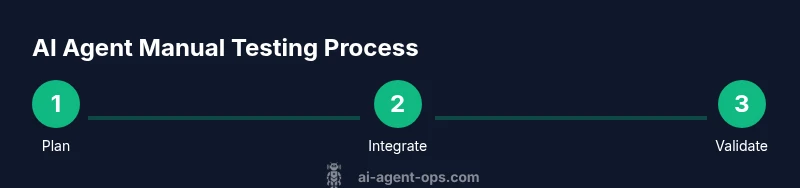
- Define objectives and scope: identify which features or test types benefit most from agent support and what success looks like. 2) Inventory and baseline: map existing test cases, data sets, and environments to determine where the agent will insert value. 3) Build a minimal viable agent: create a baseline prompt library, integration hooks, and a safe execution surface with guardrails. 4) Run a controlled pilot: pair testers with the agent in a sandbox feature, collect feedback, and capture metrics around coverage and time-to-feedback. 5) Analyze results and iterate: refine prompts, adjust test design patterns, and expand data coverage based on observed outcomes. 6) Scale incrementally: roll out to additional features and teams, ensuring governance and change management processes are followed. 7) Govern and monitor: establish ownership, incident response plans, and continuous improvement loops. Total time: 6-8 weeks for pilot, 3-6 months for broader rollout.
Governance, risk, and measuring success
Effective AI agent adoption requires clarity around governance, risk, and metrics. Establish guardrails so testers retain final decision rights, and implement explainability so that every agent suggestion is auditable. Define KPIs such as test coverage, time-to-feedback, defect leakage, and reproducibility of steps, while avoiding over-claiming about automation percentages. Regularly review policies for privacy, security, and compliance, and adapt as requirements evolve. The Ai Agent Ops team recommends adopting a phased, safety-first approach with continuous monitoring and stakeholder oversight to ensure sustainable improvements in quality assurance.
Tools & Materials
- Modern automation framework(Use a framework that supports browser automation and API interactions; integrate with test runners)
- Test data sets(Include representative synthetic/anonymized data for pilots; plan for data masking)
- CI/CD pipeline access(Enable agent-driven test execution within your existing pipeline)
- Test management and issue tracker(Ensure logs and decisions map to artifacts and defects)
- Logging and telemetry system(Capture prompts, actions, outcomes, and reasons for decisions)
- Governance policy and checklist(Policies for privacy, security, and ethics throughout the lifecycle)
- Workstation with baseline compute(Sufficient CPU/RAM for running test runners and model inference)
- Sandbox/test environments(Isolated environments for pilots to prevent production impact)
Steps
Estimated time: 6-8 weeks for pilot, 3-6 months for broader rollout
- 1
Define objectives and success criteria
Identify which test types and features will benefit from AI-assisted testing, and specify measurable success criteria such as coverage gains and time-to-feedback reductions. Align with stakeholders to set boundaries.
Tip: Document acceptance criteria before building the agent to prevent scope creep. - 2
Inventory current tests and data
Create a catalog of existing test cases, data sources, and environments. Map potentials where the agent can add value, such as repetitive steps or complex data setups.
Tip: Label tests by risk and repetition to prioritize automation opportunities. - 3
Prototype a safe agent surface
Build a minimal prompt library and a guarded execution path that requires human confirmation before sensitive actions. Keep logs clear and explainable.
Tip: Start with non-destructive steps to validate the interaction loop. - 4
Run a controlled pilot
Pair testers with the agent on a sandbox feature. Collect qualitative feedback and quantitative metrics on coverage and cycle time.
Tip: Capture both success stories and failure modes to guide improvements. - 5
Refine prompts and data
Iterate on prompts, data generation rules, and test design patterns based on pilot results. Update governance controls as needed.
Tip: Maintain versioning for prompts to track changes over time. - 6
Scale incrementally
Expand to additional features and teams, ensuring governance and change-management processes are in place. Monitor for drift and bias.
Tip: Roll out in stages and require sign-off from stakeholders at each stage. - 7
Establish ongoing governance
Define ownership, incident response, and continuous improvement loops. Schedule regular audits of data, prompts, and outcomes.
Tip: Institutionalize a feedback loop with testers and developers.
Questions & Answers
What is an AI agent for manual testing?
An AI agent for manual testing is a software component that guides testers, suggests steps, and records results, combining perception, reasoning, and action.
An AI agent guides testers, suggests steps, and records results to support manual testing.
How do you decide which tests to automate with an AI agent?
Prioritize repetitive, high-risk, and time-consuming tests. Start with flows that have clear success criteria and data traces.
Begin with repetitive, high-risk tests and review results with testers.
What are common risks with AI agents in testing?
Risks include bias, data leakage, overreliance, and loss of tester intuition. Guardrails and governance help mitigate these issues.
Be aware of bias and data leakage; use guardrails to minimize risk.
What data is needed to configure an AI agent?
Use synthetic or anonymized data for pilots, then introduce production-like data under governance with masking and auditing.
Start with synthetic data and masking for safety.
How do you measure success?
Track test coverage, time-to-feedback, defect detection, and reproducibility of AI-driven steps.
Look at coverage, speed, and reliability of AI suggestions.
Is an AI agent a replacement for testers?
No. It augments testers by handling repetitive tasks and analysis while humans focus on exploration and interpretation.
No—it's an augmentation, not a replacement.
Watch Video
Key Takeaways
- Pilot a focused feature to validate value
- Keep testers in the loop and review all AI-driven steps
- Implement guardrails, traceability, and governance
- Integrate AI agents with existing CI/CD and test-management tools
- Measure coverage and speed to guide iteration