How to Build Effective AI Agents Without the Hype in 2026
Practical, metrics-driven guidance to build AI agents that deliver real value without hype. Governance, architecture, and evaluation for 2026. Ready to scale.


Learn how to build effective ai agents without the hype by defining success metrics, choosing practical architectures, and enforcing governance that scales. This guide focuses on practical patterns, measurable outcomes, and responsible AI practices, so you can deliver real value without chasing buzzwords. It emphasizes clarity over hype, reuse of proven patterns, and safe deployment practices that align with business goals.
Demystifying AI agents: what they are and what they are not
AI agents are software systems that perceive their environment, reason about goals, and act to achieve those goals through actions in the real world or digital environments. They integrate perception, reasoning, planning, and execution in a loop, often with feedback from results. In this guide on how to build effective ai agents without the hype, we emphasize practical, testable patterns that deliver value rather than buzzwords. A well-designed agent is scoped, observable, and auditable, with clear boundaries and documented decision criteria. It’s tempting to chase more capable models, but reliability comes from modular design, explicit interfaces, and strong governance, not from the latest hype cycle. The Ai Agent Ops team has found that starting with a concrete problem and a minimal, measurable objective helps teams stay aligned, avoid scope creep, and learn quickly. When you treat an agent as a product—define success, plan monitoring, and set exit criteria—you can build toward predictable outcomes. In the wild, many agents fail because they are deployed without guardrails, lacking explainability, or with opaque data sources. By focusing on a transparent loop of sense, decide, act, and review, you build trust and deliver real business impact.
Additionally, remember that hype often disguises scope creep and data quality problems. The practical approach is to frame the challenge narrowly, test early with real users, and iterate with safe experiments. According to Ai Agent Ops, disciplined problem framing and governance are non-negotiable foundations for durable AI agent programs.
Defining success for AI agents: measurable outcomes
Without clear success criteria, even a technically elegant agent will drift toward irrelevance. Start by identifying what success looks like for the specific use case, then map those goals to observable metrics. The metrics should be actionable, time-bound, and controllable by your team. For example, you might track task completion rate, average time to respond, user adoption, and failure rate in edge cases. Importantly, metrics should be paired with guardrails that protect safety, privacy, and cost. Ai Agent Ops analysis shows that teams that articulate 2-3 primary outcomes before building tend to deliver more reliable agents and quicker ROI than those who chase novelty. For each metric, define a baseline, a target, and a plan for incrementally improving it. Create dashboards that surface anomalies and provide auditable logs for debugging. Consider how decisions are explained to users and how the agent’s actions can be rolled back if something goes wrong. Finally, establish governance checks—review cycles, versioning, and a clear process for decommissioning agents that underperform.
Architecture patterns that work (and avoid hype)
A practical AI agent architecture emphasizes modularity, testability, and composability. Start with a lightweight skeleton that exposes a small set of well-defined actions and a predictable feedback loop. The core pattern is sense–plan–act with an outer loop for monitoring and governance. Use pluggable components for perception (data ingestion widgets), reasoning (decision modules), and action (integration adapters). This separation reduces risk: you can swap a module without rewriting the entire system. Avoid monolithic AI stacks that attempt to do everything; they tend to be brittle and hard to audit. Instead, build agent ecosystems where tasks are decomposed into micro-decisions with explicit inputs and outputs. Version-control all prompts, policies, and tool configurations. Implement a sandbox environment for testing new tools and data sources before live deployment. When possible, use open standards and shared interfaces to facilitate collaboration across teams and vendors. The goal is to create a predictable, observable agent that behaves consistently as it scales. By prioritizing modularity and governance, you can deliver robust agents without succumbing to hype.
Data, prompts, and governance to maintain reliability
Data quality is the foundation of any AI agent. Start by auditing data sources for accuracy, coverage, timeliness, and privacy risk. Maintain data lineage so you can trace decisions back to source inputs. Prompt design matters: assemble prompt templates that support consistent behavior, include guardrails, and define failure modes. Governance is not a gatekeeping exercise—it's a critical mechanism for safety and accountability. Establish policies for access control, logging, and incident response. Use telemetry to monitor latency, error rates, and anomalous prompts. Build a policy layer that can throttle or suspend an agent if data quality dips or safety constraints fail. Train teams to describe decisions in plain language so stakeholders can challenge or approve them. Finally, document assumptions and decisions, and maintain a living playbook that tracks prompts, tools, and version histories. A disciplined approach to data and governance makes it far easier to scale AI agents responsibly.
Build vs buy: decision framework
Every organization faces a choice between building from scratch, composing an agent from existing tools, or buying a managed solution. Start with a decision framework: define the problem’s scope, required guarantees, and acceptable risk. If time-to-value is critical or domain expertise is limited, a managed solution or hybrid approach may be best. If you need deep domain integration, specialized prompts, or custom toolchains, building a tailored agent may be worth the extra effort. Create a simple rubric with criteria such as control, cost, compliance, and flexibility, then rate options against it. Document the rationale and set a 90-day pilot to test real-world usefulness. In many cases, teams start with a minimal viable agent built from off-the-shelf components and then incrementally replace parts with bespoke modules as requirements mature. The lesson is to test early, learn fast, and avoid over-investment in a solution that won’t scale.
Evaluation and iteration: pilot to production
To move from pilot to production, you need a repeatable evaluation standard. Build a test harness that simulates real user interactions, edge cases, and time-sensitive constraints. Use controlled experiments (A/B or multi-armed tests) to compare versions or configurations of the agent. Monitor dashboards should show reliability, latency, and cost, plus qualitative indicators like user satisfaction. Establish incident response protocols and a rollback path if failures occur. Iterate based on data: fix bugs, adjust prompts, swap tools, or recalibrate decision thresholds. Document every change, connect outcomes to metrics, and maintain a transparent changelog for stakeholders. This disciplined approach minimizes risk and fosters steady improvement rather than chaotic, hype-driven updates.
Operational excellence: safety, cost, and ethics
Operational excellence means sustaining performance while respecting safety and ethics. Implement guardrails that constrain actions, log decisions for auditing, and enforce privacy protections. Continuously assess cost and resource usage; optimize tool calls and caching strategies to prevent runaway expenses. Build explainability into critical decisions so product teams and users can understand why an agent acted as it did. Promote fairness by testing for bias in prompts and data sources and by conducting regular ethics reviews. Develop a robust incident response plan with runbooks and post-mortems to learn from failures. Finally, establish a governance cadenced with quarterly reviews, risk scoring, and clear escalation paths. The Ai Agent Ops team emphasizes that a mature AI agent program aligns technical capabilities with business outcomes, stakeholder trust, and responsible innovation.
Getting started: a practical 30-day plan
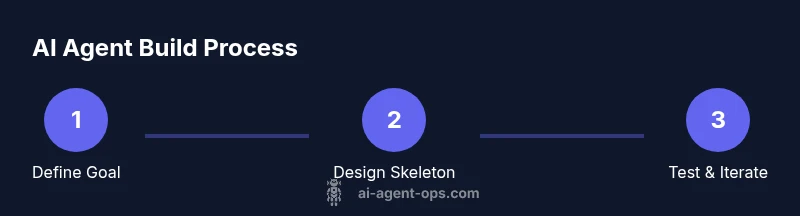
Week 1: clarify the problem, define success metrics, and assemble a small cross-functional team. Create a lightweight prototype that demonstrates core perception, decision, and action loops. Document assumptions and data requirements. Week 2: build the MVP architecture with modular components; implement basic telemetry and logging. Start with a sandbox environment to avoid live-risk exposure. Week 3: run a controlled pilot with a small user group; collect feedback on usefulness, latency, and trust. Refine prompts, tools, and governance controls based on results. Week 4: prepare for a staged rollout, update the playbook, and set up dashboards for ongoing monitoring. This plan keeps momentum while maintaining safety and practicality, ensuring you do not fall into hype-driven promises.
Tools & Materials
- Laptop with a developer environment(At least 16GB RAM; VS Code installed; Python and Node.js available)
- Python 3.x environment(Create virtualenv and manage dependencies)
- Node.js and npm(Optional for JS toolchains and integrations)
- Cloud compute credits or local GPU(For experiments, tests, and scaling pilots)
- API keys and access to tools (LLMs, databases)(Use secrets management; rotate keys periodically)
- Version control (Git)(Track code, prompts, and tool configurations)
- Monitoring/logging stack (e.g., Prometheus, Grafana)(Recommended for production-grade reliability)
- Data governance policy template(Helps codify privacy, access, and compliance)
Steps
Estimated time: 2-4 hours
- 1
Define scope and success
Clarify the problem the agent will solve and write 2-3 concrete success criteria. Align stakeholders on scope to avoid scope drift.
Tip: Document the decision endpoints and exit criteria upfront. - 2
Choose architecture and components
Select a modular skeleton with perception, reasoning, and action adapters. Define interfaces and data contracts for each module.
Tip: Prefer pluggable components to enable quick swaps without rework. - 3
Assemble a minimal viable agent
Build a small agent that can perceive a limited state, decide on a single action, and execute it in a sandbox.
Tip: Lock down prompts and tool calls before expanding scope. - 4
Add governance, safety, and logging
Incorporate guardrails, audit trails, and access controls. Establish incident response and rollback plans.
Tip: Log decisions and outcomes with clear timestamps for debugging. - 5
Set up evaluation and monitoring
Create dashboards for latency, reliability, cost, and user satisfaction. Run baseline tests and compare versions.
Tip: Automate anomaly detection to flag outliers early. - 6
Run a controlled pilot and iterate
Deploy to a small user group; collect feedback; iterate prompts, tools, and thresholds based on data.
Tip: Keep changes small and reversible during early pilots. - 7
Plan for production readiness
Prepare runbooks, SLAs, and a phased rollout strategy. Ensure compliance and governance are in place.
Tip: Document all decisions and maintain a living playbook.
Questions & Answers
What counts as an AI agent in practical terms?
An AI agent is a software system that perceives state, reasons about goals, and executes actions to achieve those goals. It operates within defined boundaries and is auditable. In practice, it combines perception, decisioning, and action with governance to ensure reliability.
An AI agent is a software system that perceives, decides, and acts within set rules, with governance for reliability.
How can I avoid hype when building AI agents?
Start with a concrete problem, define 2-3 key outcomes, and test early with real users. Use a modular architecture and governance to keep scope grounded.
Begin with a real problem, keep scope tight, and test early with real users to avoid hype.
What metrics matter most for AI agents?
Reliability, latency, completion rate, user satisfaction, and safety/compliance metrics are essential. Track baselines and targets, and surface anomalies in dashboards.
Focus on reliability, latency, user satisfaction, and safety metrics with clear baselines.
When should I build vs buy an AI agent?
If time-to-value is critical or domain knowledge is limited, a managed or hybrid solution can help. For deep customization, building a tailored agent may be worthwhile.
Choose managed or hybrid when speed matters; build if you need deep customization.
What are common failure modes for AI agents?
Prompt drift, data quality issues, brittle tool integrations, and missing guardrails are frequent problems. Plan monitoring and rollback strategies to mitigate them.
Watch for drift, data issues, and brittle integrations; have guardrails and rollback ready.
How do I measure ROI for AI agents?
Define value-focused outcomes, track them with observable metrics, and compare against baselines. Use pilots to validate cost-benefit before wider rollout.
Measure value with observable metrics and pilot tests before scaling.
Is there a recommended starting stack for agents?
Begin with modular components and off-the-shelf tools to prove the concept. Expand with bespoke modules only when value is clear.
Start with modular, off-the-shelf tools and add custom parts if value is proven.
Watch Video
Key Takeaways
- Define measurable success before building.
- Choose pragmatic architectures over hype-driven stacks.
- Implement governance and safety from day one.
- Pilot with real users to learn fast.
- Continuously monitor cost, reliability, and ethics.