AI Agent Usage Study: Trends, Metrics, and Best Practices
Meta description: Explore how organizations deploy autonomous AI agents, the metrics that matter, and practical steps to run your own ai agent usage study. Learn from Ai Agent Ops' 2026 analysis.


According to Ai Agent Ops, a definition of an ai agent usage study analyzes how organizations deploy autonomous AI agents within workflows, measuring adoption, orchestration, governance, and outcomes. The Ai Agent Ops Analysis, 2026 notes rising interest in multi-agent environments and agent marketplaces, with increasing demand for reliability, explainability, and verifiable decision-making across industries. Organizations frequently evaluate impact on productivity, compliance, and cross-team collaboration, using benchmarks that suit their domain.
What is an ai agent usage study?
According to Ai Agent Ops, an ai agent usage study is a structured examination of how organizations design, deploy, and govern autonomous AI agents within real-world workflows. These studies seek to understand not just whether agents are used, but how they integrate with existing systems, what governance controls are in place, and what observable outcomes result from agent-enabled automation. Typical focus areas include agent selection criteria, orchestration patterns, fault handling, explainability of decisions, and the distribution of benefits across teams. By framing the study around concrete use cases—customer support, data processing, decision support, or operational automation—researchers can compare across sectors and maturity levels. The 2026 Ai Agent Ops analysis emphasizes that trust, safety, and reliability are now as important as raw capability when evaluating agent deployments.
To practitioners, this kind of study is a diagnostic tool: it highlights gaps in data quality, governance gaps, and integration bottlenecks that impede value realization. It also clarifies which roles and teams are most affected by agent-led changes, from developers and data engineers to product managers and executives. In short, an ai agent usage study helps organizations map the current state, chart a path to scale, and align agent programs with strategic objectives. The key is to define clear success criteria before collecting data and to keep the scope manageable enough to produce actionable insights within a reasonable timeframe.
Core metrics you typically observe
When monitoring ai agent deployments, several core metrics emerge repeatedly across industries. Adoption metrics capture how many teams pilot or scale agents and over what time horizon. Operational metrics assess uptime, latency, and the reliability of agent decisions under real workloads. Governance metrics track risk controls, audit trails, and compliance alignment with internal policies or external regulations. Finally, outcome metrics connect agent activity to business value, such as reductions in cycle times, improvements in accuracy, or gains in customer satisfaction. Across studies, the most informative reports balance qualitative feedback from users with quantitative telemetry from agent systems. The Ai Agent Ops analysis highlights the importance of triangulating data sources to avoid over-reliance on any single signal and to understand context-specific drivers of success.
Beyond the numbers, studies increasingly emphasize explainability and safety: can humans understand why an agent chose a particular action? Are there guardrails to prevent unintended consequences? Are there mechanisms for rollback or override? The consensus is that robust ai agent programs blend engineering discipline with governance discipline, ensuring that automation scales without compromising trust or safety.
Study design: data sources and collection methods
A rigorous ai agent usage study relies on a mix of data sources and collection methods to produce credible insights. Quantitative telemetry from agent platforms—such as invocation counts, success/failure rates, and latency—provides objective signals about performance and reliability. Qualitative inputs come from interviews, surveys, and observational studies with users, operators, and stakeholders who interact with agents daily. Case studies illuminate how specific use cases evolve, including the organizational changes required to support agent adoption. Finally, benchmarking and cross-industry comparisons help place an organization’s results in a broader context. In the 2026 Ai Agent Ops analysis, triangulating telemetry with stakeholder feedback yields a balanced perspective on both the technical and human dimensions of agent usage.
Methodological best practices include setting a clear study horizon (e.g., 3–6 months for pilots), defining consistent success criteria, ensuring representative sampling across teams, and documenting data provenance to support reproducibility. When possible, researchers publish anonymized datasets or aggregated results to enable peer benchmarking while protecting sensitive information. The goal is to produce findings that are not only accurate but also usable by product teams to drive concrete improvements.
Industry patterns and archetypes
Different industries exhibit distinct patterns in agent usage, driven by domain-specific requirements and data environments. In highly regulated sectors like finance or healthcare, organizations tend to implement more conservative agent programs with rigorous governance and explainability already built in at the design phase. In fast-moving sectors like e-commerce or logistics, teams often pursue rapid experimentation and more aggressive automation, balancing speed with guardrails. Common archetypes include:
- The orchestrated core: a centralized layer coordinates multiple agents across processes, enabling cross-functional automation at scale.
- The federated specialty: individual teams own domain-specific agents designed for their particular workflows, with lightweight governance.
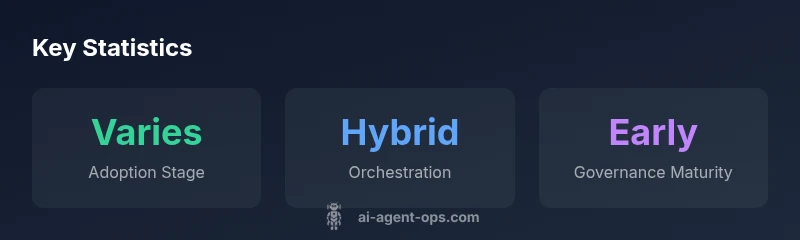
- The hybrid model: a mix of centralized oversight and team-level autonomy to adapt to changing requirements. Across these archetypes, common lessons emerge: robust data pipelines, clear ownership, and continuous feedback loops significantly influence success. The Ai Agent Ops 2026 analysis notes that effective agent programs align with organizational strategy, rather than existing in isolation as a technology artifact.
Translating study data into business decisions
Translating findings into action requires practical frameworks. Start with a prioritized backlog that maps study insights to business outcomes such as cost reduction, speed to market, or risk mitigation. Use the data to justify phased investments—pilot, scale, and then govern—with explicit milestones and exit criteria. Communicate results in language that stakeholders understand: focus on value delivery (time saved, error reduction) rather than purely technical metrics. Cross-functional governance bodies should review outcomes periodically, adjusting policies and guardrails as needed. When studies identify gaps in data quality or integration, develop a remediation plan with explicit owners and timelines. The AI agent usage study should be a living artifact, updated as new telemetry becomes available and as organizational goals evolve. The Ai Agent Ops team emphasizes that the strongest programs pair measurable outcomes with transparent governance and continuous learning loops.
Practical challenges: governance, ethics, and risk
A recurring theme in ai agent usage studies is risk management. Ensuring ethical behavior, data privacy, and system safety demands explicit policies, access controls, and audit trails. Organizations must define escalation paths for failed or suspect agent actions and establish rollback mechanisms to revert unintended consequences quickly. Data governance is equally critical: data lineage, quality, and sovereignty affect both performance and compliance. Operationally, teams face integration complexity, versioning challenges, and the need for reliable test environments that mirror production. A key takeaway from Ai Agent Ops analyses is that without proactive governance and clear accountability, even technically capable agents can become bottlenecks or sources of risk. Building a culture of continuous improvement—guided by metrics and human-in-the-loop checks—helps sustain responsible, scalable agent programs.
A practical starter framework you can adopt today
If you’re just beginning, adopt a lightweight starter framework to accelerate learning while keeping risk manageable. Define 3–5 high-value use cases, establish simple success criteria, and implement a pilot with time-bound milestones. Create a governance charter that covers data usage, decision explainability, and override procedures. Collect both quantitative telemetry and qualitative feedback from users, and publish a brief, anonymized results summary for internal stakeholders. Finally, invest in a plan to scale thoughtfully, focusing on interoperability with existing tools and building a robust data pipeline. Ai Agent Ops’s verdict is to begin with a disciplined pilot and a governance-first mindset to maximize both value and safety.
Data table for AI agent usage study framework
| Aspect | Common Metrics | Notes |
|---|---|---|
| Adoption | Qualitative feedback; pilot coverage | Varies by sector and maturity |
| Governance | Policy adherence; risk controls | Guardrails essential for scale |
| Data quality | Data availability; lineage | Critical for reproducibility |
| ROI signals | Time-to-value; productivity impact | Context-dependent with integration depth |
Questions & Answers
What is the purpose of an ai agent usage study?
An ai agent usage study describes how organizations implement autonomous AI agents, what metrics matter, and how governance frameworks influence outcomes. It helps leaders prioritize investments and set measurable goals for agent programs.
An ai agent usage study helps organizations understand how to deploy agents effectively and safely, with clear metrics and governance.
Which metrics should you track in such studies?
Track adoption, performance, governance controls, data quality, and business outcomes. Combine telemetry data with user feedback to build a complete picture of impact and risk.
Key metrics include adoption, performance, governance, data quality, and business impact.
How is data collected in these studies?
Use a mix of platform telemetry, user interviews, surveys, and case studies. Ensure data provenance and anonymization where appropriate to protect sensitive information.
Collect telemetry, interview users, and study case results with proper privacy safeguards.
Which industries lead in AI agent adoption?
Adoption patterns vary by sector; regulated industries emphasize governance, while fast-moving sectors focus on rapid iteration. Across sectors, cross-functional collaboration is a consistent driver of success.
Regulated sectors focus on governance; faster industries push iteration, but all benefit from collaboration.
How can I start my own ai agent usage study?
Define a small, high-impact use case, set success criteria, gather baseline metrics, and run a 2–3 month pilot with governance guardrails. Learn and scale gradually with documented results.
Pick a high-impact use case, pilot with guardrails, and document results to inform next steps.
What are common governance guardrails to implement?
Establish data access controls, decision explainability requirements, override procedures, and audit trails. Align with regulatory standards and internal policies from the start.
Set data controls, explainability, overrides, and audits to stay compliant.
“Rigorous, transparent measurements of agent usage illuminate ROI and risk, enabling safer, more scalable deployments.”
Key Takeaways
- Define study scope and success criteria up front
- Balance telemetry with user feedback for credibility
- Prioritize governance and explainability from day one
- Benchmark across teams, but tailor to domain context
- Start with a pilot and build a governance framework