Price Comparison AI Agent: Smarter Pricing for Modern Teams
Explore how price comparison AI agents enable real-time pricing benchmarks, boost margins, and stay competitive across channels with AI-driven insights.


Price comparison AI agent refers to software that automatically benchmarks prices across vendors, channels, and promotions in real time. By aggregating live feeds, promos, and stock levels, these agents enable teams to price competitively while maintaining margins. In practice, a pricing team uses a price comparison AI agent to monitor rivals, adjust offers, and surface actionable insights within minutes rather than days.
What price comparison ai agent delivers in practice
Price stability and margin protection are top priorities for product teams, marketplaces, and procurement departments. A price comparison ai agent collects price points from multiple sources—vendor APIs, affiliate feeds, public marketplaces, and promotional signals—and normalizes them into a unified view. It not only shows current prices but also tracks historical trends, inventory status, and seasonality. This enables teams to set dynamic price floors and ceilings while preserving brand integrity. For many organizations, the first benefit is speed: decisions that used to take hours or days can now be made in minutes, with confidence that the numbers reflect real-world conditions. The architecture typically combines data connectors (APIs, web crawlers, and partner feeds), a pricing model layer, and a decision layer that translates insights into actions. The most mature implementations support automated price updates or alerts when a competitor undercuts a key SKU, enabling rapid response that would be impractical to achieve manually. In regulated industries, governance layers guard data provenance, ensure compliance with regional pricing rules, and maintain an auditable trail of adjustments. The price comparison ai agent is not a silver bullet, but it is a strategic tool for aligning price with value in competitive markets.
How signals are collected and processed
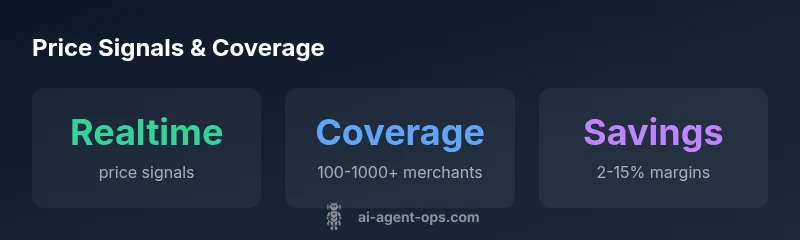
Modern price signals rely on a blend of data sources: real-time price feeds from retailers, official vendor catalogs, and occasional crawls of competitor sites. They harmonize disparate formats using a common data model, then apply business rules to resolve promotions, bundles, bulk discounts, and regional price differences. Latency is critical; the best agents prioritize streaming updates and incremental enrichment to minimize staleness. The data pipeline typically includes: 1) ingestion adapters, 2) cleansing and deduplication, 3) price normalization (currency, unit, and SKU mapping), 4) signal fusion (combining price with stock, shipping costs, and promotions), and 5) the decision module that determines whether to adjust prices, raise alerts, or trigger downstream actions. Risk controls monitor anomalies, such as sudden price spikes driven by bots or data outages, and automatically revert changes if confidence thresholds fall. Throughout, explainability features show users why a price changed and by how much. When executed well, price signals from a price comparison ai agent improve competitiveness while reducing manual work and the risk of human error.
Features to evaluate before adopting
Key features to evaluate include data freshness, breadth of coverage, pricing elasticity support, and governance. Data freshness: how often prices update and how quickly changes propagate. Coverage: number of merchants and regions; elasticity: ability to apply pricing rules under different demand conditions; governance: audit trails, access controls, and regulatory compliance. Performance: latency, accuracy, and resilience. Integrations: compatibility with existing ERP, e-commerce platforms, and BI tools. Security: data encryption, access controls, and privacy considerations. The cost of the agent should be weighed against expected savings; cheaper solutions may trade off coverage or data quality. Additionally, consider user experience: dashboards, alerting, and the ability to export or push updates to your pricing engine. Finally, evaluate vendor support and roadmap for features like MAP (minimum advertised price) enforcement, coupon stacking rules, and regional price localization. A thoughtful evaluation helps you select an implementation that scales with catalog size and business growth, while maintaining trust with customers and partners.
Implementation patterns and governance
Adopting a price comparison AI agent benefits from modular implementation patterns. Start with a narrow catalog, a defined set of rivals, and a baseline pricing rule. Then expand data sources, harmonize SKUs, and layer governance controls that ensure traceability and role-based access. Implement a staged rollout with A/B testing to measure the impact of automated price changes on margins and conversion. Establish clear escalation paths for anomalies, including automated rollbacks and human-in-the-loop checks for edge cases. Governance should cover data provenance, compliance with regional pricing laws, and transparent audit trails that explain why a price moved. Finally, design dashboards that surface key metrics, alerts, and recommended price moves in a concise, actionable format for pricing managers.
Industry use cases: ecommerce, travel, services
In ecommerce, price comparison AI agents optimize list prices across marketplaces, detect undercutting, and surface opportunistic deals to maximize gross margin. In travel, these agents track flight and hotel pricing volatility, taking advantage of seasonality and inventory shifts to protect availability and price integrity. In services and B2B procurement, AI-driven price benchmarking helps negotiate contracts, compare negotiated rates across suppliers, and keep pricing competitive while honoring service-level agreements. Across industries, the consistent thread is using real-time data and AI-powered insights to move faster than competitors without sacrificing value for customers.
Measuring success and compliance
To judge success, teams should track price accuracy, speed to adjust, and impact on margins. Common metrics include price update latency, price deviation from benchmarks, and overall gross margin improvement after implementing the agent. Compliance checks, data provenance, and privacy safeguards should be evaluated regularly to reduce the risk of regulatory violations or data misuse. Establish guardrails for price changes, including minimum uplift requirements, caps on discounting, and periodic reviews of automated decisions. Regular audits and explainability reports help keep pricing transparent to stakeholders and customers while preserving trust.
Manual pricing vs price comparison ai agent
| Aspect | Manual Pricing | Price Comparison AI Agent |
|---|---|---|
| Speed | Hours to days | Minutes to hours |
| Coverage | Limited catalogs | Broad catalogs via live feeds |
| Accuracy | Higher variance | Lower variance with automated signals |
Questions & Answers
What are typical data sources for price comparison AI agents?
Typical sources include real-time price feeds from retailers, official vendor catalogs, public marketplaces, and promotional signals. Data cleansing and normalization are essential to ensure apples-to-apples comparisons across regions and currencies.
Most agents pull from live retailer feeds, vendor catalogs, and promos, then clean and normalize the data for fair comparisons.
Can price comparison AI agents handle regional pricing differences?
Yes. Effective agents factor regional price variations, tax considerations, shipping costs, and regional promotions. They apply region-specific rules to maintain competitive pricing while honoring local constraints.
Absolutely. They account for regional differences and local rules to keep pricing accurate region by region.
How do you assess the accuracy of price comparisons?
Assess accuracy by comparing AI-driven price points to a trusted benchmark set, using metrics like mean absolute error and price deviation. Regular validation helps detect data quality issues and model drift.
You compare the AI outputs to trusted benchmarks and track error metrics over time.
Are there regulatory concerns with automated price adjustments?
Yes. Ensure compliance with pricing laws, disclosure requirements, and fair competition practices. Implement governance, audit trails, and user approval processes to mitigate risk.
There are regulatory considerations; use governance and audits to stay compliant.
What are typical deployment costs and timelines?
Costs vary by scope and data sources. Start with a pilot, estimate ongoing data, compute, and integration costs, and plan for iterative improvements over quarters rather than weeks.
Costs depend on scope; begin with a pilot and scale gradually.
“AI-enabled price intelligence unlocks faster, data-driven decisions by synthesizing real-time price signals with business context.”
Key Takeaways
- Define data sources and coverage before deployment
- Balance speed with governance and explainability
- Pilot with a small catalog to measure impact
- Vet data freshness and supplier integrations
- Monitor metrics and adjust thresholds over time