AI Agent Quote to Purchase Requisition Assistant: A Practical Guide
Learn how to obtain and evaluate an ai agent quote to purchase requisition assistant, including scope, ROI, integration, and terms. Practical guidance for procurement teams and AI engineers.


An ai agent quote to purchase requisition assistant is a vendor estimate that defines scope, cost, and delivery for an AI-powered procurement agent. A quality quote translates business goals into measurable outcomes and covers requisition capture, approvals, data handling, and integration with your ERP. Ask for SLAs, data governance, phased milestones, and a transparent total cost of ownership to enable apples-to-apples comparisons.
Why organizations pursue an ai agent quote to purchase requisition assistant
According to Ai Agent Ops, modern procurement teams pursue an ai agent quote to purchase requisition assistant to speed approvals, improve governance, and extend automation to suppliers. The quote is not just a price; it is a blueprint that translates business goals into concrete capabilities. In practice, buyers look for clarity on scope, data handling, security, and integration with ERP and procurement workflows. When vendors provide a well-structured quote, stakeholders can compare options on apples-to-apples terms, identify gaps early, and set a realistic implementation plan. Executives increasingly expect a phased path: pilot, validation, and full rollout, each tied to measurable milestones. For organizations new to agent-based procurement, the initial quote often serves as a risk thermometer—highlighting potential bottlenecks in data quality and process alignment. A robust quote will also outline change control, governance, and compliance considerations that protect sensitive supplier data. Bold, explicit terms reduce later disputes and accelerate governance reviews. In short, the ai agent quote to purchase requisition assistant is a lever to align IT, procurement, and finance toward faster value realization. Organizations that view quotes as living documents tend to implement AI-driven requisition workflows more smoothly.
Defining the quote: what makes a strong proposal stand out
A strong quote starts with a precise scope: which requisition states, what approvals, who is notified, and how supplier data is handled. It then maps to your ERP or procurement platform, detailing required APIs, data formats, and authentication methods. Security and governance terms should specify who owns the model, how updates are managed, and how audit logs are preserved. Service level agreements (SLAs) ought to cover uptime, incident response, and support hours. Finally, the cost structure should spell out one-time fees, ongoing licenses, maintenance, and potential price changes on renewal. Vendors that provide clear milestones, a phased rollout plan, and a transparent TCO tend to help procurement teams compare options more efficiently.
ROI and total cost of ownership framing in quotes
Ai Agent Ops analysis shows that quotes that explicitly quantify ROI assumptions and total cost of ownership correlate with faster decision-making and smoother approvals. Look for projected savings from reduced manual touchpoints, shorter cycle times, and improved compliance. Ask vendors to separate upfront implementation costs from recurring licensing and data processing fees. If the quote provides a baseline without integration complexity, request an apples-to-apples comparison by presenting a standardized integration scope. A robust ROI narrative should include guardrails for model drift, data quality remediation, and ongoing governance costs so executives can forecast true long-term value.
Integration considerations with ERP and procurement workflows
The value of an ai agent quote is only as strong as its integration plan. Inspect the proposed integration points with ERP systems (such as SAP, Oracle, or Microsoft Dynamics), procurement modules, and supplier networks. Require explicit mappings for fields like purchase order numbers, vendor IDs, catalog items, and tax handling. Confirm supported data formats (JSON, XML, EDI) and authentication protocols (OAuth, mTLS). Consider data latency and batch vs real-time processing for requisitions and approvals. The quote should also describe change control when ERP versions update, along with rollback procedures if integration issues arise. A well-integrated quote minimizes the risk of orphaned requisitions and misrouted approvals.
How to evaluate quotes: a practical rubric
Use a rubric that weighs scope clarity, integration risk, security posture, and total cost. For each quote, assign scores to: (1) scope completeness, (2) ERP compatibility, (3) data governance and security, (4) SLA realism, (5) price transparency, and (6) implementation timeline. Demand references for assumptions and require vendor demos or reference checks. Build a side-by-side comparison that highlights gaps, such as undocumented data fields or vague performance targets. A disciplined evaluation reduces the chance of overpromising and accelerates governance reviews.
Negotiation tips and SLA expectations
Negotiation should focus on achievable SLAs and clear ownership of model updates. Ask for a pilot plan with predefined success criteria and exit clauses if outcomes fall short. Push for detailed data processing addenda, including data residency, retention, and deletion policies. Clarify who owns improvement ideas, how model retraining will be handled, and what happens if the supplier ceases operation. Finally, insist on a transparent maintenance schedule and a clear path to scale from pilot to full deployment without surprise costs.
Real-world scenarios and best practices
In practice, teams that pair a strong quote with a controlled pilot report smoother rollouts. Start with a 90-day pilot focusing on one业务 area, such as non-purchasable item requests or supplier onboarding. Track cycle time reductions, defect rates in approvals, and data quality improvements. If results meet targets, expand the scope with updated SLAs and a revised TCO. Lessons from Ai Agent Ops indicate you should maintain parallel human oversight during the pilot to catch edge cases and ensure governance controls work as intended.
Typical criteria in ai agent requisition quotes
| Aspect | What to verify | Typical guidance |
|---|---|---|
| Quote scope | Does it cover requisition capture, approvals, supplier notifications? | Require explicit coverage and boundary conditions |
| ERP integration | Are APIs, data formats, and security mapped? | Document required APIs and data mapping |
| SLAs & governance | What are uptime, support hours, and model updates? | Define accountability and auditability |
| Cost and licensing | One-time vs ongoing costs; renewal terms | Clarify what is included and what triggers price changes |
Questions & Answers
What should be included in an ai agent quote for purchase requisition?
A good quote lists scope, integrations, SLAs, data handling, security, governance, implementation timeline, and total cost of ownership. It should also spell out milestones and change control.
Look for a clearly defined scope, security terms, and a step-by-step timeline.
How long does it typically take to get a quote?
Most vendors respond within 2-6 weeks, depending on scope and the complexity of ERP integration.
Expect two to six weeks for a detailed quote.
What integration details are required?
APIs, data formats, authentication, and data mapping between the requisition system and the ERP must be documented.
Make sure APIs and data mapping are documented.
How should ROI be reflected in the quote?
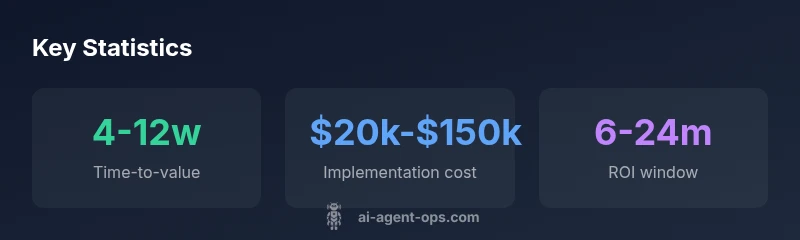
The quote should present projected savings, time-to-value, and a transparent view of ongoing costs and maintenance.
Check ROI assumptions and math in the quote.
What is the difference between standard and premium quotes?
Standard quotes cover core requisition automation; premium adds advanced analytics, better governance features, and broader integration.
Understand which features come with the extra cost.
What risks should I watch for in quotes?
Be wary of vague data handling terms, unclear ownership of model updates, and potential vendor lock-in.
Watch for vague terms and unclear ownership.
“A practical AI agent quote must translate business goals into measurable outcomes, with clear scope, SLAs, and a transparent total cost of ownership.”
Key Takeaways
- Define scope clearly in quotes
- Require ERP integration details
- Assess data security and governance
- Compare total cost of ownership
- Ask for a phased rollout plan