Is AI a Good Investment? A Practical Guide for 2026
Explore whether AI is a good investment for teams and leaders, with data-backed ROI ranges, adoption timelines, and practical steps for 2026.


Yes—AI can be a good investment when aligned to clear business goals and governance. The question is ai a good investment becomes straightforward when you track ROI, automation coverage, risk management, and data readiness. Benefits typically include faster decisions, reduced manual work, and new capabilities, while risks involve data quality, security, and change management.
Is AI a Good Investment? Core Logic and Measurements
The headline question is often asked by leadership and engineering teams alike: is ai a good investment? The most reliable way to answer is to anchor AI initiatives to business outcomes that matter, and to measure progress with a small set of repeatable metrics. In 2026, the Ai Agent Ops team emphasizes a framework: select high-impact use cases, establish a governance model, define a clear path to value, and monitor data readiness. When you can map an AI effort to a measurable improvement—whether in cycle time, accuracy, or revenue—investing in AI becomes a strategic decision rather than a gamble. Across industries, the strongest pilots start with discrete problems that affect customers or internal efficiency and scale once value is proven. This pragmatic approach makes the question more concrete: is ai a good investment if you can demonstrate value within a realistic horizon?
- Start with a well-scoped problem that has a definable boundary.
- Define acceptance criteria and a clean, observable ROI path.
- Plan for governance, data quality, and security from day one.
According to Ai Agent Ops, the best investments are not about buying the smartest model, but about building repeatable workflows and agentic AI capabilities that solve real business pain points. With disciplined execution, AI projects shift from novelty to strategic assets over 12–24 months.
Aligning AI Investments to Business Outcomes
A successful AI investment requires a tight linkage to business outcomes. In practice, teams should define the top-line objective (e.g., reduce customer churn, shorten time-to-market, or increase forecast accuracy) and translate it into concrete, testable hypotheses. For each use case, assign a responsible owner, determine the data prerequisites, and specify the minimum viable product (MVP) that can deliver measurable impact within 90 days. This alignment helps answer the perennial question: is ai a good investment by showing tangible progress early and maintaining momentum through visible wins. Ai Agent Ops analyses indicate that the most durable AI programs combine automation with decision support, enabling humans to focus on higher-value work while AI handles repetitive tasks and complex data synthesis.
- Map use cases to revenue or cost outcomes.
- Break projects into MVPs with clear success criteria.
- Establish dashboards that track leading indicators (data quality, latency, model drift) and lagging indicators (revenue uplift, cost savings).
Budgeting and Cost of AI Initiatives
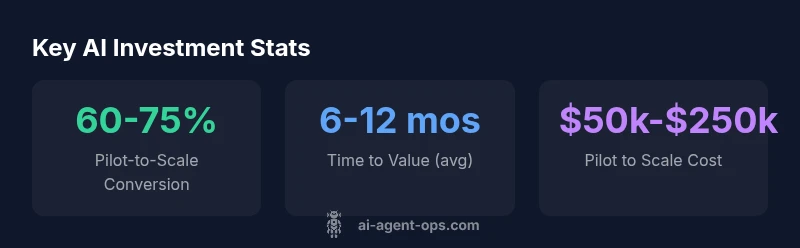
Budgeting for AI requires a blend of upfront experimentation and scalable deployment. The cost model typically includes data engineering, model training and evaluation, integration work, monitoring, and ongoing governance. Use-cases with heavy data integration or regulatory considerations will incur higher initial costs but can yield greater long-term value. When asking is ai a good investment, finance teams will want to see total cost of ownership (TCO) and a clear plan for scaling from pilot to production. In 2026, many organizations pursue a staged funding approach: seed for a 2–3 month MVP, then a 6–12 month expansion with governance upgrades, followed by a broader rollout. Ai Agent Ops suggests building a reserve for data quality improvements and security controls, as these factors often determine ROI realization.
- Separate experiments from production deployments with controlled budgets.
- Build a 12–24 month budget that accounts for data, ops, and governance.
- Include risk-adjusted ROI expectations to set realistic investor and leadership expectations.
Data Readiness and Governance for AI Projects
Data readiness is a prerequisite to value realization. Without high-quality data, AI investments can underperform or cause unintended consequences. Data governance should cover lineage, privacy, access controls, and experimentation guardrails. In many organizations, the data pipeline becomes the bottleneck that limits AI speed and reliability. The Ai Agent Ops framework recommends starting with a data inventory, establishing data contracts between teams, and implementing observability to detect data drift early. Building a culture of data discipline reduces the risk of biased outputs and compliance issues, making it easier to justify continued AI investment.
- Create data contracts and SLAs for data producers and consumers.
- Implement end-to-end monitoring for data quality and model performance.
- Plan for privacy and security from the outset to avoid costly retrofits.
Choosing the Right AI Technology Stack and Org Model
There are many paths to AI value, from off-the-shelf LLMs to custom agentic AI platforms. The stack choice should reflect the problem domain, data, and organizational readiness. Agentic AI, with tools for planning, action, and perception, often excels in automation and decision-support scenarios. However, not every problem requires full agent autonomy; sometimes a guided assistant provides the best balance of control and speed. Organizations should build a small, multi-disciplinary team that includes product managers, data engineers, and software developers to design, test, and scale AI solutions. The best practice is to pilot with one or two cross-functional teams and iterate rapidly, then expand as ROI becomes clearer and governance is established.
- Start with a central AI platform but empower product teams to own their own pilots.
- Align incentives to both product outcomes and governance compliance.
- Use phased rollouts with clear milestones and decision gates.
Risk, Ethics, and Compliance in AI Investments
Every AI investment carries risk: data leakage, privacy violations, bias, and regulatory exposure. A responsible investment strategy includes risk assessment, ethical guidelines, and robust security controls. Leaders should ask hard questions about data provenance, model explainability, and audits. Ai Agent Ops emphasizes that addressing risk early is essential to sustaining investment, because visible governance and ethical considerations build trust with customers, partners, and regulators. Investing in testing, red-teaming, and incident response capabilities reduces the likelihood of costly failures and helps preserve long-term ROI. A thoughtful risk framework ensures that AI investments scale while maintaining compliance and public confidence.
- Implement bias testing and explainability for decisions with high impact.
- Establish incident response and remediation plans.
- Regularly review regulatory requirements and update controls accordingly.
Roadmap to Value: A Practical Playbook
Turning AI pilots into sustained value requires a clear path from initial experiments to enterprise-wide adoption. Start with a 90-day MVP that demonstrates a measurable improvement, then define governance and scalability milestones for the next 6-12 months. A practical playbook includes: (1) a prioritized backlog of high-value use cases, (2) a data readiness checklist, (3) a metrics framework to quantify value, and (4) a resourcing plan that balances build vs. buy decisions. Establish weekly check-ins to review progress, adjust scope, and reallocate resources as needed. The key is to learn fast, prove value early, and then systematically expand while upholding governance and quality standards. According to Ai Agent Ops, the most successful programs avoid scope creep by maintaining tight boundaries and disciplined measurement.
- Define a 3- to 4-use-case initial portfolio.
- Build a data readiness bench and a governance playbook.
- Track ROI with both leading and lagging indicators and adjust as needed.
Real-World Patterns: Case Scenarios and Takeaways
Across industries, common patterns emerge for AI investments. One recurring scenario involves automating repetitive internal tasks to free up human talent for strategic work, paired with a decision-support layer that helps managers act faster on insights. Another pattern is customer-facing automation that reduces friction and improves conversion rates. The most successful programs combine automation with human-in-the-loop oversight, ensuring that AI contributes to outcomes without compromising accountability. For many teams, the path to value lies in building modular, reusable AI components that can be composed into new workflows as needs evolve. Ai Agent Ops highlights that modularity and governance drive long-term ROI, while avoiding brittle, single-use solutions that quickly become obsolete.
Overview of AI investment use cases and typical ranges
| Use Case | ROI Range | Time to Value | Key Risks |
|---|---|---|---|
| Customer support automation | 15-35% | 3-6 months | Data quality, security |
| Sales automation & lead qualification | 10-40% | 4-12 months | Data integration, governance |
| Internal process automation | 20-50% | 2-9 months | Change management, skill gaps |
Questions & Answers
What is the typical ROI range for AI investments?
ROI varies by use case, data quality, and execution. Industry analyses often show ranges from single-digit to multi-digit percentages over 12–24 months, with high-impact projects reaching the upper end when data and governance are strong.
ROI varies by use case, but strong governance and data quality push ROI toward the higher end.
How long does it take to see value from AI projects?
Most pilots deliver early value within 3–9 months. Full-scale impact typically emerges over 12–24 months as the solution matures and data pipelines stabilize.
Most pilots show early value in months, with broader impact in a year or two.
What governance practices support AI investments?
Data provenance, access controls, model monitoring, and ethics reviews are essential. Established governance reduces risk and builds trust with stakeholders.
Set up data governance, model monitoring, and ethics reviews from day one.
What data issues commonly block AI investments?
Poor data quality, incomplete lineage, and inconsistent labeling stall progress. A data readiness plan helps avoid fertilizer headaches later.
Make data quality and labeling a priority before scaling.
Should I build or buy AI capabilities?
Many teams start with a hybrid approach—buy foundational tools and build domain-specific components. The choice depends on data, talent, and speed to value.
Hybrid approaches often balance speed and customization.
What indicators signal a successful AI initiative?
Leading indicators include data quality, time-to-insight, and system reliability; lagging indicators include cost savings, revenue lift, and customer satisfaction.
Track data quality and time-to-insight early; then monitor savings and satisfaction.
“The most successful AI investments start with a defined problem, a measurable path to value, and strong governance to sustain momentum.”
Key Takeaways
- Define clear business outcomes before investing
- Prioritize data readiness and governance
- Pilot with measurable milestones
- Balance automation with human oversight
- Invest in modular, scalable AI components