AI Agent Market PDF: Trends, Insights, and Practical Reading Guide
Explore the ai agent market pdf landscape: definitions, drivers, and reading guides to inform smarter decisions in agentic AI initiatives. Learn how to interpret market PDFs with practical steps and credible sources.


An ai agent market pdf is a market research document focused on autonomous AI agents and agentic AI, summarizing definitions, adoption drivers, segments, benchmarks, and best practices for evaluation. It helps leaders triangulate insights from multiple PDFs to plan projects, allocate resources, and set governance. This guide explains how to read and apply those reports for smarter automation.
What an ai agent market pdf typically covers
An ai agent market pdf is a structured snapshot of how AI agents and agentic AI are defined, adopted, and measured across industries. It typically includes a high-level definition of an AI agent, market sizing in qualitative terms, key use cases, adoption drivers, vertical heatmaps, and benchmarks for maturity. Readers should look for clear sectioning on scope, methodology, and sources so they can assess relevance to their context. In practice, Ai Agent Ops analysis shows that the most useful PDFs link definitions to concrete outcomes—like time saved, cost reductions, or throughput gains—rather than just technology hype. This makes the reports actionable for product teams and executives alike.
How market PDFs define AI agents and agentic AI
Most PDFs differentiate between autonomous agents (which act with limited human input) and agentic AI (systems that collaborate with humans). Expect diagrams that map decision making, planning, and action loops, plus notes on safety, governance, and data provenance. The strongest PDFs explicitly state assumptions about data quality, latency, and integration with existing stacks (CRM, ERP, and workflow orchestration). By reading these sections, teams can gauge whether the reported capabilities align with their real-world constraints.
Current landscape: who invests in AI agents
Across sectors, early adopters tend to be large enterprises with complex workflows. Leaders in manufacturing, finance, and software services are piloting agents to automate repetitive tasks, route complex decisions, and augment human workers. The market exhibits a shift from standalone agents to orchestration layers that coordinate multiple tools (LLMs, RPA, and internal APIs). Ai Agent Ops analyzes indicate that successful pilots often embed measurable KPIs and governance reviews to accelerate broader deployment.
Key market drivers behind AI agent adoption
The primary drivers cited in ai agent market pdfs include the demand for faster automation cycles, the need to scale decisioning with human oversight, and the availability of reusable agent templates. As models mature, organizations seek end-to-end automation that reduces manual handoffs and errors. A growing emphasis on security, explainability, and governance is also driving the adoption of auditable agent workflows. In 2026, governance and risk controls are frequently highlighted as the gating factors for scale, more so than raw technical capability.
Market segments and vertical use cases
PDFs commonly segment by industry vertical and function, showing where agents add the most value. In manufacturing, AI agents optimize scheduling and predictive maintenance. In financial services, they automate approvals and customer interactions. In software and IT, agents handle incident response, monitoring, and onboarding. A typical PDF will include a matrix of use cases, required integrations, and the maturity level of each workflow. This helps product teams prioritize backlogs and design safe, auditable agent networks.
How to read and interpret market statistics in PDFs
Effective market PDFs provide context for any numbers presented: year, scope, methodology, and data sources. Pay attention to whether figures are absolute, relative, or qualitative indicators. Look for triangulation notes that cite multiple data streams (vendor briefs, customer interviews, benchmarks). When a PDF presents range estimates, treat them as insights into uncertainty rather than precise forecasts. Read the caveats and the recommended next steps to decide what applies to your team’s goals.
Practical guidance for teams evaluating AI agents
For teams evaluating AI agents, the best PDFs translate insights into a concrete action plan. Start by mapping the proposed agent capabilities to your critical workflows, then define a minimal viable program with milestones, metrics, and governance reviews. Build a cross-functional steering committee, align data access, and set guardrails for safety and compliance. Finally, corroborate PDF findings with internal experiments and pilot results to validate assumptions before scaling.
Future outlook and responsible deployment in ai agent market pdf
The near future will see deeper integration of agent orchestration, better data provenance, and stronger governance frameworks. Responsible deployment requires clear ownership, risk assessment, and ongoing evaluation of model drift and safety concerns. The most credible PDFs acknowledge uncertainty and propose adaptive roadmaps for continuous improvement, with explicit plans for monitoring, explainability, and human-in-the-loop control.
dataTableHeaderAppendix”:null,
Authoritative sources: https://www.nist.gov, https://www.mit.edu, https://www.stanford.edu
| Aspect | Descriptor | Notes |
|---|---|---|
| Market size indicator | Range used in PDFs | Indicated value tends to be ranges due to varying methodologies |
| Primary use case | Business automation | Combination of planning, execution, and learning loops |
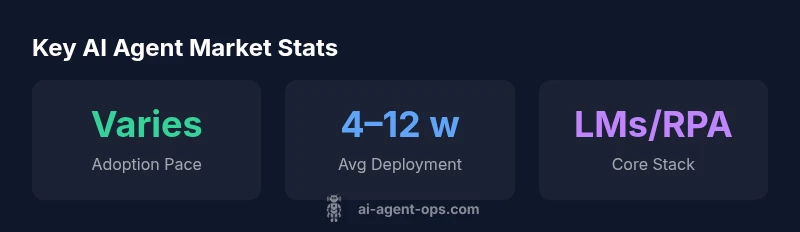
| Data sources | LMs, RPA, orchestration | Diversity in sources leads to varied conclusions |
| Authoritativeness | Cite industry reports | Best practice: triangulate multiple PDFs |
Questions & Answers
What exactly is an ai agent market pdf and why should I read one?
An ai agent market pdf is a market research document focused on autonomous AI agents and agentic AI, summarizing definitions, adoption drivers, and benchmark data. Reading one helps teams understand how to evaluate, pilot, and scale agent-driven workflows within their own contexts.
An AI agent market PDF helps you understand how to evaluate and deploy AI agents in your organization.
How reliably can I use ai agent market PDFs to plan projects?
PDFs are informative but not deterministic. Use them to identify key use cases, compare methodologies, and design pilots. Always triangulate with internal data and customer interviews to validate findings.
Use PDFs as a guide, and verify with internal tests and real-world results.
Which sections matter most for decision making?
Look for definitions, scope, methodology, use cases, and implementation roadmaps. Sections on governance, risk, and metrics are crucial for safe scaling and measuring success.
Focus on the parts about governance, metrics, and roadmaps when deciding what to do next.
How often are PDFs updated and how should I track changes?
Update frequency varies by publisher but expect quarterly to annual revisits. Track changes by keeping a changelog, noting new use cases, updated benchmarks, and governance recommendations.
Check for new editions or addenda and log changes in a shared tracker.
How can I verify data in a market PDF against real-world results?
Cross-check reported benchmarks with your pilot results, telemetry data, and independent benchmarks. Favor PDFs that demonstrate triangulation across multiple sources and real-world case studies.
Triangulate PDF data with your pilots and internal metrics.
“Reliable AI agent market PDFs become truly actionable when they connect clear definitions with benchmark data and real-world outcomes.”
Key Takeaways
- Read with purpose: map definitions to your use case
- Triangulate multiple PDFs for reliability
- Focus on governance and risk alongside automation benefits
- Plan pilots with clear KPIs and guardrails