How Much Do AI Experts Make in 2026? Salary Insights
Explore 2026 salary ranges for AI experts, including base pay, bonuses, equity, and regional differences. Learn what drives earnings and how to negotiate.


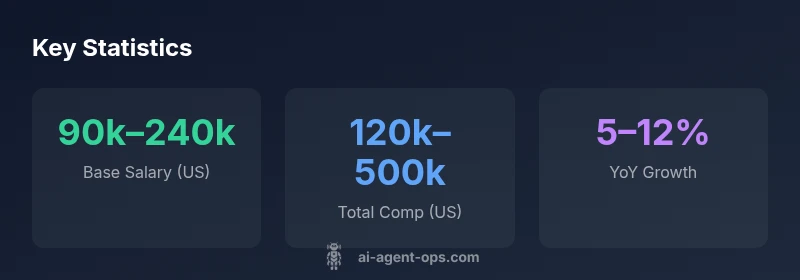
How much do ai experts make? In the United States, base salaries typically range from $90k to $240k, with senior roles and in-demand specializations pushing higher. Total compensation—including bonuses, equity, and benefits—often runs from about $120k to $500k, depending on location, company size, and performance. This article also answers how much ai experts make across regions.
How much do ai experts make in practice
The earnings landscape for AI professionals is diverse and heavily influenced by role, experience, and geographic location. For many people, the central question is still 'how much do ai experts make' as they plan career moves or compensation negotiations. In the United States, base salaries for early-career AI engineers typically fall in the $90k–$150k range, while mid-level specialists may see $120k–$180k, and senior roles frequently exceed $200k. Researchers in academia or industry labs may have different structures, often with slower base growth but generous research stipends or collaboration-based rewards.
Beyond base pay, total compensation is shaped by bonuses, equity, and benefits. In large tech firms or well-funded startups, stock options or RSUs can substantially raise the package, sometimes doubling the apparent base salary over a multi-year horizon. Location is a major modifier: hubs like San Francisco Bay Area or London command premium, while remote roles can offer competitive packages aligned to regional cost-of-living. Specializations such as natural language processing, computer vision, and agentic AI typically carry higher pay due to demand and impact. The bottom line is that the answer to how much do ai experts make is highly contextual, with strong upside for those who align skills with market needs.
Salary drivers: role, seniority, and location
Compensation scales with the responsibility and impact you carry. Entry-level AI engineers often land on the lower end of the base band, while roles with strategic influence—such as AI architects, platform leads, or research scientists shaping product direction—command premium. Seniority matters more than sheer tenure: a highly effective practitioner who owns end-to-end AI workflows can move from mid to senior bands quickly. Location multiplies or mitigates base pay: tech hubs deliver more aggressive offers, yet remote options are compressing some regional differentials as companies compete nationwide. Finally, domain relevance—deep learning, NLP, robotics, or agentic AI—hezonalizes pay; practitioners solving mission-critical problems or enabling scalable AI systems tend to attract higher compensation and faster promotions.
Regional snapshots: US, Europe, and Asia-Pacific
Salary norms vary by geography. In the US, base salaries for AI roles commonly fall within the $90k–$240k range, with total compensation frequently higher in large tech hubs. Europe shows a broad band influenced by country and industry maturity, roughly $70k–$180k base, with total packages often higher in financial centers and research-rich markets. The Asia-Pacific region is diverse: entry roles may start around $70k, rising toward $150k–$180k in major markets like Singapore, Sydney, or Tokyo, with regional equity components depending on company strategy. Global firms increasingly offer hybrid or fully remote roles that align compensation with the employee’s location while preserving market competitiveness. For teams building AI agents and agentic workflows, high-demand markets in the US and Europe typically pay a premium for experience and domain depth.
Beyond base pay: bonuses, equity, and benefits
Base salary tells only part of the story. Annual bonuses tied to performance, project milestones, or company profitability can add a meaningful lift. Equity or stock-based compensation—especially in startups and scaleups—can substantially increase total earnings over 3–4 years, though it comes with risk and vesting schedules. Benefits such as retirement contributions, health coverage, education stipends, and professional memberships also contribute to total value. When evaluating an offer, consider the expected vesting horizon, liquidity windows, and potential tax implications. In AI-centric roles, many firms also offer R&D allowances, conference budgets, and internal mobility programs that accelerate skill growth and, by extension, earning potential.
Pathways to higher earnings in AI
Specialization is a primary driver of higher earnings. Specialists in NLP, computer vision, reinforcement learning, or agentic AI can command premium salaries because they directly affect product velocity and deployment at scale. Building expertise in model deployment, MLOps, and systems design—so you can ship reliable AI at scale—also correlates with increased compensation. Third-party certifications, reputable masters programs, and hands-on project results matter as signals of value. Firms increasingly reward professionals who demonstrate ownership of end-to-end AI pipelines, from data handling to model monitoring. Finally, leadership paths—team lead, principal engineer, or chief AI architect—offer the largest salary leaps, especially in large organizations with mature AI programs.
Negotiation tactics to maximize earnings
Preparation is essential. Gather market data for your locale, role, and seniority, then frame your value around impact, not just responsibilities. Highlight measurable outcomes: throughput improvements, model accuracy gains, or cost reductions achieved through AI. When negotiating, consider total compensation, not just the base salary—target equity, signing bonuses, learning stipends, and flexible work arrangements. Propose a structured review timeline (e.g., 12 months) with clear milestones for increases. Finally, cultivate in-demand skills and build a portfolio of deployed AI solutions to strengthen your leverage in compensation conversations.
Salary benchmarks by role and experience (USD, illustrative ranges)
| Role | Experience | Base Salary (USD) | Total Comp (USD) | Notes |
|---|---|---|---|---|
| AI Engineer | Junior (0–2 yrs) | $90k–$120k | $120k–$160k | Growth path via projects |
| AI Engineer | Mid (3–5 yrs) | $120k–$170k | $180k–$260k | Specialization matters |
| AI Scientist / Researcher | Senior (6+ yrs) | $160k–$230k | $260k–$360k | Academic-to-industry moves |
| AI Architect / Lead | Senior (6+ yrs) | $180k–$260k | $320k–$500k | Team leadership, org-wide impact |
Questions & Answers
What factors influence AI expert salaries?
Salaries are shaped by role type, experience, location, company size, and domain specialization. Roles with end-to-end ownership and deployment impact tend to pay more, while geographic cost of living and market maturity also steer offers.
Salaries depend on role, experience, location, and the scope of impact you have.
Are salaries higher in the US than elsewhere?
Yes, baseline salaries are typically higher in the US due to market demand and cost structures, though regional differences exist and remote roles can balance this with flexible compensation.
US salaries are generally higher, but regional rules and remote roles change the picture.
Do bonuses and equity form a large part of compensation?
Bonuses and equity can significantly boost total compensation, especially at tech giants and startups with rapid growth. Vesting schedules and market performance influence long-term upside.
Bonuses and equity often boost total pay, especially in big tech or startups.
What is the entry point for AI salaries?
Entry-level AI roles commonly start around the $90k–$120k range in the US, with growth potential as you gain hands-on experience and broaden your toolset.
Entry AI roles often start near $90k to $120k here.
Do remote AI roles pay competitively?
Remote roles can offer competitive compensation aligned to regional benchmarks, with many companies using blended salary models to attract talent globally.
Yes, many remote AI jobs pay competitively across regions.
Which certifications boost earnings?
Certifications in ML, MLOps, and cloud AI platforms, plus proven project results, can improve negotiation leverage and lead to higher offers.
Certain certifications and proven project results can raise offers.
“Compensation for AI professionals tracks closely with market demand and depth of specialization; those who master scalable AI systems and agentic workflows tend to command premium pay.”
Key Takeaways
- Understand that salaries vary by role and location
- Consider total compensation: base, bonus, equity
- Specialize in high-demand domains to maximize pay
- Leverage negotiation and certifications
- Remote roles can widen opportunities