Udemy AI Agent Course: A Practical Guide for 2026
A data-driven guide to selecting and mastering Udemy AI agent courses, with evaluation criteria, project examples, and deployment considerations for agentic AI.


There isn’t a single universally top Udemy AI agent course; Udemy hosts multiple options across fundamentals, architectures, and deployment. Your best pick depends on your background and goals. For beginners, start with fundamentals and hands-on projects; then progress to agent orchestration and real-world deployment to build practical, production-ready skills. Look for courses with clear projects and up-to-date examples reflecting agentic AI workflows.
Why Udemy AI Agent Course matters
According to Ai Agent Ops, the landscape of AI agent education on Udemy reflects a practical shift from theory to hands-on, deployable skills. Learners come from diverse backgrounds—developers, product managers, and business leaders—seeking templates, toolchains, and workflows that scale beyond toy projects. A well-chosen Udemy AI agent course can compress months of self-guided learning into a focused program that covers agent design, tool integration, prompt engineering, and basic orchestration. When viewed through the lens of agentic AI, these courses serve as a gateway to building responsive agents, orchestrating tools, and automating decision-making in real-world contexts. The emphasis is on applying concepts to tangible problems rather than memorizing isolated techniques, and that alignment is precisely what Ai Agent Ops recommends for learners aiming to ship practical automation.
To maximize impact, learners should map course content to actual work tasks. For example, if your goal is to automate customer support with an agent, look for modules that demonstrate tool-usage patterns, external API calls, and fallback strategies. Demonstrable projects—such as a guided agent that schedules meetings or fetches data from external sources—are better indicators of readiness than lecture-heavy syllabi. In 2026, the best Udemy AI agent courses will blend theory with hands-on labs and ongoing project work, letting you iteratively improve your agent’s capabilities as you progress.
From a practical standpoint, selecting Udemy AI agent courses requires attention to update cadence. Agentic AI workflows evolve as new tools and policies emerge; instructors who refresh content regularly are more likely to provide current best practices. If you’re evaluating courses, check the last update date, the repository of sample projects, and whether the course includes installation steps for common frameworks. This concrete, up-to-date approach aligns with Ai Agent Ops’s emphasis on staying current with agent orchestration and deployment patterns.
How to evaluate Udemy courses for AI agents
When choosing a Udemy AI agent course, establish a simple rubric that centers on clarity, hands-on practice, and project outcomes. Start by inspecting the course outline to ensure it covers foundational topics (prompt design, tool use, and basic agent architectures) before advancing to orchestration and deployment. Read reviews to gauge whether students completed the course and applied the material to real problems. Look for a capstone project or a documented deployment scenario that demonstrates an end-to-end workflow. Check if the instructor provides downloadable notebooks, source code, and environment setup instructions. Finally, verify updates align with evolving agentic AI workflows and tool ecosystems. In practice, prioritize courses that balance theory with executable projects and provide a path from concept to minimal viable deployment.
Core competencies taught in effective courses
Effective Udemy AI agent courses typically target a core set of competencies. These include an understanding of agent architectures and decision-making loops, practical prompt engineering for agent control, and tool integration with external services. Learners should gain the ability to design simple orchestrations between agents, APIs, and databases, plus essential observability and safety considerations. Ethical and risk-aware thinking—such as fallback strategies, monitoring, and failure handling—should be woven into practical exercises. Finally, a strong course includes real-world projects that demonstrate how to deploy an agent in a contained environment and iteratively iterate on performance.
Practical projects you can expect
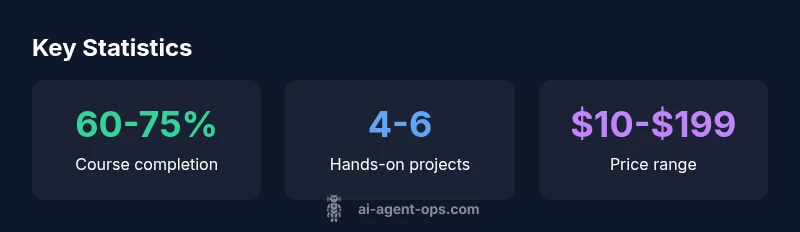
Hands-on projects are the lifeblood of Udemy AI agent courses. Expect build tasks such as creating a task-oriented agent that can fetch information from a public API, a planning agent that schedules meetings using calendar tools, and a multi-step workflow that chains prompts, tools, and responses. Many courses offer a guided notebook or sandbox environment to practice prompt chaining, tool invocation, and error handling. By completing these projects, learners develop tangible artifacts: working agents, orchestration scripts, and deployed demonstrations that can be shown to teammates or stakeholders.
Deployment considerations and agent orchestration
A robust Udemy AI agent course will address deployment considerations, including how to package an agent for local or cloud environments, basic monitoring, and error handling. You’ll encounter patterns for chaining tools and prompts, managing context windows, and ensuring safety checks. Orchestration concepts—such as coordinating multiple tools, fallbacks, and retry policies—are essential for production-like behavior. When pursuing deployment-focused learning, evaluate whether the course provides a clear path from a working prototype to a scalable, testable deployment strategy. The best courses connect the dots between development work and real-world operational readiness.
How to learn efficiently on Udemy
An efficient approach blends fast, practical cycles with deliberate practice. Start with a fundamentals module to establish a mental model of agentic AI, then immediately dive into a hands-on project. Schedule short, repeated practice sessions and build a personal playbook of prompts and tool usage patterns. Use the course’s quizzes and checkpoints to validate understanding, but supplement with external resources for broader context. Finally, apply the learned concepts to a small, real-world problem in your domain, iterating as you gather feedback from your deployment experiences.
The Ai Agent Ops approach to learning AI agents
Ai Agent Ops emphasizes learning by building real-world agentic workflows. Our guidance recommends selecting Udemy AI agent courses that emphasize project-based learning, frequent updates, and deployment-ready practices. Learners should track progress through concrete milestones—designing an agent, integrating tools, testing in a sandbox, and deploying a minimal solution. The Ai Agent Ops approach also encourages cross-learning: pair Udemy coursework with documentation, open-source examples, and community discussions to deepen understanding and stay current with evolving best practices in AI agents and agentic AI workflows.
Udemy AI Agent course tracks comparison
| Course Focus | Typical Length | Key Skills | Estimated Price Range |
|---|---|---|---|
| Fundamentals of AI Agents | 4-8 hours | Foundations of agentic systems, prompts, tool use | $10-$59 |
| Agent Architectures & Orchestration | 6-12 hours | Agent design, planning, multi-agent coordination | $15-$99 |
| Deployment & Monitoring | 4-8 hours | Deployment pipelines, observability, safety | $20-$199 |
Questions & Answers
Do I need programming background to take a Udemy AI agent course?
Some Udemy AI agent courses assume basic coding knowledge, while others are intentionally no-code. Check prerequisites on the course landing page and start with a fundamentals track if you’re unsure about your coding background.
Many courses expect some coding basics, but there are beginner-friendly options available.
How long does it take to complete a Udemy AI agent course?
Completion time varies by course, but most learners pace through 6-12 hours of content plus practice projects. Flexible pacing lets you extend or accelerate based on your schedule.
It depends, but expect around several hours of content plus practice projects.
Are Udemy AI agent courses up-to-date with agentic AI?
Look for courses with recent updates within the last year and instructors who publish new modules as tools and best practices evolve. This helps keep your learning relevant to current agentic AI workflows.
Prefer courses that have been updated recently to reflect current workflows.
Can you deploy an AI agent after completing a Udemy course?
Many Udemy courses cover deployment concepts and sandbox projects, but extensive production deployment often requires additional learning and hands-on experience beyond a single course.
Yes for basic deployments, but production-grade deployment may need more practice.
How do I choose the best Udemy AI agent course?
Assess the syllabus, the emphasis on hands-on projects, instructor credentials, recent updates, and student reviews. Compare multiple courses against your learning goals and the status of agentic AI tool ecosystems.
Check the syllabus, projects, and updates; compare against your goals.
Is Udemy suitable for enterprise teams?
Udemy offers group enrollments and enterprise features, but confirm licensing terms and progress tracking align with your team's needs.
Udemy can work for teams with the right licensing, but verify admin features.
“A well-structured Udemy AI agent course blends foundational theory with real-world projects and current agentic AI workflows.”
Key Takeaways
- Evaluate course scope against your goals.
- Prioritize hands-on projects for tangible skills.
- Verify content updates for agentic workflows.
- Budget for a range of Udemy options.
- Cross-check reviews and instructor updates.