How to identify ai agents
Learn how to identify ai agents in your systems, distinguish them from ordinary software, and apply a step-by-step process to assess autonomy, decision-making, and safety.


This guide helps you identify ai agents by examining observable behavior, autonomy, and tool usage. You’ll learn practical signals, compare against scripted systems, and follow a structured checklist to verify agentic capabilities in real-world scenarios.
What is an AI agent? Definition and scope
Identifying ai agents starts with a clear definition: an AI agent is a software entity that can perceive its environment, select actions, and execute those actions to achieve defined goals, often using machine learning, planning, or language models. In the context of modern software systems, agents can operate autonomously or semi-autonomously, learning from feedback and adapting to changing conditions. When we discuss how to identify ai agents, we’re looking for components that exhibit goal-directed behavior, not just fixed rule-based logic. This section lays the groundwork by distinguishing agents from traditional programs: agents act with intent, leverage models to infer a course of action, and may coordinate with other services or tools to accomplish outcomes. The Ai Agent Ops team emphasizes that real-world agents blend perception, reasoning, and action, making their behavior observable but not always deterministic.
Key signals that an interface is an AI agent
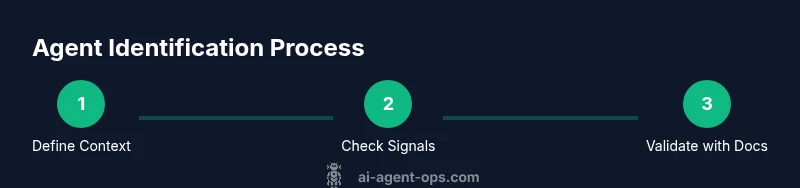
Several signals help you spot agentic behavior in practice. First, look for dynamic decision-making that depends on current inputs and past interactions, rather than a fixed script. Second, observe the use of external tools or services (APIs, databases, or ML models) to perform tasks in sequence or in parallel. Third, note any long-running processes that pause for evaluation, generate plans, and then execute actions across multiple steps. Fourth, pay attention to natural language interactions that reveal reasoning steps or chain-of-thought-like behavior, even if surfaced through a constrained UI. Finally, inspect histories or logs for how decisions evolved over time, which can reveal feedback loops and learning from prior outcomes. Ai Agent Ops notes that reliable signals combine autonomy with verifiable traces, not just clever responses.
Differentiating AI agents from traditional software
Traditional software tends to follow predefined flows: input, processing, and output with little variation. AI agents, by contrast, exhibit adaptive behavior, prioritize goals, and often break tasks into subgoals. They may plan several steps ahead, fetch information from external sources, and adjust plans when new data arrives. The key difference lies in intentionality: agents choose actions based on perceived state and objectives rather than simply executing hard-coded instructions. Another distinction is the presence of models, learning components, or probabilistic reasoning that influences decisions. When identifying ai agents, you should expect to see some level of randomness or probabilistic outcomes across runs, even if constrained by safety rails or guardrails. The combination of perception, planning, and action is a strong indicator of agentic design.
Behavioral traits to observe in operation
Behavioral traits provide practical cues for identification. Look for goal-driven actions, not just reactive responses. Agents often change tactics if a plan fails, display curiosity by seeking new information, or reorganize their approach based on outcomes. They may leverage tools (like search APIs, calculators, or data stores) and reason about trade-offs before acting. Logs can reveal iterative improvement loops, such as adjusting prompts, re-ranking options, or refining models used to decide next steps. A robust agent will show traceable decision paths that you can audit, even if some internal computations remain opaque. Remember, consistent behavior is not the same as predictable behavior; agents should be reliable under constraints but may vary in micro-actions as they optimize for goals.
Common architectures and how they reveal an agent
Behind every AI agent, there’s an architecture that supports perception, reasoning, and action. You’ll commonly encounter a core decision engine or orchestrator that receives inputs, runs models or planners, and schedules actions across tools or services. A separate memory or context store helps maintain state and history, enabling smarter responses over time. Many agents are built with layers: a user-facing interface for inputs, a reasoning layer that might use LLMs or rules, and an action layer that executes tasks via APIs. By inspecting architecture diagrams, API calls, and the sequence of tool invocations, you can infer whether a system behaves like an agent or simply a scripted workflow. The presence of an orchestration layer coordinating multiple components is a strong signal of agentic design.
Hands-on identification checklist
Use this practical checklist to steadily verify AI agent characteristics. First, confirm there is an explicit goal and measurable objective. Second, check for autonomous decision-making with actions taken without direct human prompts. Third, look for use of external tools and data sources beyond static code. Fourth, review logs for evidence of planning, evaluation, and adaptation. Fifth, assess whether the system can explain its choices at a high level or provide rationale. Sixth, verify if change and learning occur over time through feedback loops. Finally, ensure provenance and auditability of decisions. Completing all items strengthens the case that a system is an AI agent rather than a traditional program.
Challenges and caveats: limitations of identification
Identifying AI agents isn’t foolproof. Some systems imitate agent-like behavior using scripted decision trees or rule-based planners, which can mask a lack of true autonomy. Others may incorporate small agent components or hybrids that only appear agent-like under specific conditions. Network latency, partial observability, and data quality can obscure genuine agentic activity. Be cautious of bias in prompts or tools that artificially improve perceived autonomy. If you cannot see a clear rationales or decision traces, treat the claim as inconclusive and continue gathering evidence before drawing firm conclusions.
Ethical and safety considerations when identifying AI agents
Ethics and safety matter in every identification exercise. Respect user privacy and ensure that data collection complies with policies and regulations. Avoid exposing sensitive prompts, internal reasoning traces, or confidential tool usage, unless you have explicit authorization. Consider risk assessment: agents with high autonomy can impact systems or user data; ensure proper guardrails, auditability, and containment mechanisms are in place. Document any governance concerns uncovered during identification, and align findings with organizational risk tolerances and compliance requirements.
Practical examples: scenarios in product teams
Scenario 1: A product team suspects a deployed feature uses an autonomous agent to summarize user feedback and decide on response actions. By reviewing logs, you find the system queries a language model, evaluates options against defined goals, and executes actions through a messaging API. Scenario 2: A customer support bot appears to draft responses and then escalate only certain cases. Analyzing the interaction history reveals planning steps and tool use to fetch order data, confirm details, and decide on sentiment-adjusted messaging. In both cases, apply the identification rubric, confirm autonomy, and verify safety controls before making changes to the product design or governance.
The Ai Agent Ops perspective on identification outcomes
The Ai Agent Ops team emphasizes a structured, evidence-based approach to identify ai agents. By combining observable behaviors with architecture insight and documented testing, teams can distinguish genuine agentic systems from scripted components. A transparent identification process supports safer deployment, clearer accountability, and improved collaboration between engineers, product managers, and safety officers. The end goal is a robust understanding of where autonomy exists, how it operates, and what controls are in place to ensure predictable, auditable behavior.
Tools & Materials
- Observation notebook(Record interactions, prompts, actions, and outcomes during testing sessions.)
- Access to logs and audit trails(Collect API calls, decision timestamps, and tool usage.)
- Test prompts and scenarios(Predefined tasks to test agent behavior.)
- Evaluation rubric(Criteria to rate detectability, reliability, and safety.)
- Data privacy checklist(Ensure compliance with policies when handling data during tests.)
- Environment sandbox or simulator(Optionally isolate tests to prevent impact on production.)
Steps
Estimated time: Total time: 1-2 hours
- 1
Define what counts as an AI agent in your context
Establish a clear boundary for what you will classify as an AI agent in the project. Document expected autonomy, tool usage, and decision-making processes. This clarity prevents later disagreements about what qualifies as an agent.
Tip: Create a written boundary that includes at least one example of a system you consider an AI agent. - 2
Collect representative samples of agent interactions
Gather diverse interactions across typical tasks and edge cases. Include prompts, inputs, intermediate states, and final outcomes to capture the agent’s behavior under varying conditions.
Tip: Aim for at least 20-30 representative interactions to build robust evidence. - 3
Identify observable decision-making patterns
Look for steps where the system chooses between multiple options, reasons about trade-offs, or delays action to wait for new data. Note any planning phase before action.
Tip: Differentiate between deterministic branches and probabilistic choices. - 4
Cross-check with architecture docs and logs
Compare observed behavior to documented architecture, including any model usage, tool orchestration, or planning modules. Logs should reveal the sequence from perception to action.
Tip: Prioritize corroboration from multiple sources (docs, logs, interview notes). - 5
Differentiate from scripted routines
Identify whether actions follow a fixed script or adapt based on input. True agents show adaptive behavior beyond a single decision path.
Tip: Test edge cases that require novel problem-solving beyond the script. - 6
Assess environmental feedback loops and learning
Check for feedback from outcomes that alters future behavior, such as updated prompts, prompts, or policy changes based on results.
Tip: Document whether learning is offline (batch updates) or online (in-loop learning). - 7
Validate with stakeholders and use-case alignment
Present findings to product, safety, and legal teams to ensure alignment with goals and governance requirements.
Tip: Gather diverse perspectives to avoid bias in interpretation. - 8
Document findings and update the identification rubric
Capture evidence, conclusions, and any caveats. Update your rubric to reflect lessons learned for future identifications.
Tip: Store findings in a centralized repo with version history.
Questions & Answers
What is an AI agent?
An AI agent is a software entity that perceives its environment, reasons about actions, and executes those actions to achieve goals. It often uses models, planning, or learning components to adapt to new data.
An AI agent perceives the world, reasons about actions, and acts to achieve goals. It often uses models and learning to adapt.
Can regular software be mistaken for an AI agent?
Yes, especially when systems are highly scripted or use AI components behind the scenes. You should verify autonomy through behavior, tool usage, and logging rather than assumptions from interfaces alone.
Sometimes scripts mimic agent-like behavior. Check autonomy, tools, and logs to confirm.
What tools help identify AI agents?
Key tools include access to system logs, architecture diagrams, test prompts, and outcome records. Evaluating tool usage and decision traces helps distinguish AI agents from non-agent software.
Use logs, architecture docs, and tests to uncover agentic behavior.
Why is accurate identification important?
Accurate identification informs governance, safety controls, and risk management. It helps teams design appropriate safeguards and ensures accountability for automated decisions.
Knowing when an AI agent is at work helps us govern its behavior safely.
How should we handle privacy during identification?
Respect data policies and minimize exposure of sensitive prompts or data. Seek authorization and log only what’s necessary for verification.
Protect privacy by limiting data exposure and getting proper authorization.
What if evidence is inconclusive?
Mark the finding as inconclusive, expand data collection, and re-test. Avoid premature labeling and document the uncertainties.
If unclear, don’t label it yet—collect more evidence and re-check.
Watch Video
Key Takeaways
- Identify clear agent goals and observable planning.
- Differentiate autonomy from scripted routines with logs.
- Use a structured rubric and stakeholder validation.
- Prioritize ethics, safety, and auditability in identification.