How Do AI Agents Make Decisions? A Practical Guide for Developers
Explore how AI agents make decisions across paradigms, from rule-based to reinforcement learning, with practical evaluation, safety, and governance guidance for reliable agentic AI.


How AI agents decide is a blend of goals, constraints, and environmental signals. From rule-based systems to learning-enabled agents, this guide explains decision-making paradigms and practical evaluation for reliable agentic AI. You’ll learn when to apply each approach, how to handle uncertainty, and how to audit decisions for safety and fairness.
What does it mean for AI agents to make decisions?
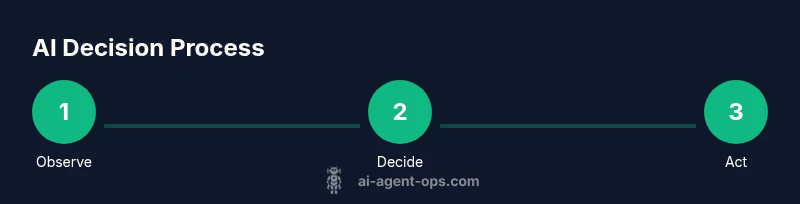
According to Ai Agent Ops, how do ai agents make decisions is a function of goals, context, and the available actions. In practical terms, an agent observes the environment, interprets signals, and selects a course of action that advances its objective within any given constraints. Decision-making is not a single event; it's an ongoing loop: sense, decide, act, observe results, and adjust. The key distinction is between deliberate planning and reactive responses, both of which are common in real-world AI agents. This section defines the core pieces: goals, constraints, signals, actions, and feedback. You will encounter several paradigms, from rigid rule-based logic to probabilistic reasoning and modern learning-based policies. The central question is not only what to do, but why this choice makes sense given the current situation, the data quality, and the system's safety requirements. Throughout, think about the tradeoffs between speed, accuracy, and interpretability, because those tradeoffs shape every subsequent design choice.
Core decision-making paradigms
AI decision making rests on several paradigms that organizations pick based on constraints like latency, data availability, and risk tolerance. The basic dichotomy is between explicit rule-based systems and learning-based approaches. Rule-based systems rely on predefined policies, decision trees, and if-then logic. They are predictable and auditable but can be brittle when faced with novel situations. Learning-based approaches use data to infer behavior: supervised learning, unsupervised discovery, and, increasingly, reinforcement learning. They excel in complex or dynamic environments but require careful validation to avoid unexpected behavior. A hybrid approach is common: fast rule-based checks guard a more flexible learned component. In addition, probabilistic methods introduce explicit uncertainty modeling, producing distributions over outcomes rather than single points. This enables risk-aware decision making, especially in safety-critical domains. Finally, agent architectures increasingly rely on modular pipelines and policy-based controllers, where the high-level objectives guide lower-level actions. Understanding where each paradigm shines helps engineers design robust, adaptable agents.
Rule-based systems and decision trees
Rule-based systems encode domain knowledge as explicit rules, often in a rule engine or decision tree. Each rule maps patterns in the observed state to actions or subgoals. The advantage is clarity: developers can explain decisions by tracing the rule path. The downside is brittleness: when inputs drift or scenarios are unseen, rules may fail or escalate to default behaviors. Decision trees provide hierarchical branching that mirrors human reasoning and can be interpreted easily. In practice, many agents implement guardrails: a top-level decision tree decides on the mode (e.g., operate, suspend, escalate), while subtrees handle context-specific choices. To keep these systems effective, teams maintain a living ruleset, monitor for rule conflicts, and retire outdated rules. A common tactic is to separate invariant checks (safety, compliance) from task-specific logic, so risk controls never depend on app logic. This separation improves maintainability and reduces unintended consequences.
Probabilistic reasoning and uncertainty
Probabilistic reasoning treats knowledge as uncertain and uses probabilities to represent belief about the world. Techniques include Bayesian inference, Kalman filters, and probabilistic graphical models. In AI agents, uncertainty is not a nuisance to be eliminated; it is a core input to decision making. Agents propagate uncertainty through the decision process, often producing a distribution over possible actions and outcomes. This allows agents to quantify risk and decide when to hedge, delay, or ask for more information. Practical implementations include probability thresholds that trigger safe-mode behaviors, or confidence-weighted actions where low confidence reduces autonomy. The challenge is calibrating probabilities to reflect real-world frequencies and ensuring that updates reflect new evidence quickly. When data quality is poor or noisy, probabilistic approaches shine by maintaining reasonable behavior rather than committing to confident but wrong conclusions.
Machine learning-based decisions
Machine learning-based decisions rely on models learned from historical data. Supervised models predict a score for each possible action; reinforcement learning models learn policies that maximize long-term reward. The advantage is adaptability: models improve as new data arrives and environments evolve. The downside is opacity: many models act as a black box, making it harder to explain why a choice was made. To mitigate this, engineers use interpretable architectures where possible, add post-hoc explanations, and monitor for distribution shifts. Feature engineering matters: high-quality signals—context, history, and user intent—improve accuracy. Data governance matters too: ensure data sources are representative and free of bias, with robust privacy controls. In production, model monitoring should track drift, latency, and reward signals to detect degraded decision quality quickly. A well-designed system combines rule-based guardrails with learning-based decision modules to balance reliability and flexibility.
Reinforcement learning and agent-environment interaction
Reinforcement learning (RL) treats decision making as a trial-and-error process in a given environment. An agent takes actions, observes rewards and next states, and updates a policy to maximize cumulative reward. The mathematical backbone are Markov decision processes (MDPs) and value functions. In practice, RL is powerful for sequential decision making under uncertainty, such as planning a sequence of steps for a robotic agent or a chat assistant that must manage a multi-turn conversation. However, RL requires careful design: reward shaping, exploration-exploitation balance, and efficient simulation. Transfer learning, curriculum learning, and safe exploration techniques help bridge the gap between simulation and real-world deployment. Contextual or multi-agent RL extends these ideas when several agents interact, or when context changes across users. Engineers often combine RL with supervised pre-training to accelerate learning and to keep base behaviors aligned with business goals and safety policies.
Policy, goals, and constraints in decision making
At the top level, an AI agent's behavior is driven by policies that map observations to actions. Goals express the desired end state; constraints encode safety, legal, and ethical boundaries. A clear policy design aligns incentives with measurable outcomes, enabling easier audits and governance. Hierarchical policies break decisions into planning (long horizon) and execution (short horizon). The environment supplies signals and feedback; the agent uses these to adjust its policy. Constraints may include latency budgets, resource limits, or privacy requirements. When constraints bite, agents may switch modes—prioritizing safety checks over speed, for example. Good policy design includes explicit handling of failure modes and escalation paths, so that when confidence is low, human oversight or watchdog components intervene. This discipline reduces risk and improves trust in agentic systems.
Explainability, transparency, and auditing decisions
Explainability is not a luxury; it's a design requirement for many deployments. Techniques range from feature attributions in ML models to rule-traceability in symbolic systems. Agents should produce justifications adequate for operators to understand why a decision occurred, not just what happened. Auditing requires reproducible logs, versioned models, and tamper-evident records of decisions. Techniques like counterfactual explanations, sensitivity analyses, and scenario drills help stakeholders challenge and validate behavior. The goal is to support accountability without compromising performance. In regulated domains like finance or healthcare, explainability is often codified into policy and governance. For developers, this means building interpretable interfaces for monitoring systems, designing transparent prompts and prompts-chains, and documenting decision criteria. The result is greater trust, easier debugging, and safer deployment in dynamic environments.
Safety, ethics, and governance
AI safety and ethics cover a spectrum from algorithmic fairness to governance frameworks. Agents should avoid biased outcomes, respect user privacy, and operate within legal constraints. A governance model includes roles, responsibilities, and escalation paths for incidents. Practical steps include risk assessments, red-teaming, bias audits, and safety constraints that are hard-wired into the decision loop. Organizations should define a 'safety envelope'—the set of behaviors that are permissible under all circumstances—and implement monitoring to detect violations. This block also discusses accountability: who is responsible when a decision causes harm, how to supervise agents in production, and how to patch or retract problematic policies quickly. Finally, ethical guidelines demand ongoing education for teams and transparent communication with users about how decisions are made.
Practical evaluation: metrics and testing strategies
Evaluation determines whether an AI agent's decisions meet functional and ethical standards. Key metrics include task success rate, response time, and safety violation rate. In addition, calibration metrics measure how well predicted confidences match actual outcomes. A/B testing, simulation environments, and live-canary deployments help validate behavior under controlled conditions. Testing must cover corner cases, distribution shifts, and adversarial inputs. Diagrams of decision pipelines assist reviewers in tracing how outcomes depend on inputs and intermediate signals. To ensure reliability, implement continuous evaluation, track drift in data, and maintain a rigorous rollback plan. Document experiments with clear hypotheses, success criteria, and reproducible code. The aim is to detect problems early and prevent unsafe decisions from reaching end users.
Real-world examples across domains
AI agents appear in customer service, robotics, finance, and smart infrastructure. In customer support, agents balance user context, policy constraints, and long-term satisfaction signals. In robotics, agents optimize motion plans under sensing and actuation noise. In finance, decision agents select trades with risk controls and regulatory constraints. In smart cities, agents coordinate traffic signals and energy use, balancing efficiency and safety. Each domain highlights different decision pressures: latency, interpretability, data availability, and safety. Across cases, the common thread is the need for robust logging, explainable reasoning, and governance that scales with the system. Readers should study domain-specific decision criteria and design agents that can gracefully recover from errors and escalate when uncertainty increases.
Design and debugging best practices for AI agents
Design for testability and observability from day one. Start with simple baselines and progressively add complexity, validating decisions at each step. Use modular architectures with clear interfaces between perception, reasoning, and execution components. Instrument decisions with structured logs, timestamps, and versioned models. When debugging, reproduce failures in a controlled environment, compare decisions across variants, and use counterfactual analyses to understand sensitivity. Establish guardrails and safety constraints early, and keep escalation paths ready. Finally, commit to continuous learning: periodically retrain or refresh models, re-assess risk, and update governance documents. This disciplined approach reduces risk and accelerates responsible deployment of agentic AI systems.
Tools & Materials
- Development environment (Python, Jupyter)(Python 3.8+; virtual environment; essential libraries (numpy, scipy, pandas) and ML frameworks (TensorFlow or PyTorch))
- Simulation framework(Open-source options like OpenAI Gym or equivalents for safe testing)
- Data sources (training/validation)(Curated datasets with clear provenance and privacy controls; include synthetic data if needed)
- Evaluation plan(Define success metrics, baseline comparisons, and the validation workflow)
- Explainability tools(SHAP, LIME, or model-specific interpretability methods)
Steps
Estimated time: Total time: 2-3 hours
- 1
Define goals and constraints
Articulate the primary objective of the agent and the hard safety, privacy, and performance constraints it must respect. This sets the evaluation criteria and boundaries for every future decision.
Tip: Start with a single, measurable objective and explicit safety envelopes to guide all modules. - 2
Map the decision space
Identify the possible states, actions, and outcomes the agent may encounter. Create a decision tree or state machine to visualize paths from observation to action.
Tip: Document edge cases to prevent blind spots in deployment. - 3
Choose the decision paradigm
Select the primary paradigm (rule-based, probabilistic, ML-based, or RL) based on latency, data, and risk tolerance. Consider a hybrid approach for robustness.
Tip: Use guardrails from the outset to avoid brittle behavior. - 4
Assemble signals and data pipelines
Define which signals (context, history, user signals) feed the decision engine and how they are preprocessed for reliability.
Tip: Prioritize signal quality and privacy by design. - 5
Integrate uncertainty handling
Incorporate mechanisms to quantify and act on uncertainty (probability thresholds, confidence scores, or hedging strategies).
Tip: Early calibration reduces surprises in production. - 6
Build governance and safety checks
Embed safety constraints and escalation paths in the decision loop to prevent unsafe outcomes.
Tip: Keep escalation paths tested and accessible to operators. - 7
Incorporate explainability
Add interpretable components or post-hoc explanations so operators can understand why actions occurred.
Tip: Aim for decisions that can be reconstructed from inputs and rules. - 8
Simulate and stress-test
Run simulations with diverse scenarios, including adversarial inputs, to reveal failure modes and calibration gaps.
Tip: Use red-team style testing to uncover hidden flaws. - 9
Prototype and validate
Create a minimal viable agent, validate its behavior against objectives, and progressively add complexity.
Tip: Avoid feature creep that blurs accountability. - 10
Deploy with monitoring
Launch with thorough logging, latency tracking, and drift detection to catch performance degradations early.
Tip: Blend automated alerts with human oversight. - 11
Audit and refine
Periodically audit decisions, update models and rules, and adjust governance as data and requirements evolve.
Tip: Treat governance as a living process. - 12
Document and maintain
Keep comprehensive documentation of decision logic, data lineage, and policy changes for future teams.
Tip: Good docs accelerate debugging and knowledge transfer.
Questions & Answers
What is the difference between rule-based and learning-based decision making?
Rule-based systems rely on explicit if-then rules and are highly interpretable, but can be brittle. Learning-based methods derive behavior from data, which offers adaptability but may sacrifice transparency. Many deployments blend both to balance reliability and flexibility.
Rule-based is clear but rigid; learning-based adapts with data but needs explanations. A hybrid approach often works best.
How is uncertainty handled in AI agent decisions?
Uncertainty is managed through probabilistic reasoning, confidence scores, and safe-mode triggers. Agents quantify risk and can hedge or request more information when confidence is low.
Agents use probabilities to gauge confidence and decide whether to proceed or ask for more data.
How do you test AI agent decisions?
Testing uses simulations, A/B testing, and canary deployments to validate behavior under diverse conditions. Coverage should include edge cases, distribution shifts, and adversarial inputs.
We test with simulations and phased rollouts to catch issues before full deployment.
Who is responsible when an agent makes a harmful decision?
Accountability requires a governance framework with escalation paths, audit trails, and clear ownership of policies. Human oversight and rapid remediation plans are essential.
There needs to be a clear owner and a plan to fix things quickly if something goes wrong.
Can AI agents be trusted to balance speed and safety?
Yes, by embedding safety constraints, monitoring latency, and using tiered decision-making that favors safety when confidence is low or risk is high.
We design the system to prioritize safety when the risk level rises, while maintaining performance elsewhere.
How can bias arise in AI agent decisions and how to mitigate?
Bias can come from data, features, or objectives. Mitigation involves diverse data, fairness-aware objectives, and ongoing audits.
We check for bias in data and decisions and adjust models and rules accordingly.
Watch Video
Key Takeaways
- Define clear goals and constraints at the start
- Choose the right decision paradigm for the context
- Balance explainability with performance
- Test decisions with simulations and live canaries
- Maintain governance and documentation for accountability