AI Agent HA: High Availability for AI Agents
A comprehensive, educational guide on AI agent high availability (HA). Learn patterns, architectures, and practical steps to keep AI agents resilient, online, and reliable across failures and outages.


ai agent ha refers to high availability for AI agents, ensuring continuous operation, fault tolerance, and automated recovery in agent-based automation systems. It emphasizes redundancy, stateless design, durable state management, and robust retry and failover policies. Implementing ai agent ha helps teams minimize downtime, improve reliability, and maintain service levels in dynamic environments.
What is ai agent ha?
ai agent ha stands for high availability in AI agent architectures, ensuring continuous operation even when components fail. In practical terms, it means designing agents and the surrounding system so tasks complete, data remains consistent, and the system recovers quickly from outages. According to Ai Agent Ops, implementing ai agent ha starts with defining reliability objectives, measuring downtime, and building governance around failover and recovery. For developers, product teams, and business leaders, the goal is to reduce disruption and keep automated workflows moving, even under stress. The core idea is to treat AI agents as first-class services with the same uptime expectations as traditional software. As systems scale, the cost of downtime grows, making HA not a luxury but a necessity for dependable automation and trust in the agent-driven workflow.
Why high availability matters for AI agents
In automation-driven environments, AI agents orchestrate decisions, actions, and data flows across services. A single outage can halt critical processes, trigger cascading failures, and erode trust. High availability ensures that an AI agent remains responsive, even during network blips, partial outages, or cloud maintenance. Ai Agent Ops Analysis, 2026, suggests that teams prioritizing HA patterns report noticeably fewer unplanned downtimes and quicker recovery times. By designing for HA, teams can meet service-level objectives (SLOs), improve customer experience, and reduce incident response costs. Achieving HA isn't only about hardware redundancy; it's about architectural choices, clear ownership, and automated, predictable recovery paths. The payoff is smoother operations, predictable automation outcomes, and a more resilient AI-driven business. The takeaway: plan for failure as a design constraint, not an afterthought.
Core architectural patterns for HA in AI agents
There are multiple patterns worth combining. Active-active deployments spread load across multiple instances, increasing capacity and reducing single points of failure. Active-passive setups keep a standby instance ready to take over. Stateless agent design minimizes the amount of state carried by any one instance, making failover faster. When state must be retained, externalized state stores (databases or caches) must be replicated and resilient. Event-driven architectures and message queues help decouple components, enabling asynchronous failover and retries. Circuit breakers protect against cascading failures by halting requests to a failing component. Idempotent actions, with deterministic outcomes for repeated requests, prevent duplicate effects during retries. Finally, regional or multi-zone replication mitigates risks from a single data center outage. The right mix depends on your latency, data gravity, and consistency requirements.
Designing for HA: essential components
A robust HA design hinges on several key components. Redundant compute resources, ideally spread across zones, provide instant capacity if one node fails. A durable, external state store ensures agent state survives restarts. A reliable messaging backbone (queue or event bus) guarantees at-least-once processing and ordered delivery where needed. Health checks and readiness probes detect issues early and trigger automatic failover. An observability stack—metrics, logs, and traces—makes failures diagnosable and predictable. A self-healing controller or orchestrator can automate failover decisions, rollbacks, and recovery workflows. Finally, clear runbooks and escalation paths ensure humans can intervene when automated recovery isn’t enough.
Observability and testing HA
Observability is non-negotiable for HA. Instrument metrics around availability, latency, error rates, and queue backlogs. Centralized logging and distributed tracing illuminate end-to-end paths and reveal where outages originate. Regular chaos testing—injecting failures in a controlled manner—helps validate recovery plans and uncover brittle paths before real incidents happen. Define synthetic transactions that mimic real user or agent workflows to exercise critical paths. Establish alerting thresholds that balance noise versus actionability, and ensure runbooks are up to date. A culture of continuous testing and improvement is the backbone of durable HA.
Deployment strategies and platforms
HA is not one-size-fits-all. In cloud-native environments, use multi-region deployments, blue-green or canary rollouts, and automated failover. Edge computing requires careful partitioning of state and latency-aware replication. Hybrid architectures blend on-premise control with cloud resilience, accommodating data gravity and regulatory constraints. Regardless of platform, maintain compatibility across versions, ensure backward-compatible API contracts, and plan rollbacks. Documentation and automation around deployment pipelines help ensure consistency across environments and reduce human error during outages.
Real-world scenarios and case studies
Consider an AI agent that orchestrates customer support actions. In a high-availability setup, a primary and standby agent cluster live in separate zones with a shared state store. If the primary lags or fails, the standby takes over with minimal delay, preserving conversation history and ensuring seamless customer experience. In another scenario, an AI agent handling order routing uses event-driven patterns to decouple decision logic from action execution. If the downstream service becomes unavailable, the system buffers intent in a durable queue and retries with backoff, while a circuit breaker prevents flooding the failed service. These patterns reduce downtime and improve reliability in live environments.
Common pitfalls and how to avoid them
Pitfalls include assuming that more hardware alone fixes HA, neglecting externalized state, and failing to test failover under realistic load. Over-optimistic retry policies can cause duplicated effects and data corruption. Ignoring latency implications of cross-zone replication leads to stale decisions. Avoid these by defining clear SLIs, implementing idempotent operations, validating data consistency across replicas, and conducting regular 실패 시나리오 테스트 (failure scenario testing).
Getting started: a practical checklist
Begin with a clear HA objective, map critical workflows, and inventory dependencies. Design agents to be stateless where possible and move state to external stores. Introduce durable messaging and set up multi-zone compute. Implement health checks and tracing, and prepare runbooks. Finally, run regular chaos tests and establish a governance cadence for reviews and updates.
Tools & Materials
- Redundant compute nodes / autoscaling group(Deploy across multiple zones to avoid zone-level failures.)
- Message broker / event bus(Choose durable queues with at-least-once delivery guarantees.)
- External durable state store(Store agent state outside of any single instance; enable replication.)
- Health checks and readiness probes(Automate failover triggers based on health signals.)
- Observability stack (metrics, logs, traces)(Centralized visibility to diagnose HA issues quickly.)
- Chaos testing framework(Simulate outages to validate resilience before production.)
Steps
Estimated time: 6-12 hours
- 1
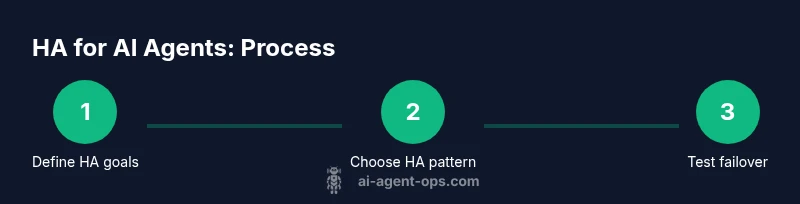
Define HA objectives
Identify critical AI agent workflows and set target uptime, RTO, and RPO. Document failure modes and response expectations to guide design choices.
Tip: Capture stakeholder SLIs and translate them into concrete architectural constraints. - 2
Choose an HA pattern
Decide between active-active, active-passive, or a hybrid approach based on latency tolerance and data consistency needs. Map how components will failover and what state is retained.
Tip: Prefer stateless agents when possible to simplify failover logic. - 3
Implement idempotent actions
Ensure that repeated executions of the same action do not cause duplicates or inconsistent state. Centralize retry logic with backoff and jitter.
Tip: Test retries under simulated load to verify no duplicate effects occur. - 4
Externalize state
Move agent state to a durable, replicated store. Ensure read/write paths are resilient, with clear consistency guarantees.
Tip: Aim for a clearly defined write path and monitor replication lag. - 5
Set up redundant compute & messaging
Provision multi-zone compute and a durable message bus. Ensure queues are configured for durability and proper acknowledgement semantics.
Tip: Use canary deployments to validate failover without affecting all users. - 6
Enable health checks & auto-failover
Implement liveness/readiness probes and an automated controller that promotes standby resources when needed.
Tip: Test failover under load to confirm quick recovery and no data loss. - 7
Instrument observability
Collect metrics for uptime, latency, error rates, and queue depth. Correlate traces end-to-end to locate issues quickly.
Tip: Define dashboards that surface HA health at-a-glance for on-call teams. - 8
Test, iterate, and roll out
Run chaos experiments, validate recovery plans, and iterate based on findings. Roll out gradually with canary or blue-green strategies.
Tip: Document lessons learned and update runbooks after each test cycle.
Questions & Answers
What is the difference between HA and high availability?
In this context, HA is the practice of designing AI agents and their systems to remain available despite failures. It combines patterns, processes, and tooling to minimize downtime and ensure fast recovery. High availability is the goal; HA is the approach.
HA means designing AI agents to stay online and recover quickly from failures, using patterns and tooling to minimize downtime.
Which HA pattern should I choose for my AI agent?
Choose based on latency tolerance, data needs, and your fault model. Active-active increases throughput and resilience but adds complexity; active-passive is simpler but requires a fast failover path.
Pick an active-active or active-passive pattern based on latency and reliability needs.
How often should I test HA for AI agents?
Regular, automated testing is essential. Include chaos experiments, failover drills, and end-to-end validation as part of CI/CD and live-site readiness.
Test HA regularly with automated failover drills to ensure readiness.
What are common HA metrics to monitor?
Monitor uptime, mean time to recovery (MTTR), failure rate, queue depth, replication lag, and end-to-end latency to detect and diagnose issues early.
Track uptime, MTTR, and latency to gauge HA health.
Do I need to redesign existing AI agents for HA?
Not always, but most architectures benefit from exposing state externally, embracing idempotent actions, and decoupling components via messaging and events.
Often yes—externalize state and use decoupled components for better HA.
Watch Video
Key Takeaways
- Define clear HA objectives and SLIs.
- Externalize state and use durable, ordered messaging.
- Test failover regularly with chaos experiments.
- Monitor end-to-end: metrics, logs, and traces.
- Roll out with canary or blue-green strategies.