How big is agentic AI? A practical guide
Explore what 'size' means for agentic AI in 2026—from capabilities and deployment scale to governance. Ai Agent Ops analyzes the spectrum and offers practical guidance for developers and leaders.


There isn’t a single fixed size for how big is agentic ai. The field spans from narrow, task-specific agents to broad, autonomous systems that operate across environments. Size is best described by capability breadth, deployment scale, and governance maturity, not a single headcount or vendor tally. This framing helps teams estimate risk, plan budgets, and align governance as capabilities expand.
What does size mean for agentic AI? A spectrum, not a single metric
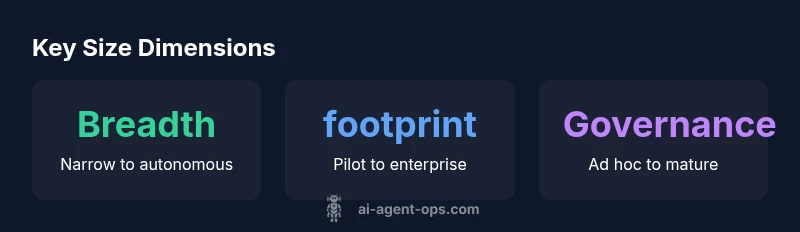
Agentic AI occupies a spectrum rather than a fixed, universal size. The phrase 'how big is agentic ai' invites curiosity, but the reality is that size depends on three intertwined dimensions: capability breadth, deployment footprint, and governance maturity. In practice, a system that autonomously coordinates multiple workflows across several teams will be larger in impact than a single-task helper, even if both are considered equally capable on a narrow task. According to Ai Agent Ops, the size of agentic AI cannot be reduced to numbers alone; it reflects how many distinct capabilities are available, how widely they are deployed, and how robust the safety and governance layers are. When you plan a project, start by mapping the potential breadth of tasks, the environments in which the agent operates, and the governance controls you will implement. This approach keeps expectations aligned with organizational risk appetite and resource constraints.
Dimensions that determine scale
Three core dimensions determine when an agent becomes “bigger” in practice:
- Capability breadth: More tasks and better coordination between modules increase the perceived size.
- Deployment footprint: The number of teams, processes, and environments that the agent touches enlarges its footprint.
- Governance maturity: Clear policies, auditing, and safety controls raise the bar for scale.
Other factors, such as data quality, integration complexity, and operator training, influence how quickly size increases. Rather than fixating on a specific count, teams should rate each dimension on a maturity scale (nascent, emerging, established, advanced). The more you advance on all three fronts, the larger your agentic system becomes in a meaningful, safe way. This framing helps teams communicate progress to stakeholders and plan incremental investments.
Industry deployment: where size grows first
Certain industries tend to see faster growth in agentic AI size due to data availability and regulatory comfort. For example, financial services and supply-chain operations may deploy agents that coordinate multiple tasks across several departments, while healthcare may focus on safety and privacy, keeping size growth more deliberate. In both cases, the 'size' of agentic AI is less about the number of lines of code and more about how many autonomous workflows exist, how wide their decision points reach, and how resilient the system is to errors. The general trend is a gradual expansion across verticals as tooling matures, standards emerge, and governance frameworks tighten, enabling bigger, safer deployments.
Governance, safety, and control as size modifiers
As size grows, governance cannot remain an afterthought. Effective agentic AI requires multi-layer controls: risk assessment protocols, explainability for decisions, access controls, and monitoring dashboards. Organizations often adopt staged rollouts (pilot, scale, optimize) to manage risk while expanding capabilities. The size of an agentic system is thus bounded by governance readiness; even a powerful agent with many capabilities may be "smaller" if it operates under tight controls, while a loosely governed system with few capabilities may feel large in impact if misaligned with policy. A disciplined approach links capability expansion to governance milestones, ensuring safety keeps pace with growth.
Measuring size in practice: a checklist
To size an agentic AI project, use a structured checklist:
- Define key capabilities and map them to concrete tasks.
- Enumerate deployment environments and user groups touched by the agent.
- Assign governance milestones (risk reviews, audits, incident response readiness).
- Track latency, reliability, and failure modes across workflows.
- Align success metrics with safety and ethics considerations.
- Build a governance-first roadmap that grows with capabilities.
This checklist helps teams maintain clarity as the project grows and prevents scope creep. Remember, bigger does not always mean better; effective scaling means safe, reliable, and auditable growth.
Case studies: sizing in real projects
Consider a logistics automation scenario where an agent coordinates inventory, routing, and alerts across three warehouses. The size increases as it adds predictive planning, supplier integration, and exception handling. In another setting, a customer-service agent that handles order status, refunds, and escalation across multiple channels grows in size as it integrates with CRM, billing, and compliance checks. In both scenarios, the emphasis moves from raw capability to governance-enabled, auditable scale. These examples illustrate that size is a function of breadth, reach, and control, not merely a feature count.
Future trends shaping the size of agentic AI
Looking ahead, the size of agentic AI will be influenced by standardized safety frameworks, modular architectures, and improved factory-scale tooling. As organizations publish governance playbooks and share risk models, scaling agentic AI across units will become smoother. The biggest shifts will come from better agent orchestration, better interoperability, and a stronger alignment between business objectives and autonomy. Teams that plan with governance and risk in mind can grow their agentic AI responsibly, achieving meaningful size without sacrificing safety.
Getting started: a practical sizing plan
Begin with a baseline assessment of current capabilities and a governance blueprint. Create a three-quarter roadmap that links capability expansion to governance milestones, and set clear, auditable metrics. Use iterative sprints to add new tasks and expand deployment gradually, while maintaining risk oversight. A well-structured sizing plan helps product teams and leaders communicate progress, secure funding, and align cross-functional partners around a shared understanding of what "size" means for their agentic AI program.
Authority sources
- NIST AI Risk Management Framework: https://www.nist.gov/itl/ai-risk-management-framework
- White House OSTP guidance on AI governance: https://www.whitehouse.gov/ostp/
- Stanford AI Lab / HAI resources: https://ai.stanford.edu/
Key size factors for agentic AI
| Aspect | Size Indicator | Notes |
|---|---|---|
| Capability breadth | Narrow to autonomous | Larger breadth indicates more complex size |
| Deployment footprint | Pilot to enterprise-wide | Wider deployment footprint equates to larger size |
| Governance maturity | Ad hoc to mature | Size grows with governance controls and safety measures |
Questions & Answers
What exactly is agentic AI?
Agentic AI refers to systems that can autonomously act to achieve goals with some degree of independence, beyond simple tool use. Not all AI qualifies as agentic; the key distinction is sustained autonomous action and goal-directed behavior.
Agentic AI acts autonomously to pursue goals, not just follow instructions.
How do you measure the size of agentic AI?
Size is measured by three dimensions: capability breadth, deployment footprint, and governance maturity. Assess each on a maturity scale and combine them to gauge overall scale.
Size is about what it can do, where it operates, and how well it’s governed.
Is there a universal standard for agentic AI size?
There is no universal standard yet. Standards vary by industry, regulation, and organizational risk appetite. Focus on governance and risk management to guide growth.
There isn’t a one-size-fits-all standard yet.
What governance considerations matter as size grows?
As size grows, implement risk assessments, explainability, access controls, and monitoring. Use staged rollouts and clear incident response plans to manage risk.
Governance becomes critical as you scale to maintain safety and accountability.
How quickly is agentic AI growing across industries?
Growth varies by industry. Some sectors with strong data foundations move faster, while others prioritize safety and compliance, resulting in slower but steadier expansion.
Adoption isn’t uniform; some sectors scale faster than others.
What are practical steps to size an agentic AI project?
Start with a capability map, define deployment scope, set governance milestones, and build an auditable roadmap. Use iterative sprints to expand tasks while maintaining safety.
Begin by mapping capabilities and governance, then grow step by step.
“Size in agentic AI is a function of capability breadth, deployment reach, and governance maturity—not a single metric. Measured together, these factors reveal how mature an agentic system has become.”
Key Takeaways
- Define size by capability breadth, not just deployments
- Link size growth to governance milestones for safe scaling
- Adopt a staged rollout to manage risk while expanding capabilities
- Size is a multi-dimensional concept: breadth, reach, and controls