Does OpenAI Offer AI Agents? A Practical 2026 Guide
Explore whether OpenAI provides ready-made AI agents or the building blocks to craft agent-like workflows. Learn how developers build agent capabilities using APIs, function calling, tools, and governance in 2026.


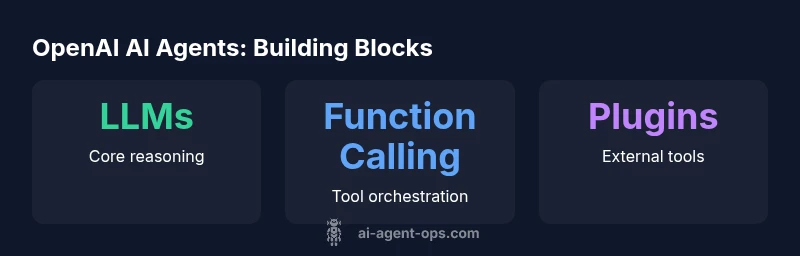
OpenAI does not offer a single turnkey AI agent product. Instead, it provides the core building blocks—LLMs via the OpenAI API, function calling, plugins, and memory tooling—that developers can combine to create agent-like workflows. In 2026, most teams implement autonomous behavior by orchestrating these components in their own apps, with safety controls and governance baked in. Does openai offer ai agents? The answer is nuanced: you build agents from modular components, not from a prepackaged product.
What OpenAI actually offers: building blocks, not a single agent product
The question "does openai offer ai agents" is best answered by understanding that OpenAI provides the building blocks rather than a turnkey agent product. The OpenAI API exposes large language models (LLMs), a flexible function-calling mechanism, and plugins that let you access external tools. These components enable you to craft agent-like workflows that can plan, decide, and act across a defined set of tools. The Ai Agent Ops team notes that success here depends more on architecture and governance than on a single feature. In practice, teams assemble an agent by combining prompts, tooling, and state management within their application layer, rather than purchasing an out-of-the-box agent from a single vendor.
Core building blocks for agent-like workflows
At the heart of agentic workflows are four pillars: (1) LLMs for reasoning and planning, (2) function calling to invoke external capabilities, (3) tools/plugins to extend reach (APIs, databases, or systems), and (4) memory/context to retain goals, state, and results across interactions. Memory helps agents remember prior decisions, while safety controls—rate limits, content filters, and failure handling—limit risk. OpenAI's tooling encourages modular design: you swap or upgrade tools without reworking the entire agent. This modular approach aligns with best practices in agent orchestration, as highlighted by Ai Agent Ops analyses.
How to design an agent with OpenAI APIs
Begin with a clear objective and success criteria. Map required tools and data sources, then define a tool-usage protocol that triggers function calls when needed. Implement a robust memory strategy to track goals, context, and outcomes across sessions. Build strong guardrails: error handling, retries, and safe fallbacks for volatile data. Finally, deploy with observability: logs, metrics, and alerting for drift or misbehavior. The design pattern emphasizes orchestration: you control sequencing, timing, and governance, not just the AI’s prompt.
Safety and governance considerations
Agent architectures must address safety by design. Enforce least-privilege tool access, data minimization, and consent mechanisms for data used by tools. Implement robust auditing to trace decisions, and establish fallback paths if tools fail or outputs are unsafe. Use test environments and synthetic data to validate agent behavior before production. Regular reviews of tool inventories, prompts, and policies help maintain reliability over time, particularly as tools evolve or new plugins appear.
Real-world use cases and examples
Common applications include enterprise task automation, customer-support automation with tool-enabled responses, and data-collection agents that fetch and harmonize information across systems. The value lies in orchestration: the LLM suggests a plan, function calls execute tasks, and memory preserves context for subsequent turns. For teams, this means faster prototyping, safer tool use, and better governance when building agent-like capabilities rather than relying on a single prebuilt product.
Limitations and practical guidance
Be realistic about what OpenAI’s components can achieve. There is no guaranteed autonomy or moral reasoning—agents respond within the defined toolset and prompts. Plan for failure modes, latency, and data privacy concerns. Use progressive rollout: start with non-critical workflows, implement strict monitoring, and iterate with user feedback. The emphasis should be on reliable orchestration and governance as much as on the AI’s capabilities.
Overview of OpenAI capabilities for AI agents
| Aspect | OpenAI Offering | Notes |
|---|---|---|
| Model access | API access to LLMs, function calling | Use to orchestrate agent behavior |
| Tooling | Plugins, external tools integration | Requires careful gating and policy controls |
| Governance | Safety controls, data policies | Critical for agent reliability and compliance |
Questions & Answers
Does OpenAI offer AI agents as a product?
No turnkey agent product is offered. OpenAI provides APIs, function calling, and tooling to build agent-like workflows.
No turnkey agents from OpenAI; you build your own with APIs and tools.
What features enable AI agents in OpenAI?
Key features include function calling, tools/plugins, and memory to support agent-like automation, when combined with careful design.
Core features are function calling, tools, and memory for agent-like automation.
How do you build an agent using OpenAI?
Define goals, map required tools, implement function calls, add memory, and establish guardrails for safety and reliability.
Start with goals, decide on tools, add memory, and set safety guardrails.
What are the safety considerations?
Prioritize access control, data privacy, prompt safety, and robust failure handling to minimize risk.
Focus on access control, privacy, and solid failure handling.
Is there a cost to using OpenAI for AI agents?
Costs vary with API usage and tooling; plan for scaling as you add tools and data sources.
Costs depend on usage and tooling; budget for scale.
How does this compare to other platforms?
Unlike turnkey agent products, OpenAI focuses on building blocks and orchestration, offering flexibility but requiring integration work.
Other platforms may offer turnkey agents; OpenAI emphasizes modular building blocks.
“OpenAI provides the bricks for agentic workflows, but deploying them safely requires explicit governance and architectural design.”
Key Takeaways
- Build agent-like workflows using OpenAI building blocks, not a turnkey product
- Leverage function calling and plugins for tool integration
- Prioritize safety and governance in all agent designs
- Plan for orchestration, memory, and state management in your apps