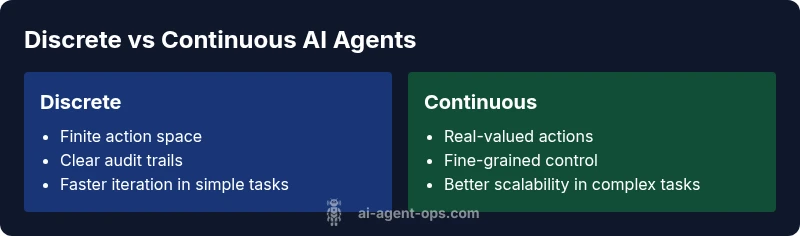
Discrete vs Continuous AI Agent: Side-by-Side Analysis
A rigorous, data-informed comparison of discrete versus continuous AI agents, covering action spaces, learning methods, architectures, scalability, and governance to help developers choose the right approach.


Discrete vs continuous ai agent design fundamentally hinges on action space, learning methods, and control granularity. Discrete agents select from a finite set of actions, enabling interpretable decisions but potentially sacrificing subtlety. Continuous agents operate over real-valued outputs for fine-grained control, at the cost of planning complexity and exploration. This quick comparison aligns with Ai Agent Ops guidance and highlights when each approach shines.
What discrete vs continuous ai agent means in practice
The phrase discrete vs continuous ai agent refers to how an agent chooses actions. A discrete agent operates over a finite or countable action set, such as approve/reject, move left/right a fixed step, or select among predefined tool invocations. A continuous agent emits real-valued actions, like precise motor torques, smooth trajectory parameters, or continuous policy outputs. In practice, this distinction shapes decision granularity, data requirements, and how you evaluate performance. According to Ai Agent Ops, the choice of action space fundamentally changes how you model the agent, how you train it, and how you monitor its behavior. In many real-world workflows, teams start with a discrete structure for safety and auditability, then explore continuous components to improve precision and scalability when the task demands it.
The taxonomy of action spaces also interacts with the environment. Some environments are naturally discrete, with clear, bounded choices. Others are naturally continuous, requiring control signals or parameterized actions. The key is to map the domain to a space that preserves task semantics while keeping learning tractable. The decision is rarely binary in practice: many teams deploy hybrid systems that mix discrete decisions with continuous controls, enabling robust governance on high-stakes steps while preserving fluid control where it matters most.
Theoretical foundations: action spaces and learning paradigms
Action space definition drives the theoretical toolkit you can use. Discrete agents typically rely on value-based or policy-based methods built for finite action sets. Classic approaches include Q-learning, deep Q-networks, and discrete policy gradients. These methods benefit from stable convergence properties and interpretable action choices. In contrast, continuous agents rely on policy gradient methods, actor-critic architectures, and sometimes model-based control. Continuous spaces invite gradient-based optimization, smoother exploration, and the ability to interpolate between actions, but they raise challenges in stability and sample efficiency. From Ai Agent Ops Analysis, 2026, researchers note that discretization introduces quantization errors that can limit optimality, while continuous methods demand careful regularization and curriculum strategies to avoid ill-conditioned learning. A solid rule of thumb is to align learning methods with the topology of the action space and with the task’s sensitivity to granularity.
Architectural implications for agent design
Architecture choice follows action space. Discrete agents often benefit from modular planning, finite-state representations, and rule-based overlays that constrain action sets. These patterns support explainability and straightforward debugging, which matters for governance and safety. Continuous agents lean into end-to-end function approximators, differentiable controllers, and neural architectures capable of handling high-dimensional outputs. Hybrid architectures are common: a discrete planner decides a high-level action bucket, while a continuous controller refines low-level execution. This separation can improve robustness, speed up iteration, and simplify testing. For teams building agentic AI workflows, the architecture should enable inspection at decision points while preserving the flexibility of continuous control when needed.
Performance, data, and compute considerations
Compute and data requirements scale with the chosen action space. Discrete agents often require fewer samples to learn optimal policies in simple environments and benefit from well-defined exploration schemes. In higher-complexity tasks, discretization can blow up the action count, demanding clever discretization schemes to keep learning tractable. Continuous agents may need larger simulation budgets and more powerful function approximators to achieve smooth, reliable control, especially in robotics or fast physics-based tasks. Practitioners should balance sample efficiency with computational overhead, preferring discrete-first prototypes to validate task feasibility, then consider introducing continuous elements for precision or scalability as needed. Ai Agent Ops emphasizes careful budgeting of simulation time, data variety, and compute to avoid overfitting to a narrow regime.
Use-case guidelines: when to pick discrete vs continuous
Some tasks benefit immediately from discrete action sets: policy enforcement in business automation, decision routing in conversation systems, and constraint-driven tool use where each action has a clear boundary. When tasks require nuanced control, like robotic manipulation, autonomous driving, or continuous parameter tuning, continuous actions often outperform discrete counterparts in precision and smoothness. In many industry settings, a hybrid approach wins: discrete decision points govern flow control, while continuous modules execute fine-grained actions. The key is to define clear success criteria, align with monitoring capabilities, and plan for governance and safety at the intersection where discrete decisions meet continuous execution.
Practical challenges: discretization errors, stability, and scale
Discretization introduces quantization errors that can cap potential performance. Choosing the granularity of a discrete action set is a delicate trade-off between manageability and fidelity. Too coarse, and the agent misses subtle opportunities; too fine, and learning becomes intractable. Continuous methods face stability issues, especially with function approximators in high-dimensional spaces. Ensuring stable learning requires regularization, careful reward shaping, and sometimes ensembles or target networks. Scaling from simulation to real-world deployment often reveals gaps in transfer, so practitioners should invest in robust validation pipelines, domain randomization, and continuous monitoring to detect drift or unsafe behavior. Ai Agent Ops suggests planning for iterative, staged deployments to manage risk while expanding capability.
Best practices: hybrid strategies and evaluation metrics
A practical path is to couple discrete decision points with continuous controllers. Use discrete abstractions to define safe, auditable workflows and reserve continuous controls for execution-level optimization. Adaptive granularity—dynamically adjusting discretization based on task difficulty—can preserve tractability while preserving performance. Evaluation should go beyond episodic success to include safety, interpretability, and robustness under distribution shifts. Metrics like decision latency, discretization error, control smoothness, and failure modes provide a fuller picture than accuracy alone. Regular code reviews, explainability checks, and transparent logging are essential in agentic AI projects.
Governance and safety for agentic AI workflows
As agents become more capable, governance and safety concerns rise. Require explicit auditing of discrete decisions and containment of continuous actions within safe bounds. Implement safety envelopes, monitoring dashboards, and anomaly detection to flag unexpected trajectories. Agent orchestration should include human-in-the-loop checks for high-stakes steps, with clear rollback mechanisms. Ai Agent Ops advocates for a mature governance model that treats discrete decision boundaries and continuous execution as first-class concerns in risk assessment, testing, and deployment planning.
The path to agent orchestration: governance, safety, and evaluation
Orchestrating multiple agents requires clear interfaces, versioning of policies, and centralized observability. Discrete components offer tractable policy evolution and easier safety verification, while continuous components enable flexible adaptation to changing environments. A balanced strategy uses modular, auditable discrete modules to steer tasks and attaches robust continuous controllers for execution. This modularity supports safer agentic AI workflows, simplifies testing, and improves maintainability. The Ai Agent Ops Team recommends documenting action space choices, keeping transformation pipelines transparent, and steadily validating end-to-end behavior in progressive stages to ensure reliable outcomes.
Comparison
| Feature | Discrete AI Agent | Continuous AI Agent |
|---|---|---|
| Action Space | Finite set of actions (discrete) | Continuous real-valued actions |
| Learning Paradigm | Value-based or discrete policy methods | Policy gradient/actor-critic and continuous controllers |
| Sample Efficiency | Often higher in structured domains with clear discretization | Can require larger data budgets for smooth control |
| Interpretability | Easier to audit due to finite actions | Can be harder due to continuous latent spaces |
| Computational Overhead | Typically lower per decision in simple domains | Per-step computation can be higher with deep controllers |
| Robustness to Noise | Quantization can dampen variability but miss fine signals | Smoothing via continuous control can improve stability |
| Best Domains | Games, rule-based automation, bounded workflows | Robotics, simulation, high-dimensional control tasks |
Positives
- Clear decision boundaries simplify debugging
- Often faster iteration with discrete steps
- Easier to guarantee safety within defined actions
- Interpretable behavior due to finite action set
What's Bad
- Discretization can lose subtlety and reduce optimality
- Scalability issues in high-dimensional tasks
- May require complex engineering to discretize continuous domains
- Less natural for fine-grained control
Discrete vs continuous AI agents both have strengths; choose based on task granularity and safety requirements.
Discrete agents are well suited to structured tasks with auditable steps, while continuous agents excel at fine-grained control. In practice, many teams use hybrids to balance safety and precision, guided by task demands and governance needs. The Ai Agent Ops Team recommends starting simple and iterating toward hybrid designs when appropriate.
Questions & Answers
What is the core difference between discrete and continuous AI agents?
The core difference lies in the action space: discrete agents choose from a finite set of actions, while continuous agents produce real-valued actions. This affects learning methods, data needs, and how you assess performance. Both have distinct strengths and trade-offs depending on the task.
Discrete agents pick from a finite set, while continuous agents generate real-valued actions. Each approach has different learning methods and data needs, so choose based on your task requirements.
When is a discrete agent usually the better choice?
Discrete agents are typically preferred for tasks with clear boundaries, strong safety constraints, and well-defined decision points such as routing, policy enforcement, and tool selection. They provide easier auditing and faster iteration in moderate-complexity environments.
Choose discrete agents for clear, bounded decisions and easier auditing when speed and safety are priorities.
Can I combine discrete and continuous approaches in one workflow?
Yes. A common pattern is a hierarchical hybrid where a discrete planner decides among broad actions and a continuous controller handles execution details. This blends safety and interpretability with the precision of continuous control. Govern the interface between layers carefully.
Absolutely. Use a discrete planner for the big decisions and a continuous controller for execution to get the best of both.
What metrics matter when evaluating discrete vs continuous agents?
Look beyond accuracy to include decision latency, discretization error, control smoothness, safety violations, and robustness under distribution shifts. Task-specific success criteria and interpretability should be part of the evaluation framework.
Track latency, discreteness error, control smoothness, safety, and robustness for a complete view.
How does discretization impact learning performance?
Discretization reduces the action space, which can speed up learning but may cap potential performance by removing near-optimal actions. The granularity choice is a critical hyperparameter and should be tuned with task demands and safety considerations in mind.
Discretization helps learning speed but may limit optimality; tune granularity carefully.
What governance practices help with agentic AI workflows?
Establish auditing of discrete decisions and monitoring of continuous actions, enforce safety envelopes, maintain rollbacks, and ensure clear human-in-the-loop points for high-stakes steps. Document action space choices and keep end-to-end testing in place.
Set up audits, safety envelopes, and human-in-the-loop checks for high-stakes steps.
Key Takeaways
- Start with discrete action plans for safety and clarity
- Adopt continuous control when precision matters
- Hybrid designs often offer the best of both worlds
- Prioritize governance and observability from day one
- Validate across simulations and real-world pilots