ai agent trend: how agentic AI reshapes work in 2026
Explore the ai agent trend shaping how developers and business leaders orchestrate autonomous AI agents, with practical guidance, growth drivers, and governance considerations. Ai Agent Ops provides evidence-based insights for building agentic AI workflows in 2026.


Definition: The ai agent trend refers to the rapid shift from static automation to autonomous, goal-directed AI agents that plan, decide, and act across tools and data sources. In 2026, organizations are moving toward agentic AI that coordinates tasks, learns from outcomes, and operates in orchestration layers with guardrails. This shift changes how teams design workflows, measure success, and govern AI-enabled processes.
The ai agent trend: redefining capability and responsibility
The ai agent trend describes a shift from stand-alone automation scripts to agentic AI systems that can interpret goals, plan actions, and execute across multiple tools and data sources with limited human input. This capability enables teams to tackle multi-step tasks—like data gathering, decision support, and action execution—in a closed loop. In 2026, organizations are prioritizing orchestration, safety, and governance as they deploy agent networks rather than a handful of isolated automations. Ai Agent Ops emphasizes that the trend is as much about process redesign as it is about technology; the most impactful deployments align agent capabilities with clear ownership, explainable behavior, and measurable outcomes.
For developers, this means thinking beyond a single model or API. For product leaders, it means embedding agents into product interfaces and workflows. For executives, the trend signals new opportunities to automate complex, cross-functional processes while maintaining human oversight where it adds value. Across industries, the shift toward agentic AI is accelerating through improved tool integration, richer memory, and more robust feedback loops that help agents adapt to changing contexts.
Why the ai agent trend matters for 2026: core drivers and risks
Several forces converge to drive the ai agent trend forward. First, platform maturity—combining large language models with plugin ecosystems, standardized APIs, and orchestration layers—reduces the friction of building agent networks. Second, organizations are recognizing the need for governance, safety controls, and explainability as agents take on more decision-making responsibility. Third, the economics of automation have shifted: agents can compress cycles, reduce manual toil, and deliver scalable outcomes across teams. However, the transition introduces new risks, including misaligned incentives, data privacy concerns, and reliability gaps if guardrails are weak. The Ai Agent Ops team notes that balancing speed with trust is essential to realize durable gains; pilot programs should include guardrails, audits, and human-in-the-loop checkpoints to prevent systemic failures.
Practically, any successful ai agent trend implementation requires alignment across people, processes, and technology. Teams should establish a clear operating model that defines ownership, decision rights, and escalation paths, then tie these to measurable outcomes like cycle time reduction and task completion rates.
Architectural patterns for agent networks: from planning to execution
Agent networks typically combine a planner, a set of tools, and an executor. The planner interprets a user goal, generates a sequence of actions, and selects tools (APIs, databases, dashboards) to fulfill each step. The executor carries out those actions, handles failures gracefully, and feeds results back to the planner. Key patterns include memory modules that retain context across steps, tool inventories with versioned interfaces, and feedback loops that allow agents to refine plans based on outcomes. This architecture enables agents to operate across domains—data retrieval, analysis, automation, and alerting—without writing custom code for every task. When designed well, agent networks reduce manual handoffs, increase repeatability, and enable cross-team collaboration around shared workflows.
Security, latency, and observability are foundational requirements. Agents must authenticate to services, respect access controls, and expose auditable traces for compliance. Observability dashboards should capture success rates, time-to-complete metrics, and error modes to pinpoint bottlenecks and guide improvement.
Data, memory, and learning loops in agent systems
Effective ai agent trend implementations rely on memory and context. Long-term memory stores help agents recall prior interactions, preferences, and constraints, enabling more consistent behavior across sessions. Short-term memory optimizes planning by retaining the most relevant recent results. Learning loops convert outcomes into better plans, refining tool selection and sequencing over time. Crucially, feedback must be structured: provide clear signals about success, failure, and partial progress, and tie them to concrete metrics. This approach supports continuous improvement while mitigating drift or unintended side effects. Memory design should respect data governance policies, ensuring that sensitive information remains protected and accessible only to authorized components. As teams scale, modular memory and standardized prompts reduce drift and support collaboration across agents.
Governance, safety, and compliance in agent-enabled workflows
With greater autonomy comes greater accountability. Implementing governance for ai agent trend deployments includes role-based access, policy enforcement, audit trails, and explainability. Organizations should define escalation paths where humans review high-risk decisions, and create guardrails that prevent agents from taking actions that could violate privacy, security, or regulatory requirements. Safety practices include red-teaming, scenario testing, and explicit constraints on tool usage. In addition, data minimization and strong authentication reduce the blast radius of potential breaches. Ai Agent Ops emphasizes the importance of a living governance playbook that evolves with the technology, incorporating lessons from real-world deployments and industry standards. A structured approach to governance helps teams move faster while maintaining trust with customers and regulators.
Organizational impact: teams, roles, and workflows in the ai agent trend
The shift toward agentic AI requires new roles and collaborative rituals. Cross-functional squads that include data scientists, software engineers, product managers, and security professionals can design, deploy, and monitor agent networks more effectively. Roles such as agent architect, tool steward, and risk officer emerge to manage the life cycle of agents, from concept to scale. Teams should adopt lightweight governance rituals—check-ins, dashboards, and automated testing—to maintain alignment without stifling creativity. As organizations grow, documentation, code reviews, and transparent decision logs become essential to maintain stability and trust. The goal is to balance autonomy with accountability, enabling teams to benefit from agentic AI while staying aligned with business objectives.
Roadmap for 2026: practical steps to start, scale, and govern
A successful ai agent trend journey begins with a small, well-scoped pilot. Begin by identifying a high-value process with clear ownership and measurable outcomes, then assemble a cross-functional team to design an agent-enabled workflow. Build a minimal viable agent that can perform a narrow task, validate results, and iterate quickly. As confidence grows, layer in more tools, memory, and decision logic. Governance should mature in parallel, with guardrails, auditing mechanisms, and privacy controls becoming standard parts of the pipeline. Scaling requires repeatable patterns, shared libraries, and robust monitoring to ensure reliability. Finally, embed agent activities into business dashboards to demonstrate impact and justify continued investment.
Measuring impact and ROI: metrics, dashboards, and success criteria
To gauge the value of the ai agent trend, organizations should track both leading and lagging indicators. Leading metrics include time-to-commit for task completion, rate of successful autonomous actions, and reduction in manual interventions. Lagging metrics cover throughput, quality of outcomes, and customer satisfaction. Dashboards should surface anomaly alerts, audit trails, and policy adherence signals. Importantly, measurement should align with business objectives and be reviewed in iterative cycles. Ai Agent Ops recommends tying agent performance to concrete business results, such as accelerated delivery times or improved forecast accuracy, to demonstrate meaningful ROI and guide ongoing investments.
The road ahead: scaling responsibly and sustaining momentum
The future of the ai agent trend lies in expanding agent networks responsibly, with strong governance, explainability, and resilience baked in. As models improve and tool ecosystems mature, agents will handle increasingly complex workflows, yet require deliberate safeguards to prevent failures or biases from propagating. Organizations should invest in developer enablement, platform standards, and cross-team collaboration to sustain momentum. The Ai Agent Ops team emphasizes that long-term success depends on balancing autonomy with human oversight, maintaining transparency with stakeholders, and continuously refining operating models to align with evolving business needs.
Table: Key adoption factors for ai agent trend
| Aspect | Current State | Challenges | Recommended Practices |
|---|---|---|---|
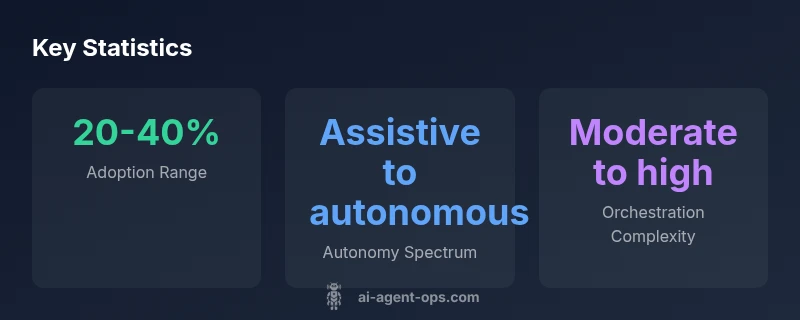
| Adoption Pace | 20-40% of organizations exploring pilots | Talent gaps, integration complexity | Invest in cross-functional pilots with clear success criteria |
| Autonomy Level | From guided assistance to autonomous agents | Safety, reliability, explainability | Implement guardrails, auditing, and fallback strategies |
| Tool Orchestration | APIs and connectors enable cross-tool work | Security, latency, versioning | Adopt standardized interfaces and runbooks |
| Governance & Safety | Policy-driven governance maturing | Compliance, privacy, accountability | Establish governance playbooks and risk dashboards |
Questions & Answers
What is an AI agent?
An AI agent is an autonomous system that interprets objectives, selects tools, executes actions, and learns from outcomes. It operates across software, data, and human inputs to complete tasks with minimal manual intervention.
An AI agent is an autonomous system that uses tools and data to complete tasks with limited human input.
How does the ai agent trend differ from traditional automation?
Traditional automation follows predefined scripts. The ai agent trend introduces planning, decision-making, and multi-tool orchestration, enabling dynamic task sequences and adaptive behavior in changing contexts.
Agents plan and adapt across tools, unlike fixed automation scripts.
What are common use cases in 2026?
Use cases include cross-tool workflow orchestration, data gathering and synthesis, autonomous decision support, and pipeline automation that reduces manual handoffs and accelerates delivery.
From orchestrating tools to autonomous decision support, these agents streamline complex workflows.
What governance considerations are essential?
Essential considerations include role-based access, audit trails, explainability, risk assessment, and formal escalation paths for high-risk actions.
Governance means clear ownership, audits, and safety checks.
What skills do teams need to implement ai agents?
Teams benefit from a mix of product thinking, software engineering, data science, security, and governance expertise to design, implement, and monitor agent networks.
A cross-disciplinary team supports successful agent deployments.
What are common risks and how can they be mitigated?
Risks include data privacy, bias, and unexpected agent behavior. Mitigations include guardrails, testing, monitoring, and transparent decision logs.
Guardrails, testing, and clear logs reduce risk.
“Agentic AI represents a shift from manual orchestration to autonomous decision-making with human-in-the-loop safety. The potential impact is significant when governance and design principles are embedded from the start.”
Key Takeaways
- Define the ai agent trend for your team and start with a concrete use case
- Invest in cross-functional pilots to validate orchestration and governance
- Prioritize guardrails, explainability, and auditable trails from day one
- Scale through modular patterns and shared libraries, not bespoke code
- Measure impact with business-aligned metrics and iterative learning