ai agent names: A practical guide to naming AI agents
Explore naming AI agents with clarity, branding, and governance in mind. This guide covers frameworks, patterns, and examples for ai agent names across domains to improve onboarding, safety, and usability.


There's no single universal 'best' name for ai agent names. The most effective approach combines clarity, function, and brand voice. Ai Agent Ops recommends a naming framework that uses a stable prefix, a descriptive core, and a role suffix where appropriate. This makes agents easy to identify, scalable, and aligned with governance expectations.
Why naming matters for ai agent names
Naming AI agents is more than a cosmetic choice; it defines how users understand, trust, and interact with automation. Clear, consistent names help map agents to tasks, domains, and governance policies. In environments where many agents operate, a meaningful naming system reduces cognitive load for developers, end-users, and security teams. When you start with ai agent names that reflect function and ownership, you enable easier onboarding, safer handoffs between agents, and better traceability for audits. The Ai Agent Ops team emphasizes that naming is an active governance control, not a one-time branding exercise. Consistency across teams improves discovery, monitoring, and maintenance over the lifecycle of agentic AI workflows.
In practice, names that reveal role or capability, while staying aligned with your brand voice, tend to perform best. This balance supports both internal governance and external perception—customers, partners, and regulators benefit from predictable naming conventions. The most successful naming efforts begin early in project scoping and extend into documentation, testing, and deployment pipelines. When teams adopt standardized ai agent names, they accelerate collaboration and reduce miscommunication during automation initiatives.
Naming frameworks: prefix-core-suffix
A practical naming framework combines three elements: a prefix to indicate domain or org, a core to describe function, and an optional suffix that signals role or capability. Examples include:
- Prefix: Data / Sec / Chat
- Core: Guard / Analyze / Assist
- Suffix (optional): -Agent / -Bot / -Suite This structure yields names like DataGuard-Agent, SecAnalyze-Agent, or ChatAssist-Bot. Keeping the core descriptive ensures anyone glancing at the name understands the agent’s primary task, while the prefix supports governance and scope. Suffixes help with tooling pipelines, versioning, and routing in orchestration systems. When you design prefixes, align them with your taxonomy and ontology so that new agents slot into your operational model without breaking conventions.
To avoid overly long names, trim qualifiers that don’t add governance value and rely on a hierarchical naming plan that references the core capability first, then domain or ownership second. For instance, in a customer-support context, you might use SupportAssist-Agent, while a fraud-detection context could use FraudGuard-Analyze. These patterns support scalability as you add dozens or hundreds of agents over time.
Domain considerations: industry, tone, and governance
Naming is not purely cosmetic; it influences risk management, regulatory compliance, and user trust. Different domains demand varying levels of formality and terminology. In heavily regulated industries, adopt names that clearly map to controlled functions and data domains (e.g., DataCompliance-Agent) to support audit trails and access controls. In consumer-facing applications, names should be concise, friendly, and easy to pronounce across languages, reducing cognitive friction and increasing user adoption.
Governance should dictate naming conventions, versioning, and deprecation policies. Establish who can propose names, how to review them, and how to retire or revamp names tied to deprecated capabilities. Document naming decisions and tie them to your organization’s risk, privacy, and safety policies. This discipline minimizes ambiguity during cross-team collaborations and supports responsible AI practices. Ai Agent Ops highlights that naming strategy should evolve with governance, not degrade into ad-hoc changes that hinder traceability.
Practical guidelines and naming patterns
Use these patterns to guide ai agent names across contexts:
- Clarity first: the name should indicate purpose or function.
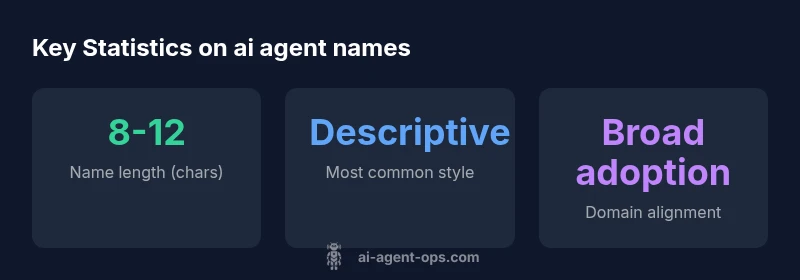
- Brevity where possible: aim for 8–12 characters when feasible to improve readability.
- Brand alignment: reflect your organization’s voice without obscuring function.
- Domain suffixing: add domain-specific prefixes to indicate ownership (e.g., HR-, Fin-).
- Versioning signals: include a version or tier indicator only if it’s critical to governance (e.g., v2 or Pro).
Practical tips:
- Test pronunciations with multilingual teams to ensure accessibility.
- Check for unintended meanings in other languages to avoid misinterpretation.
- Maintain consistency across internal tools and external APIs.
- Keep a centralized naming catalog and lifecycle policy to manage retirement and deprecation.
Case scenarios across sectors
Consider how ai agent names would look across different industries:
- Finance: FinAudit-Guard, RiskAnalyze-Agent
- Healthcare: PatientCare-Assist, MedData-Guard
- Retail: ShopAssist-Agent, InventoryPulse-Analyst
- IT/Operations: InfraMonitor-Agent, AutoRemediate-Bot These examples show how prefixes signal domain, core describes function, and suffixes indicate role. Adopting similar patterns helps teams map each agent to its responsibilities, security level, and governance requirements. As you collect feedback from users, you can refine naming rules to improve clarity and adoption.
Evaluation and governance: auditing ai agent names
Regular naming audits ensure consistency and compliance. Establish a review cadence (quarterly or per release) to assess new names against your naming catalog and governance criteria. Track metadata such as domain, ownership, deprecation status, and alignment with safety guidelines. If a name becomes ambiguous or conflicts with branding or regulatory requirements, plan a controlled rename or retirement, with minimal disruption to workflows. Documentation, version control, and cross-team sign-offs are essential for sustainable naming governance.
Future trends: automation and evolution in ai agent naming
As AI agent ecosystems scale, automated tooling can generate and validate names against policy checks. Consider integrating naming rules into your CI/CD pipelines so every new agent name passes a policy gate before deployment. Expect richer naming paradigms that combine semantic meaning with dynamic context, enabling adaptive naming as agents gain new capabilities. The goal is to maintain human-readability while supporting scalable automation across complex agent networks.
Comparison of common ai agent name styles
| Name Style | Pros | Cons |
|---|---|---|
| Descriptive/functional | Clear purpose, easy mapping to tasks | Longer names; hard to pronounce in fast UI contexts |
| Brand-aligned | Strong brand coherence | May be less descriptive of function |
| Domain-specific | Eases governance within sector | Requires updates across domains |
| Ambiguous/creative | Memorable, branding-ready | Risk of unclear capabilities |
Questions & Answers
What makes a good ai agent name?
A good ai agent name clearly communicates function, is easy to pronounce, and aligns with brand voice. It should support governance by enabling domain and ownership mapping, versioning signals where needed, and consistent formatting across teams.
A good name shows what the agent does and who owns it, without being hard to say or spell.
Should names reflect domain or function?
Yes. Names should reflect at least one aspect of domain or function to aid onboarding and governance. Domain prefixes can indicate ownership (e.g., Fin-, Health-), while the core should describe the task (e.g., Analyze, Guard, Assist).
Domain or function helps people and systems know what the agent does at a glance.
How long should ai agent names be?
Aim for readability and scannability: 8–12 characters for core names, longer variants only when domain prefixes add value and governance requires it.
Keep names short enough to read quickly, but descriptive enough to be meaningful.
Do names affect performance or safety?
Naming itself does not affect algorithmic performance, but clear, governed names improve safety, auditing, and maintenance, reducing misconfigurations and misuse.
Names help people manage risk; they don’t change how the code runs, but they guide safer use.
Are there naming frameworks or templates to use?
Yes. Use a prefix-core-suffix framework, with optional versioning. Maintain a centralized catalog and establish review processes to keep naming consistent across agents.
There are proven templates you can adopt to keep naming consistent across teams.
“Clear, consistent naming reduces confusion and accelerates governance for AI agents.”
Key Takeaways
- Define a naming framework early for ai agent names
- Balance descriptive function with brand voice
- Use domain prefixes to aid governance and routing
- Audit names regularly to sustain governance and safety
- Avoid overly long or ambiguous names to preserve usability